Title: The Literary Remains of Samuel Taylor Coleridge, Volume 1
Author: Samuel Taylor Coleridge
Editor: Henry Nelson Coleridge
Release date: July 1, 2005 [eBook #8488]
Most recently updated: February 14, 2020
Language: English
Other information and formats: www.gutenberg.org/ebooks/8488
Credits: Produced by Jonathan Ingram, Clytie Siddall, David Widger
and the Online Distributed Proofreading Team
Mr. Coleridge by his will, dated in September, 1829,
authorized his executor, if he should think it expedient, to
publish any of the notes or writing made by him (Mr. C.) in his
books, or any other of his manuscripts or writings, or any
letters which should thereafter be collected from, or supplied
by, his friends or correspondents. Agreeably to this authority,
an arrangement was made, under the superintendence of Mr. Green,
for the collection of Coleridge's literary remains; and at the
same time the preparation for the press of such part of the
materials as should consist of criticism and general literature,
was entrusted to the care of the present Editor. The volumes now
offered to the public are the first results of that arrangement.
They must in any case stand in need of much indulgence from the
ingenuous reader;- multa sunt condonanda in opere postumo;
but a short statement of the difficulties attending the
compilation may serve to explain some apparent anomalies, and to
preclude some unnecessary censure.
The materials were fragmentary in the extreme Sibylline
leaves; notes of the lecturer, memoranda of the
investigator, out-pourings of the solitary and self-communing
student. The fear of the press was not in them. Numerous as they
were, too, they came to light, or were communicated, at different
times, before and after the printing was commenced; and the
dates, the occasions, and the references, in most instances
remained to be discovered or conjectured. To give to such
materials method and continuity, as far as might be, to set
them forth in the least disadvantageous manner which the
circumstances would permit, was a delicate and perplexing
task; and the Editor is painfully sensible that he could bring
few qualifications for the undertaking, but such as were involved
in a many years' intercourse with the author himself, a patient
study of his writings, a reverential admiration of his genius,
and an affectionate desire to help in extending its beneficial
influence.
The contents of these volumes are drawn from a portion only of
the manuscripts entrusted to the Editor: the remainder of the
collection, which, under favourable circumstances, he hopes may
hereafter see the light, is at least of equal value with what is
now presented to the reader as a sample. In perusing the
following pages, the reader will, in a few instances, meet with
disquisitions of a transcendental character, which, as a general
rule, have been avoided: the truth is, that they were sometimes
found so indissolubly intertwined with the more popular matter
which preceded and followed, as to make separation impracticable.
There are very many to whom no apology will be necessary in this
respect; and the Editor only adverts to it for the purpose of
obviating, as far as may be, the possible complaint of the more
general reader. But there is another point to which, taught by
past experience, he attaches more importance, and as to which,
therefore, he ventures to put in a more express and particular
caution. In many of the books and papers, which have been used in
the compilation of these volumes, passages from other writers,
noted down by Mr. Coleridge as in some way remarkable, were mixed
up with his own comments on such passages, or with his
reflections on other subjects, in a manner very embarrassing to
the eye of a third person undertaking to select the original
matter, after the lapse of several years. The Editor need not say
that he has not knowingly admitted any thing that was not genuine
without an express declaration, as in Vol. I. p. 1; and in
another instance, Vol. II. p. 379, he has intimated his own
suspicion: but, besides these, it is possible that some cases of
mistake in this respect may have occurred. There may be one or
two passages they cannot well be more printed in
these volumes, which belong to other writers; and if such there
be, the Editor can only plead in excuse, that the work has been
prepared by him amidst many distractions, and hope that, in this
instance at least, no ungenerous use will be made of such a
circumstance to the disadvantage of the author, and that persons
of greater reading or more retentive memories than the Editor,
who may discover any such passages, will do him the favour to
communicate the fact.
The Editor's motive in publishing the few poems and fragments
included in these volumes, was to make a supplement to the
collected edition of Coleridge's poetical works. In these
fragments the reader will see the germs of several passages in
the already published poems of the author, but which the Editor
has not thought it necessary to notice more particularly. The
Fall of Robespierre, a joint composition, has been so long in
print in the French edition of Coleridge's poems, that,
independently of such merit as it may possess, it seemed natural
to adopt it upon the present occasion, and to declare the true
state of the authorship.
To those who have been kind enough to communicate books and
manuscripts for the purpose of the present publication, the
Editor and, through him, Mr. Coleridge's executor return their
grateful thanks. In most cases a specific acknowledgement has
been made. But, above and independently of all others, it is to
Mr. and Mrs. Gillman, and to Mr. Green himself, that the public
are indebted for the preservation and use of the principal part
of the contents of these volumes. The claims of those respected
individuals on the gratitude of the friends and admirers of
Coleridge and his works are already well known, and in due season
those claims will receive additional confirmation.
With these remarks, sincerely conscious of his own inadequate
execution of the task assigned to him, yet confident withal of
the general worth of the contents of the following pages
the Editor commits the reliques of a great man to the indulgent
consideration of the Public.
Lincoln's Inn, August 11, 1836.
L'Envoy.
He was one who with long and large arm still collected precious armfulls in whatever direction he pressed forward, yet still took up so much more than he could keep together, that those who followed him gleaned more from his continual droppings than he himself brought home; nay, made stately corn-ricks therewith, while the reaper himself was still seen only with a strutting armful of newly-cut sheaves. But I should misinform you grossly if I left you to infer that his collections were a heap of incoherent miscellanea. No! the very contrary. Their variety, conjoined with the too great coherency, the too great both desire and power of referring them in systematic, nay, genetic subordination, was that which rendered his schemes gigantic and impracticable, as an author, and his conversation less instructive as a man.
Auditorem inopem ipsa copia fecit.
Too much was given, all so weighty and brilliant as to preclude a chance of its being all received, so that it not seldom passed over the hearer's mind like a roar of many waters.
and other poems
to H. Martin, Esq.
of Jesus College, Cambridge
Dear Sir
Accept, as a small testimony of my grateful attachment, the
following Dramatic Poem, in which I have endeavoured to detail,
in an interesting form, the fall of a man, whose great bad
actions have cast a disastrous lustre on his name. In the
execution of the work, as intricacy of plot could not have been
attempted without a gross violation of recent facts, it has been
my sole aim to imitate the impassioned and highly figurative
language of the French Orators, and to develope the characters of
the chief actors on a vast stage of horrors.
Yours fraternally,
S. T. COLERIDGE.
Jesus College, September 22, 1794.
the Fall of Robespierre
an Historic Drama. 1794 1
ACT I.
scene the Tuileries
BARRERE.
The tempest gathers be it mine to seek
A friendly shelter, ere it bursts upon him.
But where? and how? I fear the tyrant's soul
Sudden in action, fertile in resource,
And rising awful 'mid impending ruins;
In splendour gloomy, as the midnight meteor,
That fearless thwarts the elemental war.
When last in secret conference we met,
He scowl'd upon me with suspicious rage,
Making his eye the inmate of my bosom.
I know he scorns me and I feel, I hate him
Yet there is in him that which makes me tremble!
It was Barrere, Legendre! didst thou mark him?
Abrupt he turn'd, yet linger'd as he went,
And tow'rds us cast a look of doubtful meaning.
I mark'd him well. I met his eye's last glance;
It menac'd not so proudly as of yore.
Methought he would have spoke but that he dar'd not
Such agitation darken'd on his brow.
'Twas all-distrusting guilt that kept from bursting
Th' imprison'd secret struggling in the face:
E'en as the sudden breeze upstarting onwards
Hurries the thunder cloud, that pois'd awhile
Hung in mid air, red with its mutinous burthen.
Perfidious traitor! still afraid to bask
In the full blaze of power, the rustling serpent
Lurks in the thicket of the tyrant's greatness,
Ever prepar'd to sting who shelters him.
Each thought, each action in himself converges;
And love and friendship on his coward heart
Shine like the powerless sun on polar ice:
To all attach'd, by turns deserting all,
Cunning and dark a necessary villain!
Yet much depends upon him well you know
With plausible harangue 'tis his to paint
Defeat like victory and blind the mob
With truth-mix'd falsehood. They, led on by him,
And wild of head to work their own destruction,
Support with uproar what he plans in darkness.
O what a precious name is liberty
To scare or cheat the simple into slaves!
Yes we must gain him over: by dark hints
We'll show enough to rouse his watchful fears,
Till the cold coward blaze a patriot.
O Danton! murder'd friend! assist my counsels
Hover around me on sad memory's wings,
And pour thy daring vengeance in my heart.
Tallien! if but to-morrow's fateful sun
Beholds the tyrant living we are dead!
Yet his keen eye that flashes mighty meanings
Fear not or rather fear th' alternative,
And seek for courage e'en in cowardice
But see hither he comes let us away!
His brother with him, and the bloody Couthon,
And, high of haughty spirit, young St. Just.
What! did La Fayette fall before my power
And did I conquer Roland's spotless virtues
The fervent eloquence of Vergniaud's tongue,
And Brissot's thoughtful soul unbribed and bold!
Did zealot armies haste in vain to save them!
What! did th' assassin's dagger aim its point
Vain, as a dream of murder, at my bosom;
And shall I dread the soft luxurious Tallien?
Th' Adonis Tallien, banquet-hunting Tallien,
Him, whose heart flutters at the dice-box! Him,
Who ever on the harlots' downy pillow
Resigns his head impure to feverish slumbers!
I cannot fear him yet we must not scorn him.
Was it not Antony that conquer'd Brutus,
Th' Adonis, banquet-hunting Antony?
The state is not yet purified: and though
The stream runs clear, yet at the bottom lies
The thick black sediment of all the factions
It needs no magic hand to stir it up!
O, we did wrong to spare them fatal error!
Why lived Legendre, when that Danton died,
And Collot d'Herbois dangerous in crimes?
I've fear'd him, since his iron heart endured
To make of Lyons one vast human shambles,
Compar'd with which the sun-scorch'd wilderness
Of Zara were a smiling paradise.
Rightly thou judgest, Couthon! He is one,
Who flies from silent solitary anguish,
Seeking forgetful peace amid the jar
Of elements. The howl of maniac uproar
Lulls to sad sleep the memory of himself.
A calm is fatal to him then he feels
The dire upboilings of the storm within him.
A tiger mad with inward wounds! I dread
The fierce and restless turbulence of guilt.
Is not the Commune ours? the stern Tribunal?
Dumas? and Vivier? Fleuriot? and Louvet?
And Henriot? We'll denounce a hundred, nor
Shall they behold to-morrow's sun roll westward.
Nay I am sick of blood! my aching heart
Reviews the long, long train of hideous horrors
That still have gloom'd the rise of the Republic.
I should have died before Toulon, when war
Became the patriot!
Most unworthy wish!
He, whose heart sickens at the blood of traitors
Would be himself a traitor, were he not
A coward! 'Tis congenial souls alone
Shed tears of sorrow for each other's fate.
O, thou art brave, my brother! and thine eye
Full firmly shines amid the groaning battle
Yet in thine heart the woman-form of pity
Asserts too large a share, an ill-timed guest!
There is unsoundness in the state to-morrow
Shall see it cleansed by wholesome massacre!
Beware! already do the Sections murmur
"O the great glorious patriot, Robespierre
The tyrant guardian of the country's freedom!"
'Twere folly sure to work great deeds by halves!
Much I suspect the darksome fickle heart
Of cold Barrere!
I see the villain in him!
If he if all forsake thee what remains?
Myself! the steel-strong rectitude of soul
And poverty sublime 'mid circling virtues!
The giant victories, my counsels form'd,
Shall stalk around me with sun-glittering plumes,
Bidding the darts of calumny fall pointless.
So we deceive ourselves! What goodly virtues
Bloom on the poisonous branches of ambition!
Still, Robespierre! thou'l't guard thy country's freedom
To despotize in all the patriot's pomp.
While conscience, 'mid the mob's applauding clamours,
Sleeps in thine ear, nor whispers blood-stain'd tyrant!
Yet what is conscience? superstition's dream
Making such deep impression on our sleep
That long th' awaken'd breast retains its horrors!
But he returns and with him comes Barrere.
There is no danger but in cowardice.
Barrere! we make the danger, when we fear it.
We have such force without, as will suspend
The cold and trembling treachery of these members.
Twill be a pause of terror.
But to whom?
Rather the short-lived slumber of the tempest,
Gathering its strength anew. The dastard traitors!
Moles, that would undermine the rooted oak!
A pause! a moment's pause! 'Tis all their life.
Yet much they talk and plausible their speech.
Couthon's decree has given such powers, that
That what?
The freedom of debate
Transparent mask!
They wish to clog the wheels of government,
Forcing the hand that guides the vast machine
To bribe them to their duty. English patriots!
Are not the congregated clouds of war
Black all around us? In our very vitals
Works not the king-bred poison of rebellion?
Say, what shall counteract the selfish plottings
Of wretches, cold of heart, nor awed by fears
Of him, whose power directs th' eternal justice?
Terror? or secret-sapping gold? The first.
Heavy, but transient as the ills that cause it;
And to the virtuous patriot render'd light
By the necessities that gave it birth:
The other fouls the fount of the Republic,
Making it flow polluted to all ages;
Inoculates the state with a slow venom,
That once imbibed, must be continued ever.
Myself incorruptible I ne'er could bribe them
Therefore they hate me.
Are the Sections friendly?
There are who wish my ruin but I'll make them
Blush for the crime in blood!
Nay but I tell thee,
Thou art too fond of slaughter and the right
(If right it be) workest by most foul means!
Self-centering Fear! how well thou canst ape Mercy!
Too fond of slaughter! matchless hypocrite!
Thought Barrere so, when Brissot, Danton died?
Thought Barrere so, when through the streaming streets
Of Paris red-eyed Massacre, o'er wearied,
Reel'd heavily, intoxicate with blood?
And when (O heavens!) in Lyons' death-red square
Sick fancy groan'd o'er putrid hills of slain,
Didst thou not fiercely laugh, and bless the day?
Why, thou hast been the mouth-piece of all horrors,
And, like a blood-hound, crouch'd for murder! Now
Aloof thou standest from the tottering pillar,
Or, like a frighted child behind its mother,
Hidest thy pale face in the skirts of Mercy!
O prodigality of eloquent anger!
Why now I see thou'rt weak thy case is desperate!
The cool ferocious Robespierre turn'd scolder!
Who from a bad man's bosom wards the blow,
Reserves the whetted dagger for his own.
Denounced twice and twice I sav'd his life!
The Sections will support them there's the point!
No! he can never weather out the storm
Yet he is sudden in revenge No more!
I must away to Tallien.
Didst thou present the letter that I gave thee?
Did Tallien answer, he would soon return?
He is in the Tuilleries with him, Legendre
In deep discourse they seem'd: as I approach'd
He waved his hand, as bidding me retire:
I did not interrupt him.
Thou didst rightly.
O this new freedom! at how dear a price
We've bought the seeming good! The peaceful virtues
And every blandishment of private life,
The father's cares, the mother's fond endearment,
All sacrificed to liberty's wild riot.
The winged hours, that scatter'd roses round me,
Languid and sad drag their slow course along,
And shake big gall-drops from their heavy wings.
But I will steal away these anxious thoughts
By the soft languishment of warbled airs,
If haply melodies may lull the sense
Of sorrow for a while.
Music, my love? O breathe again that air!
Soft nurse of pain, it soothes the weary soul
Of care, sweet as the whisper'd breeze of evening
That plays around the sick man's throbbing temples.
Tell me, on what holy ground
May domestic peace be found?
Halcyon daughter of the skies,
Far on fearful wing she flies,
From the pomp of sceptred state,
From the rebel's noisy hate.
In a cottag'd vale she dwells,
List'ning to the Sabbath bells!
Still around her steps are seen
Spotless honour's meeker mien,
Love, the sire of pleasing fears,
Sorrow smiling through her tears,
And conscious of the past employ,
Memory, bosom-spring of joy.
I thank thee, Adelaide! 'twas sweet, though mournful.
But why thy brow o'ercast, thy cheek so wan?
Thou look'st as a lorn maid beside some stream,
That sighs away the soul in fond despairing,
While sorrow sad, like the dank willow near her,
Hangs o'er the troubled fountain of her eye.
Ah! rather let me ask what mystery lowers
On Tallien's darken'd brow. Thou dost me wrong
Thy soul distemper'd, can my heart be tranquil?
Tell me, by whom thy brother's blood was spilt?
Asks he not vengeance on these patriot murderers?
It has been borne too tamely. Fears and curses
Groan on our midnight beds, and e'en our dreams
Threaten the assassin hand of Robespierre.
He dies! nor has the plot escaped his fears.
Yet yet be cautious! much I fear the Commune
The tyrant's creatures, and their fate with his
Fast link'd in close indissoluble union.
The pale Convention
Hate him as they fear him,
Impatient of the chain, resolved and ready.
Th' enthusiast mob, confusion's lawless sons
They are aweary of his stern morality,
The fair-mask'd offspring of ferocious pride.
The Sections too support the delegates:
All all is ours! e'en now the vital air
Of Liberty, condens'd awhile, is bursting
(Force irresistible!) from its compressure
To shatter the arch chemist in the explosion!
Tallien! was this a time for amorous conference?
Henriot, the tyrant's most devoted creature,
Marshals the force of Paris: The fierce club,
With Vivier at their head, in loud acclaim
Have sworn to make the guillotine in blood
Float on the scaffold. But who comes here?
Say, are ye friends to freedom? I am hers!
Let us, forgetful of all common feuds,
Rally around her shrine! E'en now the tyrant
Concerts a plan of instant massacre!
Away to the Convention! with that voice
So oft the herald of glad victory,
Rouse their fallen spirits, thunder in their ears
The names of tyrant, plunderer, assassin!
The violent workings of my soul within
Anticipate the monster's blood!
Hear ye that outcry? If the trembling members
Even for a moment hold his fate suspended,
I swear by the holy poniard, that stabbed Caesar,
This dagger probes his heart!
Once more befits it that the voice of truth,
Fearless in innocence, though leaguer'd round
By envy and her hateful brood of hell,
Be heard amid this hall; once more befits
The patriot, whose prophetic eye so oft
Has pierc'd thro' faction's veil, to flash on crimes
Of deadliest import. Mouldering in the grave
Sleeps Capet's caitiff corse; my daring hand
Levell'd to earth his blood-cemented throne,
My voice declared his guilt, and stirr'd up France
To call for vengeance. I too dug the grave
Where sleep the Girondists, detested band!
Long with the show of freedom they abused
Her ardent sons. Long time the well-turn'd phrase,
The high fraught sentence, and the lofty tone
Of declamation thunder'd in this hall,
Till reason, midst a labyrinth of words,
Perplex'd, in silence seem'd to yield assent.
I durst oppose. Soul of my honour'd friend,
Spirit of Marat, upon thee I call
Thou know'st me faithful, know'st with what warm zeal
I urged the cause of justice, stripp'd the mask
From faction's deadly visage, and destroy'd
Her traitor brood. Whose patriot arm hurl'd down
Hebert and Rousin, and the villain friends
Of Danton, foul apostate! those, who long
Mask'd treason's form in liberty's fair garb,
Long deluged France with blood, and durst defy
Omnipotence! but I, it seems, am false!
I am a traitor too! I Robespierre!
I at whose name the dastard despot brood
Look pale with fear, and call on saints to help them
Who dares accuse me? who shall dare belie
My spotless name? Speak, ye accomplice band,
Of what am I accused? of what strange crime
Is Maximilian Robespierre accused,
That through this hall the buzz of discontent
Should murmur? who shall speak?
O patriot tongue,
Belying the foul heart! Who was it urged
Friendly to tyrants that accurst decree,
Whose influence brooding o'er this hallow'd hall,
Has chill'd each tongue to silence. Who destroy'd
The freedom of debate, and carried through
The fatal law, that doom'd the delegates,
Unheard before their equals, to the bar
Where cruelty sat throned, and murder reign'd
With her Dumas coequal? Say thou man
Of mighty eloquence, whose law was that?
That law was mine. I urged it I proposed
The voice of France assembled in her sons
Assented, though the tame and timid voice
Of traitors murmur'd. I advised that law
I justify it. It was wise and good.
Oh, wondrous wise, and most convenient too!
I have long mark'd thee, Robespierre and now
Proclaim thee traitor tyrant!
It is well;
I am a traitor! oh, that I had fallen
When Regnault lifted high the murderous knife;
Regnault, the instrument, belike of those
Who now themselves would fain assassinate,
And legalize their murders. I stand here
An isolated patriot hemm'd around
By faction's noisy pack; beset and bay'd
By the foul hell-hounds who know no escape
From justice' outstretch'd arm, but by the force
That pierces through her breast.
Nay, but I will be heard. There was a time
When Robespierre began, the loud applauses
Of honest patriots drown'd the honest sound.
But times are changed, and villany prevails.
No villany shall fall. France could not brook
A monarch's sway; sounds the dictator's name
More soothing to her ear?
Rattle her chains
More musically now than when the hand
Of Brissot forged her fetters; or the crew
Of Hebert thunder'd out their blasphemies,
And Danton talk'd of virtue?
Oh, that Brissot
Were here again to thunder in this hall,
That Hebert lived, and Danton's giant form
Scowl'd once again defiance! so my soul
Might cope with worthy foes.
People of France,
Hear me! Beneath the vengeance of the law
Traitors have perish'd countless; more survive:
The hydra-headed faction lifts anew
Her daring front, and fruitful from her wounds,
Cautious from past defects, contrives new wiles
Against the sons of Freedom.
Freedom lives!
Oppression falls for France has felt her chains,
Has burst them too. Who, traitor-like, stept forth
Amid the hall of Jacobins to save
Camille Desmoulins, and the venal wretch
D'Eglantine?
I did for I thought them honest.
And Heaven forefend that vengeance e'er should strike,
Ere justice doom'd the blow.
Traitor, thou didst.
Yes, the accomplice of their dark designs,
Awhile didst thou defend them, when the storm
Lour'd at safe distance. When the clouds frown'd darker,
Fear'd for yourself, and left them to their fate.
Oh, I have mark'd thee long, and through the veil
Seen thy foul projects. Yes, ambitious man,
Self-will'd dictator o'er the realm of France,
The vengeance thou hast plann'd for patriots,
Falls on thy head. Look how thy brother's deeds
Dishonour thine! He, the firm patriot;
Thou, the foul parricide of Liberty!
Barrere attempt not meanly to divide
Me from my brother. I partake his guilt,
For I partake his virtue.
Brother, by my soul,
More dear I hold thee to my heart, that thus
With me thou dar'st to tread the dangerous path
Of virtue, than that nature twined her cords
Of kindred round us.
Yes, allied in guilt,
Even as in blood ye are. Oh, thou worst wretch,
Thou worse than Sylla! hast thou not proscrib'd,
Yea, in most foul anticipation slaughter'd
Each patriot representative of France?
Was not the younger Caesar too to reign
O'er all our valiant armies in the south,
And still continue there his merchant wiles?
His merchant wiles! Oh, grant me patience, heaven!
Was it by merchant wiles I gain'd you back
Toulon, when proudly on her captive towers
Wav'd high the English flag? or fought I then
With merchant wiles, when sword in hand I led
Your troops to conquest? fought I merchant-like,
Or barter'd I for victory, when death
Strode o'er the reeking streets with giant stride,
And shook his ebon plumes, and sternly smil'd
Amid the bloody banquet? when appall'd
The hireling sons of England spread the sail
Of safety, fought I like a merchant then?
Oh, patience! patience!
How this younger tyrant
Mouths out defiance to us! even so
He had led on the armies of the south,
Till once again the plains of France were drench'd
With her best blood.
Till once again display'd
Lyons' sad tragedy had call'd me forth
The minister of wrath, whilst slaughter by
Had bathed in human blood.
No wonder, friend,
That we are traitors that our heads must fall
Beneath the axe of death! when Caesar-like
Reigns Robespierre, 'tis wisely done to doom
The fall of Brutus. Tell me, bloody man,
Hast thou not parcell'd out deluded France
As it had been some province won in fight
Between your curst triumvirate. You, Couthon,
Go with my brother to the southern plains;
St. Just, be yours the army of the north;
Meantime I rule at Paris.
Matchless knave!
What not one blush of conscience on thy cheek
Not one poor blush of truth! most likely tale!
That I, who ruin'd Brissot's towering hopes,
I, who discover'd Hebert's impious wiles,
And sharp'd for Danton's recreant neck the axe,
Should now be traitor! had I been so minded,
Think ye I had destroy'd the very men
Whose plots resembled mine? bring forth your proofs
Of this deep treason. Tell me in whose breast
Found ye the fatal scroll? or tell me rather
Who forged the shameless falsehood?
Ask you proofs?
Robespierre, what proofs were ask'd when Brissot died?
What proofs adduced you when the Danton died?
When at the imminent peril of my life
I rose, and, fearless of thy frowning brow,
Proclaim'd him guiltless?
I remember well
The fatal day. I do repent me much
That I kill'd Caesar and spared Antony.
But I have been too lenient. I have spared
T he stream of blood, and now my own must flow
To fill the current.
Triumph not too soon,
Justice may yet be victor.
I come from the committee charged to speak
Of matters of high import. I omit
Their orders. Representatives of France,
Boldly in his own person speaks St. Just
What his own heart shall dictate.
Hear ye this,
Insulted delegates of France? St. Just
From your committee comes comes charged to speak
Of matters of high import yet omits
Their orders! Representatives of France,
That bold man I denounce, who disobeys
The nation's orders. I denounce St. Just.
Hear me!
He shall be heard!
Must we contaminate this sacred hall
With the foul breath of treason?
Drag him away!
Hence with him to the bar.
Oh, just proceedings!
Robespierre prevented liberty of speech
And Robespierre is a tyrant! Tallien reigns,
He dreads to hear the voice of innocence
And St. Just must be silent!
Heed we well
That justice guide our actions. No light import
Attends this day. I move St. Just be heard.
Inviolate be the sacred right of man,
The freedom of debate.
I may be heard then! much the times are changed,
When St. Just thanks this hall for hearing him.
Robespierre is call'd a tyrant. Men of France,
Judge not too soon. By popular discontent
Was Aristides driven into exile,
Was Phocion murder'd! Ere ye dare pronounce
Robespierre is guilty, it befits ye well,
Consider who accuse him. Tallien,
Bourdon of Oise the very men denounced,
For that their dark intrigues disturb'd the plan
Of government. Legendre, the sworn friend
Of Danton fall'n apostate. Dubois Crance,
He who at Lyons spared the royalists
Collot d'Herbois
What shall the traitor rear
His head amid our tribune, and blaspheme
Each patriot? shall the hireling slave of faction
I am of no one faction. I contend
Against all factions.
I espouse the cause
Of truth. Robespierre on yester morn pronounced
Upon his own authority a report.
To-day St. Just comes down. St. Just neglects
What the committee orders, and harangues
From his own will. O citizens of France,
I weep for you I weep for my poor country
I tremble for the cause of Liberty,
When individuals shall assume the sway,
And with more insolence than kingly pride
Rule the Republic.
Shudder, ye representatives of France,
Shudder with horror. Henriot commands
The marshall'd force of Paris. Henriot,
Foul parricide the sworn ally of Hebert
Denounced by all upheld by Robespierre.
Who spared La Valette? who promoted him,
Stain'd with the deep die of nobility?
Who to an ex-peer gave the high command?
Who screen'd from justice the rapacious thief?
Who cast in chains the friends of Liberty?
Robespierre, the self-styled patriot, Robespierre
Robespierre, allied with villain Daubignè
Robespierre, the foul arch tyrant, Robespierre.
He talks of virtue of morality
Consistent patriot! he Daubignè's friend!
Henriot's supporter virtuous! preach of virtue,
Yet league with villains, for with Robespierre
Villains alone ally. Thou art a tyrant!
I style thee tyrant, Robespierre!
Take back the name. Ye citizens of France
Oppression falls. The traitor stands appall'd
Guilt's iron fangs engrasp his shrinking soul
He hears assembled France denounce his crimes!
He sees the mask torn from his secret sins
He trembles on the precipice of fate.
Fall'n guilty tyrant! murder'd by thy rage,
How many an innocent victim's blood has stain'd
Fair freedom's altar! Sylla-like thy hand
Mark'd down the virtues, that, thy foes removed,
Perpetual Dictator thou might'st reign,
And tyrannize o'er France, and call it freedom!
Long time in timid guilt the traitor plann'd
His fearful wiles success embolden'd sin
And his stretch'd arm had grasp'd the diadem
Ere now, but that the coward's heart recoil'd,
Lest France awaked, should rouse her from her dream,
And call aloud for vengeance. He, like Caesar,
With rapid step urged on his bold career,
Even to the summit of ambitious power,
And deem'd the name of King alone was wanting.
Was it for this we hurl'd proud Capet down?
Is it for this we wage eternal war
Against the tyrant horde of murderers,
The crowned cockatrices whose foul venom
Infects all Europe? was it then for this
We swore to guard our liberty with life,
That Robespierre should reign? the spirit of freedom
Is not yet sunk so low. The glowing flame
That animates each honest Frenchman's heartv Not yet extinguish'd. I invoke thy shade,
Immortal Brutus! I too wear a dagger;
And if the representatives of France
Through fear or favour should delay the sword
Of justice, Tallien emulates thy virtues;
Tallien, like Brutus, lifts the avenging arm;
Tallien shall save his country.
I demand
The arrest of all the traitors. Memorable
Will be this day for France.
Yes! Memorable
This day will be for France for villains triumph.
I will not share in this day's damning guilt.
Condemn me too.
Caesar is fallen! The baneful tree of Java,
Whose death-distilling boughs dropt poisonous dew,
Is rooted from its base. This worse than Cromwell,
The austere, the self-denying Robespierre,
Even in this hall, where once with terror mute
We listen'd to the hypocrite's harangues,
Has heard his doom.
Yet must we not suppose
The tyrant will fall tamely. His sworn hireling
Henriot, the daring desperate Henriot
Commands the force of Paris. I denounce him.
I denounce Fleuriot too, the mayor of Paris.
Robespierre is rescued. Henriot, at the head
Of the arm'd force, has rescued the fierce tyrant.
Ring the tocsin call all the citizens
To save their country never yet has Paris
Forsook the representatives of France.
It is the hour of danger. I propose
This sitting be made permanent.
The national Convention shall remain
Firm at its post.
Robespierre has reach'd the Commune. They espouse
The tyrant's cause. St. Just is up in arms!
St. Just the young, ambitious, bold St. Just
Harangues the mob. The sanguinary Couthon
Thirsts for your blood.
These tyrants are in arms against the law:
Outlaw the rebels.
Health to the representatives of France!
I pass'd this moment through the armed force
They ask'd my name and when they heard a delegate,
Swore I was not the friend of France.
The tyrants threaten us as when they turn'd
The cannon's mouth on Brissot.
Vivier harangues the Jacobins the club
Espouse the cause of Robespierre.
All's lost the tyrant triumphs. Henriot leads
The soldiers to his aid. Already I hear
The rattling cannon destin'd to surround
This sacred hall.
Why, we will die like men then.
The representatives of France dare death,
When duty steels their bosoms.
Citizens!
France is insulted in her delegates
The majesty of the Republic is insulted
Tyrants are up in arms. An armed force
Threats the Convention. The Convention swears
To die, or save the country!
We too swear
To die, or save the country. Follow me.
Henriot is taken!
Henriot is taken. Three of your brave soldiers
Swore they would seize the rebel slave of tyrants,
Or perish in the attempt. As he patroll'd
The streets of Paris, stirring up the mob,
They seized him.
Let the names of these brave men
Live to the future day.
I have clear'd the Commune.
Through the throng I rush'd,
Brandishing my good sword to drench its blade
Deep in the tyrant's heart. The timid rebels
Gave way. I met the soldiery I spake
Of the dictator's crimes of patriots chain'd
In dark deep dungeons by his lawless rage
Of knaves secure beneath his fostering power.
I spake of Liberty. Their honest hearts
Caught the warm flame. The general shout burst forth,
"Live the Convention Down with Robespierre!"
I hear, I hear the soul-inspiring sounds,
France shall be saved! her generous sons attach'd
To principles, not persons, spurn the idol
They worshipp'd once. Yes, Robespierre shall fall
As Capet fell! Oh! never let us deem
That France shall crouch beneath a tyrant's throne,
That the almighty people who have broke
On their oppressors' heads the oppressive chain,
Will court again their fetters! easier were it
To hurl the cloud-capt mountain from its base,
Than force the bonds of slavery upon men
Determined to be free!
So let the mutinous Jacobins meet now
In the open air.
A factious, turbulent party,
Lording it o'er the state since Danton died,
And with him the Cordeliers. A hireling band
Of loud-tongued orators controll'd the club,
And bade them bow the knee to Robespierre.
Vivier has 'scap'd me. Curse his coward heart
This fate-fraught tube of Justice in my hand,
I rush'd into the hall. He mark'd mine eye,
That beam'd its patriot anger, and flash'd full
With death-denouncing meaning. 'Mid the throng
He mingled. I pursued but staid my hand,
Lest haply I might shed the innocent blood.
They took from me my ticket of admission
Expell'd me from their sittings. Now, forsooth,
Humbled and trembling re-insert my name.
But Freron enters not the club again
Till it be purged of guilt till, purified
Of tyrants and of traitors, honest men
May breathe the air in safety.
What means this uproar! if the tyrant band
Should gain the people once again to rise
We are as dead!
And wherefore fear we death?
Did Brutus fear it? or the Grecian friends
Who buried in Hipparchus' breast the sword,
And died triumphant? Caesar should fear death,
Brutus must scorn the bugbear.
Hark! again
The sounds of honest Freedom!
Citizens! representatives of France!
Hold on your steady course. The men of Paris
Espouse your cause. The men of Paris swear
They will defend the delegates of Freedom.
Hear ye this, colleagues? hear ye this, my brethren?
And does no thrill of joy pervade your breasts?
My bosom bounds to rapture. I have seen
The sons of France shake off the tyrant yoke;
I have, as much as lies in mine own arm,
Hurl'd down the usurper. Come death when it will,
I have lived long enough.
Hark! how the noise increases! through the gloom
Of the still evening harbinger of death
Rings the tocsin! the dreadful generale
Thunders through Paris
So may eternal justice blast the foes
Of France! so perish all the tyrant brood,
As Robespierre has perish'd! Citizens,
Caesar is taken.
I marvel not, that, with such fearless front,
He braved our vengeance, and with angry eye
Scowl'd round the hall defiance. He relied
On Henriot's aid the Commune's villain friendship,
And Henriot's boughten succours. Ye have heard
How Henriot rescued him how with open arms
The Commune welcomed in the rebel tyrant
How Fleuriot aided, and seditious Vivier
Stirr'd up the Jacobins. All had been lost
The representatives of France had perish'd
Freedom had sunk beneath the tyrant arm
Of this foul parricide, but that her spirit
Inspired the men of Paris. Henriot call'd
"To arms" in vain, whilst Bourdon's patriot voice
Breathed eloquence, and o'er the Jacobins
Legendre frown'd dismay. The tyrants fled
They reach'd the Hotel. We gather'd round we call'd
For vengeance! Long time, obstinate in despair,
With knives they hack'd around them. Till foreboding
The sentence of the law, the clamorous cry
Of joyful thousands hailing their destruction,
Each sought by suicide to escape the dread
Of death. Lebas succeeded. From the window
Leap'd the younger Robespierre; but his fractur'd limb
Forbade to escape. The self-will'd dictator
Plung'd often the keen knife in his dark breast,
Yet impotent to die. He lives, all mangled
By his own tremulous hand! All gash'd and gored,
He lives to taste the bitterness of death.
Even now they meet their doom. The bloody Couthon,
The fierce St. Just, even now attend their tyrant
To fall beneath the axe. I saw the torches
Flash on their visages a dreadful light
I saw them whilst the black blood roll'd adown
Each stern face, even then with dauntless eye
Scowl round contemptuous, dying as they lived,
Fearless of fate!
For ever hallow'd be this glorious day,
When Freedom, bursting her oppressive chain,
Tramples on the oppressor. When the tyrant,
Hurl'd from his blood-cemented throne by the arm
Of the almighty people, meets the death
He plann'd for thousands. Oh! my sickening heart
Has sunk within me, when the various woes
Of my brave country crowded o'er my brain
In ghastly numbers when assembled hordes,
Dragg'd from their hovels by despotic power,
Rush'd o'er her frontiers, plunder'd her fair hamlets,
And sack'd her populous towns, and drench'd with blood
The reeking fields of Flanders. When within,
Upon her vitals prey'd the rankling tooth
Of treason; and oppression, giant form,
Trampling on freedom, left the alternative
Of slavery, or of death. Even from that day,
When, on the guilty Capet, I pronounced
The doom of injured France, has faction rear'd
Her hated head amongst us. Roland preach'd
Of mercy the uxorious, dotard Roland,
The woman-govern'd Roland durst aspire
To govern France; and Petion talk'd of virtue,
And Vergniaud's eloquence, like the honey'd tongue
Of some soft Syren wooed us to destruction.
We triumph'd over these. On the same scaffold
Where the last Louis pour'd his guilty blood,
Fell Brissot's head, the womb of darksome treasons,
And Orleans, villain kinsman of the Capet,
And Hebert's atheist crew, whose maddening hand
Hurl'd down the altars of the living God,
With all the infidel's intolerance.
The last worst traitor triumph'd triumph'd long,
Secured by matchless villany. By turns
Defending and deserting each accomplice
As interest prompted. In the goodly soil
Of Freedom, the foul tree of treason struck
Its deep-fix'd roots, and dropt the dews of death
On all who slumber'd in its specious shade.
He wove the web of treachery. He caught
The listening crowd by his wild eloquence,
His cool ferocity that persuaded murder,
Even whilst it spake of mercy! never, never
Shall this regenerated country wear
The despot yoke. Though myriads round assail,
And with worse fury urge this new crusade
Than savages have known; though the leagued despots
Depopulate all Europe, so to pour
The accumulated mass upon our coasts,
Sublime amid the storm shall France arise,
And like the rock amid surrounding waves
Repel the rushing ocean. She shall wield
The thunder-bolt of vengeance she shall blast
The despot's pride, and liberate the world!
medio de fonte leporum Surgit amari aliquid. LUCRET."Julia was blest..."
Julia was blest with beauty, wit, and grace:
Small poets loved to sing her blooming face.
Before her altars, lo! a numerous train
Preferr'd their vows; yet all preferr'd in vain:
Till charming Florio, born to conquer, came,
And touch'd the fair one with an equal flame.
The flame she felt, and ill could she conceal
What every look and action would reveal.
With boldness then, which seldom fails to move,
He pleads the cause of marriage and of love;
The course of hymeneal joys he rounds,
The fair one's eyes dance pleasure at the sounds.
Nought now remain'd but "Noes" how little meant
And the sweet coyness that endears consent.
The youth upon his knees enraptur'd fell:
The strange misfortune, oh! what words can tell?
Tell! ye neglected sylphs! who lap-dogs guard,
Why snatch'd ye not away your precious ward?
Why suffer'd ye the lover's weight to fall
On the ill-fated neck of much-loved Ball?
The favourite on his mistress cast his eyes,
Gives a short melancholy howl, and dies!
Sacred his ashes lie, and long his rest!
Anger and grief divide poor Julia's breast.
Her eyes she fix'd on guilty Florio first,
On him the storm of angry grief must burst.
That storm he fled: he wooes a kinder fair,
Whose fond affections no dear puppies share.
'Twere vain to tell how Julia pined away;
Unhappy fair, that in one luckless day
(From future almanacks the day be crost!)
At once her lover and her lap-dog lost!
1789. 1
Footnote 1: This copy of verses was written at Christ's Hospital, and transcribed, honoris causa, into the book kept by the head-master, Mr. Bowyer, for that purpose. They are printed by Mr. Trollope in p. 192 of his History of the Hospital, published in 1834. Ed.
"I yet remain..."
I yet remain
To mourn the hours of youth (yet mourn in vain)
That fled neglected: wisely thou hast trod
The better path and that high meed which God
Assign'd to virtue, tow'ring from the dust,
Shall wait thy rising, Spirit pure and just!
O God! how sweet it were to think, that all
Who silent mourn around this gloomy ball
Might hear the voice of joy; but 'tis the will
Of man's great Author, that through good and ill
Calm he should hold his course, and so sustain
His varied lot of pleasure, toil, and pain!
l793. 1
Footnote 1: These lines were found in Mr. Coleridge's hand-writing in one of the Prayer Books in the chapel of Jesus College, Cambridge. Ed.
to the Rev. W. J. Hort 1
Hush! ye clamorous cares, be mute!
Again, dear harmonist! again
Through the hollow of thy flute
Breathe that passion-warbled strain;
Till memory back each form shall bring
The loveliest of her shadowy throng,
And hope, that soars on sky-lark wing,
Shall carol forth her gladdest song!
O skill'd with magic spell to roll
The thrilling tones that concentrate the soul!
Breathe through thy flute those tender notes again,
While near thee sits the chaste-eyed maiden mild;
And bid her raise the poet's kindred strain
In soft impassion'd voice, correctly wild.
In freedom's undivided dell,
Where toil and health with mellow'd love shall dwell
Far from folly, far from men,
In the rude romantic glen,
Up the cliff, and through the glade,
Wand'ring with the dear-loved maid,
I shall listen to the lay,
And ponder on thee far away;
Still as she bids those thrilling notes aspire
(Making my fond attuned heart her lyre),
Thy honour'd form, my friend! shall reappear,
And I will thank thee with a raptured tear!
1794.
Footnote 1: Mr. Hort was a Unitarian clergyman, and in 1794 second master in Mr. (afterwards Dr.) Estlin's school on St. Michael's Hill, Bristol. Ed.
return to footnote mark
to Charles Lamb
with an unfinished poem
Thus far my scanty brain hath built the rhyme
Elaborate and swelling; yet the heart
Not owns it. From thy spirit-breathing powers
I ask not now, my friend! the aiding verse
Tedious to thee, and from thy anxious thought
Of dissonant mood. In fancy (well I know)
From business wand'ring far and local cares,
Thou creepest round a dear-loved sister's bed
With noiseless step, and watchest the faint look,
Soothing each pang with fond solicitude,
And tenderest tones medicinal of love.
I, too, a sister had, an only sister 1
She loved me dearly, and I doted on her;
To her I pour'd forth all my puny sorrows;
(As a sick patient in a nurse's arms,)
And of the heart those hidden maladies
That e'en from friendship's eye will shrink ashamed.
O! I have waked at midnight, and have wept
Because she was not! Cheerily, dear Charles!
Thou thy best friend shalt cherish many a year;
Such warm presages feel I of high hope!
For not uninterested the dear maid
I've view'd her soul affectionate yet wise,
Her polish'd wit as mild as lambent glories
That play around a sainted infant's head.
He knows (the Spirit that in secret sees,
Of whose omniscient and all-spreading love
Aught to implore were impotence of mind!) 2
That my mute thoughts are sad before his throne,
Prepared, when He his healing ray vouchsafes,
Thanksgiving to pour forth with lifted heart,
And praise him gracious with a brother's joy!
1794.
Footnote 1: This line and the six and a half which follow are printed, by mistake, as a fragment in the first volume of the Poetical Works, 1834, p. 35. Ed.
return to footnote mark
Footnote 2: "I utterly recant the sentiment contained in the lineit being written in Scripture, Ask, and it shall be given you! and my human reason being, moreover, convinced of the propriety of offering petitions as well as thanksgivings to Deity." S. T. C. 1797.Of whose omniscient and all-spreading love Aught to implore were impotence of mind,
"I will add, at the risk of appearing to dwell too long on religious topics, that on this my first introduction to Coleridge, he reverted with strong compunction to a sentiment which he had expressed in earlier days upon prayer. In one of his youthful poems, speaking of God, he had said, This sentiment he now so utterly condemned, that, on the contrary, he told me, as his own peculiar opinion, that the act of praying was the highest energy of which the human heart was capable praying, that is, with the total concentration of the faculties; and the great mass of worldly men and of learned men he pronounced absolutely incapable of praying." (Mr. De Quincey in Tait's Magazine, September, 1834, p.515.) 'Of whose all-seeing eye
Aught to demand were impotence of mind.'
"Mr. Coleridge, within two years of his death, very solemnly declared to me his conviction upon the same subject. I was sitting by his bed-side one afternoon, and he fell an unusual thing for him into a long account of many passages of his past life, lamenting some things, condemning others, but complaining withal, though very gently, of the way in which many of his most innocent acts had been cruelly misrepresented. 'But I have no difficulty,' said he, 'in forgiveness; indeed, I know not how to say with sincerity the clause in the Lord's Prayer, which asks forgiveness as we forgive. I feel nothing answering to it in my heart. Neither do I find, or reckon, the most solemn faith in God as a real object, the most arduous act of the reason and will; O no! my dear, it is to pray, to pray as God would have us; this is what at times makes me turn cold to my soul. Believe me, to pray with all your heart and strength, with the reason and the will, to believe vividly that God will listen to your voice through Christ, and verily do the thing he pleaseth thereupon this is the last, the greatest achievement of the Christian's warfare on earth. Teach us to pray, O Lord!' And then he burst into a flood of tears, and begged me to pray for him. O what a sight was there!" Table Talk, vol. i. p. 162. Ed.
return to footnote mark
to the Nightingale
Sister of lovelorn poets, Philomel!
How many bards in city garret spent,
While at their window they with downward eye
Mark the faint lamp-beam on the kennell'd mud,
And listen to the drowsy cry of watchmen,
(Those hoarse, unfeather'd nightingales of time!)
How many wretched bards address thy name,
And hers, the full-orb'd queen, that shines above.
But I do hear thee, and the high bough mark,
Within whose mild moou-mellow'd foliage hid,
Thou warblest sad thy pity-pleading strains.
O I have listen'd, till my working soul,
Waked by those strains to thousand phantasies,
Absorb'd, hath ceas'd to listen! Therefore oft
I hymn thy name; and with a proud delight
Oft will I tell thee, minstrel of the moon,
Most musical, most melancholy bird!
That all thy soft diversities of tone,
Though sweeter far than the delicious airs
That vibrate from a white-arm'd lady's harp,
What time the languishment of lonely love
Melts in her eye, and heaves her breast of snow,
Are not so sweet, as is the voice of her,
My Sara best beloved of human kind!
When breathing the pure soul of tenderness,
She thrills me with the husband's promised name!
1794.
to Sara
The stream with languid murmur creeps
In Lumin's flowery vale;
Beneath the dew the lily weeps,
Slow waving to the gale.
"Cease, restless gale," it seems to say,
"Nor wake me with thy sighing:
The honours of my vernal day
On rapid wings are flying.
"To-morrow shall the traveller come,
That erst beheld me blooming,
His searching eye shall vainly roam
The dreary vale of Lumin."
With eager gaze and wetted cheek
My wonted haunts along,
Thus, lovely maiden, thou shalt seek
The youth of simplest song.
But I along the breeze will roll
The voice of feeble power,
And dwell, the moon-beam of thy soul,
In slumber's nightly hour.
1794
to Joseph Cottle
Unboastful Bard! whose verse concise, yet clear,
Tunes to smooth melody unconquer'd sense,
May your fame fadeless live, as never-sere
The ivy wreathes yon oak, whose broad defence
Embowers me from noon's sultry influence!
For, like that nameless rivulet stealing by,
Your modest verse to musing quiet dear,
Is rich with tints heaven-borrow'd; the charm'd eye
Shall gaze undazzled there, and love the soften'd sky.
Circling the base of the poetic mount,
A stream there is, which rolls in lazy flow
Its coal-black waters from oblivion's fount:
The vapour-poison'd birds, that fly too low,
Fall with dead swoop, and to the bottom go.
Escaped that heavy stream on pinion fleet
Beneath the mountain's lofty-frowning brow,
Ere aught of perilous ascent you meet,
A mead of mildest charm delays th' unlabouring feet.
Not there the cloud-climb'd rock, sublime and vast,
That, like some giant king, o'er-glooms the hill;
Nor there the pine-grove to the midnight blast
Makes solemn music! but th' unceasing rill
To the soft wren or lark's descending trill,
Murmurs sweet undersong mid jasmine bowers.
In this same pleasant meadow, at your will,
I ween, you wander'd there collecting flowers
Of sober tint, and herbs of med'cinable powers!
There for the monarch-murder'd soldier's tomb
You wove th' unfinish'd wreath of saddest hues;
And to that holier chaplet added bloom,
Besprinkling it with Jordan's cleansing dews.
But lo! your Henderson awakes the Muse
His spirit beckon'd from the mountain's height!
You left the plain, and soar'd mid richer views.
So Nature mourn'd, when sank the first day's light,
With stars, unseen before, spangling her robe of night!
Still soar, my friend! those richer views among,
Strong, rapid, fervent, flashing fancy's beam!
Virtue and truth shall love your gentler song;
But poesy demands th' impassion'd theme.
Wak'd by heaven's silent dews at eve's mild gleam,
What balmy sweets Pomona breathes around!
But if the vext air rush a stormy stream,
Or autumn's shrill gust moan in plaintive sound,
With fruits and flowers she loads the tempest-honour'd ground!
1795.
Casimir
If we except Lucretius and Statius, I know no Latin poet, ancient or modern, who has equalled Casimir in boldness of conception, opulence of fancy, or beauty of versification. The Odes of this illustrious Jesuit were translated into English about 150 years ago, by a G. Hils, I think. 1
I never saw the translation. A few of the Odes have been translated in a very animated manner by Watts. I have subjoined the third Ode of the second Book, which, with the exception of the first line, is an effusion of exquisite elegance. In the imitation attempted, I am sensible that I have destroyed the effect of suddenness, by translating into two stanzas what is one in the original. 1796.
Ad LyramSonora buxi filia sutilis,
Pendebis alta, barbite, populo,
Dum ridet aer, et supinas
Solicitat levis aura frondes.
Te sibilantis lenior halitus
Perflabit Euri: me juvet interim
Collum reclinasse, et virenti
Sic temere 2 jacuisse ripa.
Eheu! serenum quæ nebulæ tegunt
Repente cælum! quis sonus imbrium!
Surgamus heu semper fugaci
Gaudia præteritura passu!
Imitation.Footnote 1: The Odes of Casimire translated by G.H. [G. Hils.] London, 1646. 12mo. Ed.The solemn-breathing air is ended
Cease, O Lyre! thy kindred lay!
From the poplar branch suspended,
Glitter to the eye of day!
On thy wires, hov'ring, dying,
Softly sighs the summer wind:
I will slumber, careless lying,
By yon waterfall reclin'd.
In the forest hollow-roaring,
Hark! I hear a deep'ning sound
Clouds rise thick with heavy low'ring!
See! th' horizon blackens round!
Parent of the soothing measure,
Let me seize thy wetted string!
Swiftly flies the flatterer, pleasure,
Headlong, ever on the wing!
return to footnote mark
Footnote 2: Had Casimir any better authority for this quantity than Tertullian's line, In the classic poets the last syllable is, I believe, uniformly cut off. Ed.Immemor ille Dei temere committere tale ?
return to footnote mark
Darwiniana
The hour when we shall meet again. (Composed during illness and in absence).
Dim Hour! that sleep'st on pillowing clouds afar,
O rise, and yoke the turtles to thy car!
Bend o'er the traces, blame each lingering dove,
And give me to the bosom of my love!
My gentle love! caressing and carest,
With heaving heart shall cradle me to rest;
Shed the warm tear-drop from her smiling eyes,
Lull with fond woe, and med'cine me with sighs;
While finely-flushing float her kisses meek,
Like melted rubies, o'er my pallid cheek.
Chill'd by the night, the drooping rose of May
Mourns the long absence of the lovely day:
Young Day returning at her promised hour,
Weeps o'er the sorrows of the fav'rite flower,
Weeps the soft dew, the balmy gale she sighs,
And darts a trembling lustre from her eyes.
New life and joy th' expanding flow'ret feels:
His pitying mistress mourns, and mourning heals!
1796.
In my calmer moments I have the firmest faith that all things work together for good. But, alas! it seems a long and a dark process:
"The early year..."
The early year's fast-flying vapours stray
In shadowing trains across the orb of day;
And we, poor insects of a few short hours,
Deem it a world of gloom.
Were it not better hope, a nobler doom,
Proud to believe, that with more active powers
On rapid many-colour'd wing,
We thro' one bright perpetual spring
Shall hover round the fruits and flowers,
Screen'd by those clouds, and cherish'd by those showers!
1796.
These, Virtue, are thy triumphs, that adorn
Fitliest our nature, and bespeak us born
For loftiest action; not to gaze and run
From clime to clime; or batten in the sun,
Dragging a drony flight from flower to flower,
Like summer insects in a gaudy hour;
Nor yet o'er lovesick tales with fancy range,
And cry, ' 'Tis pitiful,'tis passing strange!'
But on life's varied views to look around,
And raise expiring sorrow from the ground:
And he who thus hath borne his part assign'd
In the sad fellowship of human kind,
Or for a moment soothed the bitter pain
Of a poor brother has not lived in vain.
on a Late Marriage between an Old Maid and a French Maître
Tho' Miss 's match is a subject of mirth
She consider'd the matter full well,
And wisely preferr'd leading one ape on earth
To perhaps a whole dozen in hell.
1796.
on an Amorous Doctor
From Rufa's eye sly Cupid shot his dart,
And left it sticking in Sangrado's heart.
No quiet from that moment has he known,
And peaceful sleep has from his eyelids flown;
And opium's force, and what is more, alack!
His own orations cannot bring it back.
In short, unless she pities his afflictions,
Despair will make him take his own prescriptions.
1796.
"There comes from old Avaro's grave..."
There comes from old Avaro's grave
A deadly stench; why, sure, they have
Immured his soul within his grave!
1796.
"Last Monday all the papers said..."
Last Monday all the papers said
That Mr. was dead;
Why, then, what said the city?
The tenth part sadly shook their head,
And shaking sigh'd, and sighing said,
"Pity, indeed, 'tis pity!"
But when the said report was found
A rumour wholly without ground,
Why, then, what said the city?
The other nine parts shook their head,
Repeating what the tenth had said,
"Pity, indeed, 'tis pity!"
1796.
the first seen in the season
-nitens, et roboris expers
Turget et insolida est: at spe delectat.
(Ovid).
Thy smiles I note, sweet early flower,
That peeping from thy rustic bower,
The festive news to earth dost bring,
A fragrant messenger of spring!
But tender blossom, why so pale?
Dost hear stern winter in the gale?
And didst them tempt th' ungentle sky
To catch one vernal glance and die?
Such the wan lustre sickness wears,
When health's first feeble beam appears;
So languid are the smiles that seek
To settle on the care-worn cheek,
When timorous hope the head uprears,
Still drooping and still moist with tears,
If, through dispersing grief, be seen
Of bliss the heavenly spark serene.
This day among the faithful placed,
And fed with fontal manna,
O with maternal title graced
Dear Anna's dearest Anna!
While others wish thee wise and fair,
A maid of spotless fame,
I'll breathe this more compendious prayer
May'st thou deserve thy name!
Thy mother's name a potent spell,
That bids the virtues hie
From mystic grove and living cell
Confess'd to fancy's eye;
Meek quietness without offence;
Content in homespun kirtle;
True love; and true love's innocence,
White blossom of the myrtle!
Associates of thy name, sweet child!
These virtues may'st thou win;
With face as eloquently mild
To say, they lodge within.
So, when her tale of days all flown,
Thy mother shall be mist here;
When Heaven at length shall claim its own,
And angels snatch their sister;
Some hoary-headed friend, perchance,
May gaze with stifled breath;
And oft, in momentary trance,
Forget the waste of death.
Ev'n thus a lovely rose I view'd,
In summer-swelling pride;
Nor mark'd the bud, that green and rude
Peep'd at the rose's side.
It chanced, I pass'd again that way
In autumn's latest hour,
And wond'ring saw the selfsame spray
Rich with the selfsame flower.
Ah, fond deceit! the rude green bud
Alike in shape, place, name,
Had bloom'd, where bloom'd its parent stud,
Another and the same!
Hoarse Maevius reads his hobbling verse
To all, and at all times;
And finds them both divinely smooth,
His voice, as well as rhymes.
Yet folks say "Maevius is no ass:"
But Maevius makes it clear,
That he's a monster of an ass,
An ass without an ear.
in Nether Stowey Church
Lætus abi! mundi strepitu curisque remotus;
Lætus abi! cæli qua vocat alma quies.
Ipsa Fides loquitur, lacrymamque incusat inanem,
Quæ cadit in vestros, care pater, cineres.
Heu! tantum liceat meritos hos solvere ritus,
Et longum tremula dicere voce, Vale!
Translation
Depart in joy from this world's noise and strife
To the deep quiet of celestial life!
Depart! Affection's self reproves the tear
Which falls, O honour'd Parent! on thy bier;
Yet Nature will be heard, the heart will swell,
And the voice tremble with a last Farewell!
The following poem is intended as the introduction to a
somewhat longer one. The use of the old ballad word Ladie
for Lady, is the only piece of obsoleteness in it; and as it is
professedly a tale of ancient times, I trust that the
affectionate lovers of venerable antiquity, as Camden says, will
grant me their pardon, and perhaps may be induced to admit a
force and propriety in it. A heavier objection may be adduced
against the author, that in these times of fear and expectation,
when novelties explode around us in all directions, he should
presume to offer to the public a silly tale of old-fashioned
love: and five years ago, I own I should have allowed and felt
the force of this objection. But alas! explosion has succeeded
explosion so rapidly, that novelty itself ceases to appear new;
and it is possible that now, even a simple story, wholly
uninspired with politics or personality, may find some attention
amid the hubbub of revolutions, as to those who have remained a
long time by the falls of Niagara, the lowest whispering becomes
distinctly audible.
1799.
O leave the lily on its stem;
O leave the rose upon the spray;
O leave the elder-bloom, fair maids!
And listen to my lay.
A cypress and a myrtle-bough
This morn around my harp you twin'd,
Because it fashion'd mournfully
Its murmurs in the wind.
And now a tale of love and woe,
A woful tale of love I sing;
Hark, gentle maidens, hark! it sighs
And trembles on the string.
But most, my own dear Genevieve,
It sighs and trembles most for thee!
O come and hear the cruel wrongs
Befell the Dark Ladie! 1
...
And now once more a tale of woe,
A woful tale of love I sing;
For thee, my Genevieve! it sighs,
And trembles on the string.
When last I sang the cruel scorn
That craz'd this bold and lovely knight,
And how he roam'd the mountain-woods,
Nor rested day or night;
I promised thee a sister tale
Of man's perfidious cruelty;
Come, then, and hear what cruel wrong
Befell the Dark Ladie.
an uncomposed poem
We ask and urge (here ends the story!)
All Christian Papishes to pray
That this unhappy Conjuror may,
Instead of Hell, be but in Purgatory,
For then there's hope;
Long live the Pope!
The butterfly the ancient Grecians made
The soul's fair emblem, and its only name
But of the soul, escap'd the slavish trade
Of mortal life! For in this earthly frame
Ours is the reptile's lot, much toil, much blame,
Manifold motions making little speed,
And to deform and kill the things whereon we feed.
How seldom, Friend! a good great man inherits
Honour or wealth, with all his worth and pains!
It sounds like stories from the land of spirits,
If any man obtain that which he merits,
Or any merit that which he obtains.
For shame, dear Friend! renounce this canting strain!
What would'st thou have a good great man obtain?
Place titles salary a gilded chain
Or throne of corses which his sword hath slain?
Greatness and goodness are not means, but ends!
Hath he not always treasures, always friends,
The good great man? three treasures, love and light,
And calm thoughts, regular as infants' breath;
And three firm friends, more sure than day and night
Himself, his Maker, and the angel Death.
composed before day-light on the morning appointed for the
departure of a very worthy, but not very pleasant visitor, whom
it was feared the rain might detain
I know it is dark; and though I have lain
Awake, as I guess, an hour or twain,
I have not once open'd the lids of my eyes,
But I lie in the dark, as a blind man lies.
0 Rain! that I lie listening to,
You're but a doleful sound at best:
I owe you little thanks, 'tis true,
For breaking thus my needful rest!
Yet if, as soon as it is light,
O Rain! you will but take your flight,
I'll neither rail, nor malice keep,
Though sick and sore for want of sleep.
But only now, for this one day,
Do go, dear Rain! do go away!
O Rain! with your dull two-fold sound,
The clash hard by, and the murmur all round!
You know, if you know aught, that we,
Both night and day, but ill agree:
For days, and months, and almost years,
Have limped on through this vale of tears,
Since body of mine, and rainy weather,
Have lived on easy terms together.
Yet if, as soon as it is light,
O Rain! you will but take your flight,
Though you should come again to-morrow,
And bring with you both pain and sorrow;
Though stomach should sicken, and knees should swell
I'll nothing speak of you but well.
But only now for this one day,
Do go, dear Rain! do go away!
Dear Rain! I ne'er refused to say
You're a good creature in your way.
Nay, I could write a book myself,
Would fit a parson's lower shelf,
Showing, how very good you are.
What then? sometimes it must be fair!
And if sometimes, why not to-day?
Do go, dear Rain! do go away!
Dear Rain! if I've been cold and shy,
Take no offence! I'll tell you why.
A dear old Friend e'en now is here,
And with him came my sister dear;
After long absence now first met,
Long months by pain and grief beset
With three dear friends! in truth, we groan
Impatiently to be alone.
We three, you mark! and not one more!
The strong wish makes my spirit sore.
We have so much to talk about,
So many sad things to let out;
So many tears in our eye-corners,
Sitting like little Jacky Horners
In short, as soon as it is day,
Do go, dear Rain! do go away.
And this I'll swear to you, dear Rain!
Whenever you shall come again,
Be you as dull as e'er you could;
(And by the bye 'tis understood,
You're not so pleasant, as you're good;)
Yet, knowing well your worth and place,
I'll welcome you with cheerful face;
And though you stay'd a week or more,
Were ten times duller than before;
Yet with kind heart, and right good will,
I'll sit and listen to you still;
Nor should you go away, dear Rain!
Uninvited to remain.
But only now, for this one day,
Do go, dear Rain! do go away.
in Ottfried's Metrical Paraphrase of the Gospels
"This Paraphrase, written about the time of Charlemagne, is by no
means deficient in occasional passages of considerable poetic
merit. There is a flow, and a tender enthusiasm in the following
lines (at the conclusion of Chapter V.), which even in the
translation will not, I flatter myself, fail to interest the
reader. Ottfried is describing the circumstances immediately
following the birth of our Lord." Biog. Lit. vol. i.
p. 203.
She gave with joy her virgin breast;
She hid it not, she bared the breast,
Which suckled that divinest babe!
Blessed, blessed were the breasts
Which the Saviour infant kiss'd;
And blessed, blessed was the mother
Who wrapp'd his limbs in swaddling clothes,
Singing placed him on her lap,
Hung o'er him with her looks of love,
And soothed him with a lulling motion.
Blessed! for she shelter'd him
From the damp and chilling air;
Blessed, blessed! for she lay
With such a babe in one blest bed,
Close as babes and mothers lie!
Blessed, blessed evermore,
With her virgin lips she kiss'd,
With her arms, and to her breast,
She embraced the babe divine,
Her babe divine the virgin mother!
There lives not on this ring of earth
A mortal that can sing her praise.
Mighty mother, virgin pure,
In the darkness and the night
For us she bore the heavenly Lord.
on the death of the Princess Charlotte of Wales.
from the Hebrew of Hyman Hurwitz
Mourn, Israel! Sons of Israel, mourn!
Give utterance to the inward throe,
As wails of her first love forlorn
The virgin clad in robes of woe!
Mourn the young mother snatch'd away
From light and life's ascending sun!
Mourn for the babe, death's voiceless prey,
Earn'd by long pangs, and lost ere won!
Mourn the bright rose that bloom'd and went,
Ere half disclosed its vernal hue!
Mourn the green bud, so rudely rent,
It brake the stem on which it grew!
Mourn for the universal woe,
With solemn dirge and falt'ring tongue;
For England's Lady is laid low,
So dear, so lovely, and so young!
The blossoms on her tree of life
Shone with the dews of recent bliss;
Translated in that deadly strife
She plucks its fruit in Paradise.
Mourn for the prince, who rose at morn
To seek and bless the firstling bud
Of his own rose, and found the thorn,
Its point bedew'd with tears of blood.
Mourn for Britannia's hopes decay'd;
Her daughters wail their dear defence,
Their fair example, prostrate laid,
Chaste love, and fervid innocence!
O Thou! who mark'st the monarch's path,
To sad Jeshurun's sons attend!
Amid the lightnings of thy wrath
The showers of consolation send!
Jehovah frowns! The Islands bow,
And prince and people kiss the rod!
Their dread chastising judge wert Thou
Be Thou their comforter, O God!
The rose that blushes like the morn
Bedecks the valleys low;
And so dost thou, sweet infant corn,
My Angelina's toe.
But on the rose there grows a thorn
That breeds disastrous woe;
And so dost thou, remorseless corn,
On Angelina's toe.
This way or that, ye Powers above me!
I of my grief were rid
Did Enna either really love me,
Or cease to think she did.
We pledged our hearts, my love and I,
I in my arms the maiden clasping;
I could not tell the reason why,
But, oh! I trembled like an aspen.
Her father's love she bade me gain;
I went, and shook like any reed!
I strove to act the man in vain!
We had exchanged our hearts indeed.
Resembles life what once was deem'd of light,
Too ample in itself for human sight?
An absolute self an element ungrounded
All that we see, all colours of all shade
By encroach of darkness made?
Is very life by consciousness unbounded?
And all the thoughts, pains, joys of mortal breath,
A war-embrace of wrestling life and death?
Now! It is gone. Our brief hours travel post,
Each with its thought or deed, its Why or How:
But know, each parting hour gives up a ghost
To dwell within thee an eternal Now!
There are few families, at present, in the higher and middle
classes of English society, in which literary topics and the
productions of the Fine Arts, in some one or other of their
various forms, do not occasionally take their turn in
contributing to the entertainment of the social board, and the
amusement of the circle at the fire side. The acquisitions and
attainments of the intellect ought, indeed, to hold a very
inferior rank in our estimation, opposed to moral worth, or even
to professional and specific skill, prudence, and industry. But
why should they be opposed, when they may be made subservient
merely by being subordinated? It can rarely happen, that a man of
social disposition, altogether a stranger to subjects of taste,
(almost the only ones on which persons of both sexes can converse
with a common interest) should pass through the world without at
times feeling dissatisfied with himself. The best proof of this
is to be found in the marked anxiety which men, who have
succeeded in life without the aid of these accomplishments, shew
in securing them to their children. A young man of ingenuous mind
will not wilfully deprive himself of any species of respect. He
will wish to feel himself on a level with the average of the
society in which he lives, though he may be ambitious of
distinguishing himself only in his own immediate pursuit or
occupation.
Under this conviction, the following Course of Lectures
was planned. The several titles will best explain the particular
subjects and purposes of each: but the main objects proposed, as
the result of all, are the two following.
1. To convey, in a form best fitted to render them impressive at
the time, and remembered afterwards, rules and principles of
sound judgment, with a kind and degree of connected information,
such as the hearers cannot generally be supposed likely to form,
collect, and arrange for themselves, by their own unassisted
studies. It might be presumption to say, that any important part
of these Lectures could not be derived from books; but none, I
trust, in supposing, that the same information could not be so
surely or conveniently acquired from such books as are of
commonest occurrence, or with that quantity of time and attention
which can be reasonably expected, or even wisely desired, of men
engaged in business and the active duties of the world.
2. Under a strong persuasion that little of real value is derived
by persons in general from a wide and various reading; but still
more deeply convinced as to the actual mischief of unconnected
and promiscuous reading, and that it is sure, in a greater or
less degree, to enervate even where it does not likewise inflate;
I hope to satisfy many an ingenuous mind, seriously interested in
its own development and cultivation, how moderate a number of
volumes, if only they be judiciously chosen, will suffice for the
attainment of every wise and desirable purpose; that is, in
addition to those which he studies for specific and professional
purposes. It is saying less than the truth to affirm, that an
excellent book (and the remark holds almost equally good of a
Raphael as of a Milton) is like a well chosen and well tended
fruit tree. Its fruits are not of one season only. With the due
and natural intervals, we may recur to it year after year, and it
will supply the same nourishment and the same gratification, if
only we ourselves return to it with the same healthful
appetite.
The subjects of the Lectures are indeed very different, but not
(in the strict sense of the term) diverse; they are various,
rather than miscellaneous. There is this bond of connexion common
to them all, that the mental pleasure which they are
calculated to excite is not dependent on accidents of fashion,
place, or age, or the events or the customs of the day; but
commensurate with the good sense, taste, and feeling, to the
cultivation of which they themselves so largely contribute, as
being all in kind, though not all in the same degree, productions
of genius.
What it would be arrogant to promise, I may yet be permitted to
hope, that the execution will prove correspondent and
adequate to the plan. Assuredly, my best efforts have not been
wanting so to select and prepare the materials, that, at the
conclusion of the Lectures, an attentive auditor, who should
consent to aid his future recollection by a few notes taken
either during each Lecture or soon after, would rarely feel
himself, for the time to come, excluded, from taking an
intelligent interest in any general conversation likely to occur
in mixed society.
Syllabus of the Course.
I. January 27, l8l8. On the manners, morals,
literature, philosophy, religion, and the state of society in
general, in European Christendom, from the eighth to the
fifteenth century, (that is from A.D. 700, to A.D. 1400), more
particularly in reference to England, France, Italy and Germany;
in other words, a portrait of the so called dark ages of
Europe.
II. January 30. On the tales and metrical romances
common, for the most part, to England, Germany, and the north of
France, and on the English songs and ballads, continued to the
reign of Charles I. A few selections will be made from the
Swedish, Danish, and German languages, translated for the purpose
by the Lecturer.
III. February 3. Chaucer and Spenser; of Petrarch;
of Ariosto, Pulci, and Boiardo.
IV. V. VI. February 6, 10, l3. On the dramatic works
of Shakspeare. In these Lectures will be comprised the substance
of Mr. Coleridge's former courses on the same subject, enlarged
and varied by subsequent study and reflection.
Note: These lectures have not been included in the original
text. html Ed.
VII. February l7. On Ben Jonson, Beaumont and
Fletcher, and Massinger; with the probable causes of the
cessation of dramatic poetry in England with Shirley and Otway,
soon after the restoration of Charles II.
VIII. February 20. Of the life and all the works of
Cervantes, but chiefly of his Don Quixote. The ridicule of knight
errantry shewn to have been but a secondary object in the mind of
the author, and not the principal cause of the delight which the
work continues to give to all nations, and under all the
revolutions of manners and opinions.
IX. February 24. On Rabelais, Swift, and Sterne: on
the nature and constituents of genuine Humour, and on the
distinctions of the Humorous from the Witty, the Fanciful, the
Droll, and the Odd.
X. February 27. Of Donne, Dante, and Milton.
XI. March 3. On the Arabian Nights' Entertainments,
and on the romantic use of the supernatural in poetry, and in
works of fiction not poetical. On the conditions and regulations
under which such books may be employed advantageously in the
earlier periods of education.
XII. March 6. On tales of witches, apparitions, &c.
as distinguished from the magic and magicians of Asiatic origin.
The probable sources of the former, and of the belief in them in
certain ages and classes of men. Criteria by which mistaken and
exaggerated facts may be distinguished from absolute falsehood
and imposture. Lastly, the causes of the terror and interest
which stories of ghosts and witches inspire, in early life at
least, whether believed or not.
XIII. March 10. On colour, sound, and form in
Nature, as connected with poesy: the word "Poesy" used as the
generic or class term, including poetry, music, painting,
statuary, and ideal architecture, as its species. The reciprocal
relations of poetry and philosophy to each other; and of both to
religion, and the moral sense.
XIV. March 13. On the corruptions of the English
language since the reign of Queen Ann, in our style of writing
prose. A few easy rules for the attainment of a manly, unaffected
and pure language, in our genuine mother tongue, whether for the
purpose of writing, oratory, or conversation.
Mr. Coleridge began by treating of the races
of mankind as descended from Shem, Ham, and Japhet, and therein
of the early condition of man in his antique form. He then dwelt
on the pre-eminence of the Greeks in Art and Philosophy, and
noticed the suitableness of polytheism to small insulated states,
in which patriotism acted as a substitute for religion, in
destroying or suspending self. Afterwards, in consequence of the
extension of the Roman empire, some universal or common spirit
became necessary for the conservation of the vast body, and this
common spirit was, in fact, produced in Christianity. The causes
of the decline of the Roman empire were in operation long before
the time of the actual overthrow; that overthrow had been
foreseen by many eminent Romans, especially by Seneca. In fact,
there was under the empire an Italian and a German party in Rome,
and in the end the latter prevailed.
He then proceeded to describe the generic character of the
Northern nations, and defined it as an independence of the whole
in the freedom of the individual, noticing their respect for
women, and their consequent chivalrous spirit in war; and how
evidently the participation in the general council laid the
foundation of the representative form of government, the only
rational mode of preserving individual liberty in opposition to
the licentious democracy of the ancient republics.
He called our attention to the peculiarity of their art, and
showed how it entirely depended on a symbolical expression of the
infinite, which is not vastness, nor immensity, nor
perfection, but whatever cannot be circumscribed within the
limits of actual sensuous being. In the ancient art, on the
contrary, every thing was finite and material. Accordingly,
sculpture was not attempted by the Gothic races till the ancient
specimens were discovered, whilst painting and architecture were
of native growth amongst them. In the earliest specimens of the
paintings of modern ages, as in those of Giotto and his
associates in the cemetery at Pisa, this complexity, variety, and
symbolical character are evident, and are more fully developed in
the mightier works of Michel Angelo and Raffael. The
contemplation of the works of antique art excites a feeling of
elevated beauty, and exalted notions of the human self; but the
Gothic architecture impresses the beholder with a sense of
self-annihilation; he becomes, as it were, a part of the work
contemplated. An endless complexity and variety are united into
one whole, the plan of which is not distinct from the execution.
A Gothic cathedral is the petrefaction of our religion. The only
work of truly modern sculpture is the Moses of Michel Angelo.
The Northern nations were prepared by their own previous religion
for Christianity; they, for the most part, received it gladly,
and it took root as in a native soil. The deference to woman,
characteristic of the Gothic races, combined itself with devotion
in the idea of the Virgin Mother, and gave rise to many beautiful
associations. Mr. C. remarked how Gothic an instrument in origin
and character the organ was.
He also enlarged on the influence of female character on our
education, the first impressions of our childhood being derived
from women. Amongst oriental nations, he said, the only
distinction was between lord and slave. With the antique Greeks,
the will of every one conflicting with the will of all, produced
licentiousness; with the modern descendants from the northern
stocks, both these extremes were shut out, to reappear mixed and
condensed into this principle or temper; submission, but
with free choice, illustrated in chivalrous devotion to
women as such, in attachment to the sovereign, &c.
Footnote 1:
From Mr. Green's note taken at the delivery. Ed.
return to footnote mark
In my last lecture I stated that the descendants of Japhet and
Shem peopled Europe and Asia, fulfilling in their distribution
the prophecies of Scripture, while the descendants of Ham passed
into Africa, there also actually verifying the interdiction
pronounced against them. The Keltic and Teutonic nations occupied
that part of Europe, which is now France, Britain, Germany,
Sweden, Denmark, &c. They were in general a hardy race,
possessing great fortitude, and capable of great endurance. The
Romans slowly conquered the more southerly portion of their
tribes, and succeeded only by their superior arts, their policy,
and better discipline. After a time, when the Goths, to use
the name of the noblest and most historical of the Teutonic
tribes, had acquired some knowledge of these arts from
mixing with their conquerors, they invaded the Roman territories.
The hardy habits, the steady perseverance, the better faith of
the enduring Goth rendered him too formidable an enemy for the
corrupt Roman, who was more inclined to purchase the subjection
of his enemy, than to go through the suffering necessary to
secure it. The conquest of the Romans gave to the Goths the
Christian religion as it was then existing in Italy; and the
light and graceful building of Grecian, or Roman-Greek order,
became singularly combined with the massy architecture of the
Goths, as wild and varied as the forest vegetation which it
resembled. The Greek art is beautiful. When I enter a Greek
church, my eye is charmed, and my mind elated; I feel exalted,
and proud that I am a man. But the Gothic art is sublime. On
entering a cathedral, I am filled with devotion and with awe; I
am lost to the actualities that surround me, and my whole being
expands into the infinite; earth and air, nature and art, all
swell up into eternity, and the only sensible impression left,
is, 'that I am nothing!' This religion, while it tended to soften
the manners of the Northern tribes, was at the same time highly
congenial to their nature. The Goths are free from the stain of
hero worship. Gazing on their rugged mountains, surrounded by
impassable forests, accustomed to gloomy seasons, they lived in
the bosom of nature, and worshipped an invisible and unknown
deity. Firm in his faith, domestic in his habits, the life of the
Goth was simple and dignified, yet tender and affectionate.
The Greeks were remarkable for complacency and completion; they
delighted in whatever pleased the eye; to them it was not enough
to have merely the idea of a divinity, they must have it placed
before them, shaped in the most perfect symmetry, and presented
with the nicest judgment; and if we look upon any Greek
production of art, the beauty of its parts, and the harmony of
their union, the complete and complacent effect of the whole, are
the striking characteristics. It is the same in their poetry. In
Homer you have a poem perfect in its form, whether originally so,
or from the labour of after critics, I know not; his descriptions
are pictures brought vividly before you, and as far as the eye
and understanding are concerned, I am indeed gratified. But if I
wish my feelings to be affected, if I wish my heart to be
touched, if I wish to melt into sentiment and tenderness, I must
turn to the heroic songs of the Goths, to the poetry of the
middle ages. The worship of statues in Greece had, in a civil
sense, its advantage, and disadvantage; advantage, in promoting
statuary and the arts; disadvantage, in bringing their gods too
much on a level with human beings, and thence depriving them of
their dignity, and gradually giving rise to scepticism and
ridicule. But no statue, no artificial emblem, could satisfy the
Northman's mind; the dark wild imagery of nature, which
surrounded him, and the freedom of his life, gave his mind a
tendency to the infinite, so that he found rest in that which
presented no end, and derived satisfaction from that which was
indistinct.
We have few and uncertain vestiges of Gothic literature till the
time of Theodoric, who encouraged his subjects to write, and who
made a collection of their poems. These consisted chiefly of
heroic songs, sung at the Court; for at that time this was the
custom. Charlemagne, in the beginning of the ninth century,
greatly encouraged letters, and made a further collection of the
poems of his time, among which were several epic poems of great
merit; or rather in strictness there was a vast cycle of heroic
poems, or minstrelsies, from and out of which separate poems were
composed. The form of poetry was, however, for the most part, the
metrical romance and heroic tale. Charlemagne's army, or a large
division of it, was utterly destroyed in the Pyrenees, when
returning from a successful attack on the Arabs of Navarre and
Arragon; yet the name of Roncesvalles became famous in the songs
of the Gothic poets. The Greeks and Romans would not have done
this; they would not have recorded in heroic verse the death and
defeat of their fellow-countrymen. But the Goths, firm in their
faith, with a constancy not to be shaken, celebrated those brave
men who died for their religion and their country! What, though
they had been defeated, they died without fear, as they had lived
without reproach; they left no stain on their names, for they
fell fighting for their God, their liberty, and their rights; and
the song that sang that day's reverse animated them to future
victory and certain vengeance.
I must now turn to our great monarch, Alfred, one of the most
august characters that any age has ever produced; and when I
picture him after the toils of government and the dangers of
battle, seated by a solitary lamp, translating the holy
scriptures into the Saxon tongue, when I reflect on his
moderation in success, on his fortitude and perseverance in
difficulty and defeat, and on the wisdom and extensive nature of
his legislation, I am really at a loss which part of this great
man's character most to admire. Yet above all, I see the
grandeur, the freedom, the mildness, the domestic unity, the
universal character of the middle ages condensed into Alfred's
glorious institution of the trial by jury. I gaze upon it as the
immortal symbol of that age; an age called indeed dark;
but how could that age be considered dark, which solved the
difficult problem of universal liberty, freed man from the
shackles of tyranny, and subjected his actions to the decision of
twelve of his fellow countrymen? The liberty of the Greeks was a
phenomenon, a meteor, which blazed for a short time, and then
sank into eternal darkness. It was a combination of most opposite
materials, slavery and liberty. Such can neither be happy nor
lasting. The Goths on the other hand said, You shall be our
Emperor; but we must be Princes on our own estates, and over them
you shall have no power! The Vassals said to their Prince, We
will serve you in your wars, and defend your castle; but we must
have liberty in our own circle, our cottage, our cattle, our
proportion of land. The Cities said, We acknowledge you for our
Emperor; but we must have our walls and our strong holds, and be
governed by our own laws. Thus all combined, yet all were
separate; all served, yet all were free. Such a government could
not exist in a dark age. Our ancestors may not indeed have been
deep in the metaphysics of the schools; they may not have shone
in the fine arts; but much knowledge of human nature, much
practical wisdom must have existed amongst them, when this
admirable constitution was formed; and I believe it is a decided
truth, though certainly an awful lesson, that nations are not the
most happy at the time when literature and the arts flourish the
most among them.
The translations I had promised in my syllabus I shall defer to
the end of the course, when I shall give a single lecture of
recitations illustrative of the different ages of poetry. There
is one Northern tale I will relate, as it is one from which
Shakspeare derived that strongly marked and extraordinary scene
between Richard III. and the Lady Anne. It may not be equal to
that in strength and genius, but it is, undoubtedly, superior in
decorum and delicacy.
A Knight had slain a Prince, the lord of a strong castle, in
combat. He afterwards contrived to get into the castle, where he
obtained an interview with the Princess's attendant, whose life
he had saved in some encounter; he told her of his love for her
mistress, and won her to his interest. She then slowly and
gradually worked on her mistress's mind, spoke of the beauty of
his person, the fire of his eyes, the sweetness of his voice, his
valour in the field, his gentleness in the court; in short, by
watching her opportunities, she at last filled the Princess's
soul with this one image; she became restless; sleep forsook her;
her curiosity to see this Knight became strong; but her maid
still deferred the interview, till at length she confessed she
was in love with him; the Knight is then introduced, and
the nuptials are quickly celebrated.
In this age there was a tendency in writers to the droll and the
grotesque, and in the little dramas which at that time existed,
there were singular instances of these. It was the disease of the
age. It is a remarkable fact that Luther and Melancthon, the
great religious reformers of that day, should have strongly
recommended for the education of children, dramas, which at
present would be considered highly indecorous, if not bordering
on a deeper sin. From one which they particularly recommended, I
will give a few extracts; more I should not think it right to do.
The play opens with
Adam and Eve washing and dressing their children to appear before
the Lord, who is coming from heaven to hear them repeat the
Lord's Prayer, Belief, &c. In the next scene the Lord appears
seated like a schoolmaster, with the children standing round,
when Cain, who is behind hand, and a sad pickle, comes running in
with a bloody nose and his hat on. Adam says, "What, with your
hat on!" Cain then goes up to shake hands with the Almighty, when
Adam says (giving him a cuff), "Ah, would you give your left hand
to the Lord?" At length Cain takes his place in the class, and it
becomes his turn to say the Lord's Prayer. At this time the Devil
(a constant attendant at that time) makes his appearance, and
getting behind Cain, whispers in his ear; instead of the Lord's
Prayer, Cain gives it so changed by the transposition of the
words, that the meaning is reversed; yet this is so artfully done
by the author, that it is exactly as an obstinate child would
answer, who knows his lesson, yet does not choose to say it. In
the last scene, horses in rich trappings and carriages covered
with gold are introduced, and the good children are to ride in
them and be Lord Mayors, Lords, &c.; Cain and the bad ones are to
be made cobblers and tinkers, and only to associate with
such.
This, with numberless others, was written by Hans Sachs. Our
simple ancestors, firm in their faith, and pure in their morals,
were only amused by these pleasantries, as they seemed to them,
and neither they nor the reformers feared their having any
influence hostile to religion. When I was many years back in the
north of Germany, there were several innocent superstitions in
practice. Among others at Christmas, presents used to be given to
the children by the parents, and they were delivered on Christmas
day by a person who personated, and was supposed by the children
to be, Christ: early on Christmas morning he called, knocking
loudly at the door, and (having received his instructions) left
presents for the good and a rod for the bad. Those who have since
been in Germany have found this custom relinquished; it was
considered profane and irrational. Yet they have not found the
children better, nor the mothers more careful of their offspring;
they have not found their devotion more fervent, their faith more
strong, nor their morality more pure. 2
Footnote 1:
From Mr. William Hammond's note taken at the delivery.
Ed.
return to footnote mark
Footnote 2:
See this custom of Knecht Rupert more minutely described in Mr.
Coleridge's own letter from Germany, published in the 2nd vol. of
the Friend, p. 320. Ed.; also in the 1st vol. of
the Bibliographia Epistolaris, currently also available in
both .txt and .html form, free for download from
Project Gutenberg. html
Ed.
The last Lecture (II) was allotted to an investigation into
the origin and character of a species of poetry, the least
influenced of any by the literature of Greece and Rome,
that in which the portion contributed by the Gothic conquerors,
the predilections and general tone or habit of thought and
feeling, brought by our remote ancestors with them from the
forests of Germany, or the deep dells and rocky mountains of
Norway, are the most prominent. In the present Lecture I must
introduce you to a species of poetry, which had its birth-place
near the centre of Roman glory, and in which, as might be
anticipated, the influences of the Greek and Roman muse are far
more conspicuous, as great, indeed, as the efforts of
intentional imitation on the part of the poets themselves could
render them. But happily for us and for their own fame, the
intention of the writers as men is often at complete variance
with the genius of the same men as poets. To the force of their
intention we owe their mythological ornaments, and the greater
definiteness of their imagery; and their passion for the
beautiful, the voluptuous, and the artificial, we must in part
attribute to the same intention, but in part likewise to their
natural dispositions and tastes. For the same climate and many of
the same circumstances were acting on them, which had acted on
the great classics, whom they were endeavouring to imitate. But
the love of the marvellous, the deeper sensibility, the higher
reverence for womanhood, the characteristic spirit of sentiment
and courtesy, these were the heir-looms of nature, which
still regained the ascendant, whenever the use of the living
mother-language enabled the inspired poet to appear instead of
the toilsome scholar.
From this same union, in which the soul (if I may dare so express
myself) was Gothic, while the outward forms and a majority of the
words themselves, were the reliques of the Roman, arose the
Romance, or romantic language, in which the Troubadours or
Love-singers of Provence sang and wrote, and the different
dialects of which have been modified into the modern Italian,
Spanish, and Portuguese; while the language of the Trouveurs,
Trouveres, or Norman-French poets, forms the intermediate link
between the Romance or modified Roman, and the Teutonic,
including the Dutch, Danish, Swedish, and the upper and lower
German, as being the modified Gothic. And as the northernmost
extreme of the Norman-French, or that part of the link in which
it formed on the Teutonic, we must take the Norman-English
minstrels and metrical romances, from the greater predominance of
the Anglo-Saxon Gothic in the derivation of the words. I mean,
that the language of the English metrical romance is less
romanized, and has fewer words, not originally of a northern
origin, than the same romances in the Norman- French; which is
the more striking, because the former were for the most part
translated from the latter; the authors of which seem to have
eminently merited their name of Trouveres, or inventors.
Thus then we have a chain with two rings or staples: at the
southern end there is the Roman, or Latin; at the northern end
the Keltic, Teutonic, or Gothic; and the links beginning with the
southern end, are the Romance, including the Provençal,
the Italian, Spanish, and Portuguese, with their different
dialects, then the Norman-French, and lastly the English.
My object in adverting to the Italian poets, is not so much for
their own sakes, in which point of view Dante and Ariosto alone
would have required separate Lectures, but for the elucidation of
the merits of our countrymen, as to what extent we must consider
them as fortunate imitators of their Italian predecessors, and in
what points they have the higher claims of original genius. Of
Dante, I am to speak elsewhere. Of Boccaccio, who has little
interest as a metrical poet in any respect, and none for my
present purpose, except, perhaps, as the reputed inventor or
introducer of the octave stanza in his Teseide, it will be
sufficient to say, that we owe to him the subjects of numerous
poems taken from his famous tales, the happy art of narration,
and the still greater merit of a depth and fineness in the
workings of the passions, in which last excellence, as likewise
in the wild and imaginative character of the situations, his
almost neglected romances appear to me greatly to excel his far
famed Decameron. To him, too, we owe the more doubtful
merit of having introduced into the Italian prose, and by the
authority of his name and the influence of his example, more or
less throughout Europe, the long interwoven periods, and
architectural structure which arose from the very nature of their
language in the Greek writers, but which already in the Latin
orators and historians, had betrayed a species of effort, a
foreign something, which had been superinduced on the language,
instead of growing out of it; and which was far too alien from
that individualizing and confederating, yet not blending,
character of the North, to become permanent, although its
magnificence and stateliness were objects of admiration and
occasional imitation. This style diminished the control of the
writer over the inner feelings of men, and created too great a
charm between the body and the life; and hence especially it was
abandoned by Luther.
But lastly, to Boccaccio's sanction we must trace a large portion
of the mythological pedantry and incongruous paganisms, which for
so long a period deformed the poetry, even of the truest poets.
To such an extravagance did Boccaccio himself carry this folly,
that in a romance of chivalry, he has uniformly styled God the
Father Jupiter, our Saviour Apollo, and the Evil Being Pluto. But
for this there might be some excuse pleaded. I dare make none for
the gross and disgusting licentiousness, the daring profaneness,
which rendered the Decameron of Boccaccio the parent of a
hundred worse children, fit to be classed among the enemies of
the human race; which poisons Ariosto (for that I
may not speak oftener than necessary of so odious a subject, I
mention it here once for all) which interposes a painful
mixture in the humour of Chaucer, and which has once or twice
seduced even our pure-minded Spenser into a grossness, as
heterogeneous from the spirit of his great poem, as it was alien
to the delicacy of his morals.
| GOOD: | |
| Sonnet 1 | Voi, ch' ascoltate, &c. |
| Sonnet 7 | La gola, e 'l sonno, &c. |
| Sonnet 11 | Se la mia vita, &c. |
| Sonnet 12 | Quando fra l'altre, &c. |
| Sonnet 18 | Vergognando talor, &c. |
| Sonnet 25 | Quanto più m' avvicino, &c. |
| Sonnet 28 | Solo e pensoso, &c. |
| Sonnet 29 | S' io credessi, &c.. |
| Canz. 14 | Sì è debile il filo, &c. |
| PLEASING: | |
| Ballade 1 | Lassare il velo, &c. |
| Canzone 1 | Nel dolce tempo, &c. |
| DIGNIFIED: | |
| Canzone 2 | O aspettata in ciel, &c. |
| Canzone 9 | Gentil mia Donna, &c. |
O poggi, o valli, &c.
| DIGNIFIED, cont.: | |
| Canzone 9 | Daquel dì innanzi a me medesmo piacqui Empiendo d'un pensier' alto, e soave Quel core, ond' hanno i begli occhi la chiave |
| Canzone 1 | Che debb' io far? &c. |
| Canzone 2 | Amor, se vuoi ch' i' torni, &c. |
| L. 17-19 | e la soave fiamma Ch' ancor, lasso! m' infiamma Essendo spenta, or che fea dunque ardendo? |
| L. 54-56 | ov' erano a tutt' ore Disposti gli ami ov' io fui preso, e l'esca Ch' i' bramo sempre |
| L. 76-79 | onde l' accese Saette uscivan d' invisibil foco, E ragion temean poco; Chè contra 'l ciel non val difesa umana. |
Poser' in dubbio, a cui
Devesse il pregio di più laude darsi
Pulcia Gallorum soboles descendit in urbem,
Clara quidem bello, sacris nec inhospita Musis.
(Verino De illustrat. Cort. Flor. III. v. 118.)
Carminibus patriis notissima Pulcia proles;
Quis non hanc urbem Musarum dicat arnicam,
Si tres producat fratres domus una poetas?
(Ib. II. v. 241.)
Disse Astarotte: un error lungo e fioco
Per molti secol non ben conosciuto,
Fa che si dice d' Ercol le colonne,
E che più là molti periti sonne.
Sappi che questa opinione è vana;
Perchè più oltre navicar si puote,
Però che l' acqua in ogni parte è piana,
Benchè la terra abbi forma di ruote:
Era più grossa allor la gente humana;
Falche potrebbe arrosirne le gote
Ercule ancor d' aver posti que' segni,
Perchè più oltre passeranno i legni.
E puossi andar giù ne l' altro emisperio,
Però che al centro ogni cosa reprime;
Sì che la terra per divin misterio
Sospesa sta fra le stelle sublime,
E là giù son città, castella, e imperio;
Ma nol cognobbon quelle genti prime:
Vedi che il sol di camminar s' affretta,
Dove io ti dico che là giù s' aspetta.
E come un segno surge in Oriente,
Un altro cade con mirabil arte,v Come si vede qua ne l' Occidente,
Però che il ciel giustamente comparte;
Antipodi appellata è quella gente;
Adora il sole e Jupiterre e Marte,
E piante e animal come voi hanno,
E spesso insieme gran battaglie fanno.
C. XXV. st. 228, &c.
Yet she, most faithfull ladie, all this while
Forsaken, wofull, solitarie mayd,
Far from all peoples preace, as in exile,
In wildernesse and wastfull deserts strayd
To seeke her knight; who, subtily betrayd
Through that late vision which th' enchaunter wrought,
Had her abandond; she, of nought affrayd,
Through woods and wastnes wide him daily sought,
Yet wished tydinges none of him unto her brought.
(F. Qu.. B. I. c. 3. st. 3.)
In wildernesse and wastful deserts,
Through woods and wastnes wilde,
They passe the bitter waves of Acheron,
Where many soules sit wailing woefully,
And come to fiery flood of Phlegeton,
Whereas the damned ghosts in torments fry,
And with sharp shrilling shrieks doth bootlesse cry, &c.
A ramping lyon rushed suddenly, And sad to see her sorrowful constraint,
And on the grasse her daintie limbes did lay, &c.
By this the northerne wagoner had set
His sevenfol teme behind the stedfast starre
That was in ocean waves yet never wet,
But firme is fixt, and sendeth light from farre
To all that in the wide deepe wandring arre;
And chearefull chaunticlere with his note shrill
Had warned once, that Phoebus' fiery carre
In hast was climbing up the easterne hill,
Full envious that Night so long his roome did fill;
When those accursed messengers of hell,
That feigning dreame, and that faire-forged spright
Came, &c.
(B. I. c. 2. st. 1.)
...
At last, the golden orientall gate
Of greatest Heaven gan to open fayre;
And Phoebus, fresh as brydegrome to his mate,
Came dauncing forth, shaking his deawie hayre;
And hurld his glistring beams through gloomy ayre.
Which when the wakeful Elfe perceiv'd, streightway
He started up, and did him selfe prepayre
In sunbright armes and battailons array;
For with that Pagan proud he combat will that day.
(Ib. c. 5. st. 2.)
His haughtie helmet, horrid all with gold,
Both glorious brightnesse and great terrour bredd
For all the crest a dragon did enfold
With greedie pawes, and over all did spredd
His golden winges; his dreadfull hideous hedd,
Close couched on the bever, seemd to throw
From flaming mouth bright sparkles fiery redd,
That suddeine horrour to faint hartes did show;
And scaly tayle was stretcht adowne his back full low.
Upon the top of all his loftie crest
A bounch of haires discolourd diversly,
With sprinkled pearle and gold full richly drest,
Did shake, and seemd to daunce for jollitie;
Like to an almond tree ymounted hye
On top of greene Selinis all alone,
With blossoms brave bedecked daintily,
Whose tender locks do tremble every one
At everie little breath that under heaven is blowne.
(Ib. c. 7. st. 31-2.)
Oh! would to Alla!
The raven or the sea-mew were appointed
To bring me food! or rather that my soul
Might draw in life from the universal air!
It were a lot divine in some small skiff
Along some ocean's boundless solitude
To float for ever with a careless course
And think myself the only being alive!
(Remorse, Act iv. sc. 3.)
As pilot well expert in perilous wave,
That to a stedfast starre his course hath bent,
When foggy mistes or cloudy tempests have
The faithfull light of that faire lampe yblent,
And coverd Heaven with hideous dreriment;
Upon his card and compas firmes his eye,
The maysters of his long experiment,
And to them does the steddy helme apply,
Bidding his winged vessell fairely forward fly.
(B. II. c. 7. st. 1.)
From her fayre head her fillet she undight,
And layd her stole aside: her angels face,
As the great eye of Heaven, shyned bright,
And made a sunshine in the shady place;
Did never mortal eye behold such heavenly grace.
(B. I. c. 3. st. 4.)
Ne thence the Irishe rivers absent were;
Sith no lesse famous than the rest they be, &c.
(Ib.)
...
And Mulla mine, whose waves I whilom taught to weep.
(Ib.)
"One day," quoth he, "I sat, as was my trade,
Under the foot of Mole," &c.
A contemporary is rather an ambiguous term, when applied to
authors. It may simply mean that one man lived and wrote while
another was yet alive, however deeply the former may have been
indebted to the latter as his model. There have been instances in
the literary world that might remind a botanist of a singular
sort of parasite plant, which rises above ground, independent and
unsupported, an apparent original; but trace its roots, and you
will find the fibres all terminating in the root of another plant
at an unsuspected distance, which, perhaps, from want of sun and
genial soil, and the loss of sap, has scarcely been able to peep
above the ground. Or the word may mean those whose
compositions were contemporaneous in such a sense as to preclude
all likelihood of the one having borrowed from the other. In the
latter sense I should call Ben Jonson a contemporary of
Shakspeare, though he long survived him; while I should prefer
the phrase of immediate successors for Beaumont and Fletcher, and
Massinger, though they too were Shakspeare's contemporaries in
the former sense.
Oth. I look down towards his feet; but that's a fable.
If that thou be'st a devil, I cannot kill thee.
Iago. I bleed, Sir; but not kill'd.
Oth. I am not sorry neither.
Lust thro' some gentle strainers, &c.
Sylli. You may, madam,
Perhaps, believe that I in this use art
To make you dote upon me, by exposing
My more than most rare features to your view;
But I, as I have ever done, deal simply,
A mark of sweet simplicity, ever noted
In the family of the Syllis. Therefore, lady,
Look not with too much contemplation on me;
If you do, you are in the suds.
Maid of Honour, act i. sc. 2.
Full many a glorious morning have I seen
Flatter the mountain tops with sovereign eye;
Kissing with golden face the meadows green,
Gilding pale streams with heavenly alchymy, &c.
(33rd Sonnet.)
Bert. No! they are useful
For your imitation; I remember you, &c.;
Born at Madrid, 1547; Shakspeare, 1564; both put off
mortality on the same day, the 23rd of April, 1616, the one
in the sixty-ninth, the other in the fifty-second, year of his
life. The resemblance in their physiognomies is striking, but
with a predominance of acuteness in Cervantes, and of reflection
in Shakspeare, which is the specific difference between the
Spanish and English characters of mind.
I. The nature and eminence of Symbolical writing;
II. Madness, and its different sorts, (considered without
pretension to medical science);
To each of these, or at least to my own notions respecting them,
I must devote a few words of explanation, in order to render the
after critique on Don Quixote, the master work of Cervantes' and
his country's genius easily and throughout intelligible. This is
not the least valuable, though it may most often be felt by us
both as the heaviest and least entertaining portion of these
critical disquisitions: for without it, I must have foregone one
at least of the two appropriate objects of a Lecture, that of
interesting you during its delivery, and of leaving behind in
your minds the germs of after-thought, and the materials for
future enjoyment. To have been assured by several of my
intelligent auditors that they have reperused Hamlet or
Othello with increased satisfaction in consequence of the
new points of view in which I had placed those characters
is the highest compliment I could receive or desire; and should
the address of this evening open out a new source of pleasure, or
enlarge the former in your perusal of Don Quixote, it will
compensate for the failure of any personal or temporary
object.
I. The Symbolical cannot, perhaps, be better defined in
distinction from the Allegorical, than that it is always itself a
part of that, of the whole of which it is the representative.
"Here comes a sail," (that is, a ship) is a
symbolical expression. "Behold our lion!" when we speak of some
gallant soldier, is allegorical. Of most importance to our
present subject is this point, that the latter (the allegory)
cannot be other than spoken consciously; whereas in the
former (the symbol) it is very possible that the general truth
represented may be working unconsciously in the writer's mind
during the construction of the symbol; and it proves itself
by being produced out of his own mind, as the Don Quixote
out of the perfectly sane mind of Cervantes, and not by outward
observation, or historically. The advantage of symbolical writing
over allegory is, that it presumes no disjunction of faculties,
but simple predominance.
II. Madness may be divided as
1. hypochondriasis; or, the man is out of his senses.
2. derangement of the understanding; or, the man is out
of his wits.
loss of reason.
4. frenzy, or derangement of the sensations.
Cervantes's own preface to Don Quixote
is a perfect model of the gentle, every where intelligible, irony
in the best essays of the Tatler and the Spectator.
Equally natural and easy, Cervantes is more spirited than
Addison; whilst he blends with the terseness of Swift, an
exquisite flow and music of style, and above all, contrasts with
the latter by the sweet temper of a superior mind, which saw the
follies of mankind, and was even at the moment suffering severely
under hard mistreatment; 1 and yet seems every
where to have but one thought as the undersong "Brethren!
with all your faults I love you still!" or as a mother that
chides the child she loves, with one hand holds up the rod, and
with the other wipes off each tear as it drops!
Don Quixote was neither fettered to the earth by want, nor holden
in its embraces by wealth; of which, with the temperance
natural to his country, as a Spaniard, he had both far too
little, and somewhat too much, to be under any necessity of
thinking about it. His age too, fifty, may be well supposed to
prevent his mind from being tempted out of itself by any of the
lower passions; while his habits, as a very early riser and
a keen sportsman, were such as kept his spare body in serviceable
subjection to his will, and yet by the play of hope that
accompanies pursuit, not only permitted, but assisted, his fancy
in shaping what it would. Nor must we omit his meagerness and
entire featureliness, face and frame, which Cervantes gives us at
once: "It is said that his surname was Quixada or
Quesada," &c. even in this trifle showing an
exquisite judgment; just once insinuating the association
of lantern-jaws into the reader's mind, yet not retaining
it obtrusively like the names in old farces and in the
Pilgrim's Progress, but taking for the regular
appellative one which had the no meaning of a proper name in real
life, and which yet was capable of recalling a number of very
different, but all pertinent, recollections, as old armour, the
precious metals hidden in the ore, &c. Don Quixote's leanness and
featureliness are happy exponents of the excess of the formative
or imaginative in him, contrasted with Sancho's plump rotundity,
and recipiency of external impression.
He has no knowledge of the sciences or scientific arts which give
to the meanest portions of matter an intellectual interest, and
which enable the mind to decypher in the world of the senses the
invisible agency that alone, of which the world's phenomena
are the effects and manifestations, and thus, as in a
mirror, to contemplate its own reflex, its life in the powers,
its imagination in the symbolic forms, its moral instincts in the
final causes, and its reason in the laws of material nature: but
estranged from all the motives to observation from
self-interest the persons that surround him too few and too
familiar to enter into any connection with his thoughts, or to
require any adaptation of his conduct to their particular
characters or relations to himself his judgment lies
fallow, with nothing to excite, nothing to employ it. Yet,
and here is the point, where genius even of the most perfect
kind, allotted but to few in the course of many ages, does not
preclude the necessity in part, and in part counterbalance the
craving by sanity of judgment, without which genius either cannot
be, or cannot at least manifest itself, the dependency of
our nature asks for some confirmation from without, though it be
only from the shadows of other men's fictions.
Too uninformed, and with too narrow a sphere of power and
opportunity to rise into the scientific artist, or to be himself
a patron of art, and with too deep a principle and too much
innocence to become a mere projector, Don Quixote has recourse to
romances:
His curiosity and extravagant fondness herein arrived at that pitch, that he sold many acres of arable land to purchase books of knight-errantry, and carried home all he could lay hands on of that kind! (C.I.)
He had some doubt 2 as to the dreadful wounds which Don Belianis gave and received: for he imagined, that notwithstanding the most expert surgeons had cured him, his face and whole body must still be full of seams and scars. Nevertheless 3 he commended in his author the concluding his book with a promise of that unfinishable adventure! (C. 1.)
(B. I. c. 1.) But not altogether approving of his having broken it to pieces with so much ease, to secure himself from the like danger for the future, he made it over again, fencing it with small bars of iron within, in such a manner, that he rested satisfied of its strength; and without caring to make a fresh experiment on it, he approved and looked upon it as a most excellent helmet.
(Ib) Near the place where he lived, there dwelt a very comely country lass, with whom he had formerly been in love; though, as it is supposed, she never knew it, nor troubled herself about it.
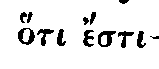
(C. 2.) "Scarcely had ruddy Phoebus spread the golden tresses of his beauteous hair over the face of the wide and spacious earth; and scarcely had the little painted birds, with the sweet and mellifluous harmony of their forked tongues, saluted the approach of rosy Aurora, who, quitting the soft couch of her jealous husband, disclosed herself to mortals through the gates of the Mauchegan horizon; when the renowned Don Quixote," &c.
(C. 3.) "Ho, there, whoever thou art, rash knight, that approachest to touch the arms of the most valorous adventurer that ever girded sword," &c.
When they were come so near as to be seen and heard, Don Quixote raised his voice, and with arrogant air cried out: "Let the whole world stand; if the whole world does not confess that there is not in the whole world a damsel more beautiful than," &c.
Let the whole world stand!
'If there had been any experience in proof of the excellence of our code, where would be our superiority in this enlightened age?'
"No! the business is that without seeing her, you believe, confess, affirm, swear, and maintain it; and if not, I challenge you all to battle." 4
(C. 7.) Among other things, Don Quixote told him, he should dispose himself to go with him willingly; for some time or other such an adventure might present, that an island might be won, in the turn of a hand, and he be left governor thereof.
(C. 7.) Sancho Panza went riding upon his ass, like any patriarch, with his wallet and leathern bottle, and with a vehement desire to find himself governor of the island which his master had promised him.
(C. 8.) "I no gentleman! I swear by the great God, thou liest, as I am a Christian. Biscainer by land, gentleman by sea, gentleman for the devil, and thou liest: look then if thou hast any thing else to say."
(B. II. c. 2.) "Be pleased, my lord Don Quixote, to bestow upon me the government of that island," &c.
(C. 2.) "But tell me, on your life, have you ever seen a more valorous knight than I, upon the whole face of the known earth? Have you read in story of any other, who has, or ever had, more bravery in assailing, more breath in holding out, more dexterity in wounding, or more address in giving a fall?" "The truth is," answered Sancho, "that I never read any history at all; for I can neither read nor write; but what I dare affirm is, that I never served a bolder master," &c.
(C. 3.) "Happy times and happy ages," &c. 5
"Peace! and have patience; the day will come," &c.
"Your Worship," said Sancho, "would make a better preacher than knight errant!"
"Make account, he carried them all over," said Don Quixote, "and do not be going and coming in this manner; for at this rate, you will not have done carrying them over in a twelvemonth." "How many are passed already?" said Sancho, &c.
Don Quixote desired to have it, and bade him take the money, and keep it for himself. Sancho kissed his hands for the favour, &c.
"And I (Don Q.) say again, they lie, and will lie two hundred times more, all who say, or think her so." "I neither say, nor think so," answered Sancho: "let those who say it, eat the lie, and swallow it with their bread: whether they were guilty or no, they have given an account to God before now: I come from my vineyard, I know nothing; I am no friend to inquiring into other men's lives; for he that buys and lies shall find the lie left in his purse behind; besides, naked was I born, and naked I remain; I neither win nor lose; if they were guilty, what is that to me? Many think to find bacon, where there is not so much as a pin to hang it on: but who can hedge in the cuckoo? Especially, do they spare God himself?"
(Ib.) "And it is no great matter, if it be in another hand; for by what I remember, Dulcinea can neither write nor read," &c.
I. Perhaps the most important of our intellectual
operations are those of detecting the difference in similar, and
the identity in dissimilar, things. Out of the latter operation
it is that wit arises; and it, generically regarded, consists in
presenting thoughts or images in an unusual connection with each
other, for the purpose of exciting pleasure by the surprise. This
connection may be real; and there is in fact a scientific wit;
though where the object, consciously entertained, is truth, and
not amusement, we commonly give it some higher name. But in wit
popularly understood, the connection may be, and for the most
part is, apparent only, and transitory; and this connection may
be by thoughts, or by words, or by images. The first is our
Butler's especial eminence; the second, Voltaire's; the third,
which we oftener call fancy, constitutes the larger and more
peculiar part of the wit of Shakspeare. You can scarcely turn to
a single speech of Falstaff's without finding instances of it.
Nor does wit always cease to deserve the name by being transient,
or incapable of analysis. I may add that the wit of thoughts
belongs eminently to the Italians, that of words to the French,
and that of images to the English.
II. Where the laughable is its own end, and neither
inference, nor moral is intended, or where at least the writer
would wish it so to appear, there arises what we call drollery.
The pure, unmixed, ludicrous or laughable belongs exclusively to
the understanding, and must be presented under the form of the
senses; it lies within the spheres of the eye and the ear, and
hence is allied to the fancy. It does not appertain to the reason
or the moral sense, and accordingly is alien to the imagination.
I think Aristotle has already excellently defined the
laughable,  , as consisting of, or depending
on, what is out of its proper time and place, yet without danger
or pain. Here the impropriety
, as consisting of, or depending
on, what is out of its proper time and place, yet without danger
or pain. Here the impropriety  is the positive qualification; the
dangerlessness
is the positive qualification; the
dangerlessness  the negative.
Neither the understanding without an object of the senses, as for
example, a mere notional error, or idiocy; nor any external
object, unless attributed to the understanding, can produce the
poetically laughable. Nay, even in ridiculous positions of the
body laughed at by the vulgar, there is a subtle personification
always going on, which acts on the, perhaps, unconscious mind of
the spectator as a symbol of intellectual character. And hence
arises the imperfect and awkward effect of comic stories of
animals; because although the understanding is satisfied in them,
the senses are not. Hence too, it is, that the true ludicrous is
its own end. When serious satire commences, or satire that is
felt as serious, however comically drest, free and genuine
laughter ceases; it becomes sardonic. This you experience in
reading Young, and also not unfrequently in Butler. The true
comic is the blossom of the nettle.
the negative.
Neither the understanding without an object of the senses, as for
example, a mere notional error, or idiocy; nor any external
object, unless attributed to the understanding, can produce the
poetically laughable. Nay, even in ridiculous positions of the
body laughed at by the vulgar, there is a subtle personification
always going on, which acts on the, perhaps, unconscious mind of
the spectator as a symbol of intellectual character. And hence
arises the imperfect and awkward effect of comic stories of
animals; because although the understanding is satisfied in them,
the senses are not. Hence too, it is, that the true ludicrous is
its own end. When serious satire commences, or satire that is
felt as serious, however comically drest, free and genuine
laughter ceases; it becomes sardonic. This you experience in
reading Young, and also not unfrequently in Butler. The true
comic is the blossom of the nettle.
III. When words or images are placed in unusual
juxta-position rather than connection, and are so placed merely
because the juxta-position is unusual we have the odd or
the grotesque; the occasional use of which in the minor ornaments
of architecture, is an interesting problem for a student in the
psychology of the Fine Arts.
IV. In the simply laughable there is a mere disproportion
between a definite act and a definite purpose or end, or a
disproportion of the end itself to the rank or circumstances of
the definite person; but humour is of more difficult description.
I must try to define it in the first place by its points of
diversity from the former species. Humour does not, like the
different kinds of wit, which is impersonal, consist wholly in
the understanding and the senses. No combination of thoughts,
words, or images will of itself constitute humour, unless some
peculiarity of individual temperament and character be indicated
thereby, as the cause of the same. Compare the comedies of
Congreve with the Falstaff in Henry IV. or with Sterne's
Corporal Trim, Uncle Toby, and Mr. Shandy, or with some of
Steele's charming papers in the Tatler, and you will feel
the difference better than I can express it. Thus again, (to take
an instance from the different works of the same writer), in
Smollett's Strap, his Lieutenant Bowling, his Morgan the honest
Welshman, and his Matthew Bramble, we have exquisite humour,
while in his Peregrine Pickle we find an abundance of
drollery, which too often degenerates into mere oddity; in short,
we feel that a number of things are put together to counterfeit
humour, but that there is no growth from within. And this indeed is the origin of the word, derived from
the humoral pathology, and excellently described by Ben
Jonson:
So in every human body,
The choler, melancholy, phlegm, and blood,
By reason that they flow continually
In some one part, and are not continent,
Receive the name of humours. Now thus far
It may, by metaphor, apply itself
Unto the general disposition:
As when some one peculiar quality
Doth so possess a man, that it doth draw
All his effects, his spirits, and his powers,
In their confluctions, all to run one way,
This may be truly said to be a humour. 1
Rabelais laughing in his easy chair

(B. III. c. 9.) How Panurge asketh counsel of Pantagruel, whether he should marry, yea or no.
"Go," says he, one day at dinner, to an overgrown one which had buzzed about his nose, and tormented him cruelly all dinner-time, and which, after infinite attempts, he had caught at last, as it flew by him; "I'll not hurt thee," says my Uncle Toby, rising from his chair, and going across the room, with the fly in his hand, "I'll not hurt a hair of thy head: Go," says he, lifting up the sash, and opening his hand as he spoke, to let it escape; "go, poor devil, get thee gone, why should I hurt thee? This world is surely wide enough to hold both thee and me." (Vol. ii. ch. 12.)
Alas o'day! had Mrs. Shandy (poor gentlewoman!) had but her wish in going up to town just to lie in and come down again; which, they say, she begged and prayed for upon her bare knees, and which, in my opinion, considering the fortune which Mr. Shandy got with her, was no such mighty matter to have complied with, the lady and her babe might both of them have been alive at this hour. (Vol. i. c. 18.)
"I see plainly, Sir, by your looks" (or as the case happened) my father would say "that you do not heartily subscribe to this opinion of mine which, to those," he would add, "who have not carefully sifted it to the bottom, I own has an air more of fancy than of solid reasoning in it; and yet, my dear Sir, if I may presume to know your character, I am morally assured, I should hazard little in stating a case to you, not as a party in the dispute, but as a judge, and trusting my appeal upon it to your good sense and candid disquisition in this matter; you are a person free from as many narrow prejudices of education as most men; and, if I may presume to penetrate farther into you, of a liberality of genius above bearing down an opinion, merely because it wants friends. Your son, your dear son, from whose sweet and open temper you have so much to expect, your Billy, Sir! would you, for the world, have called him JUDAS? Would you, my dear Sir," he would say, laying his hand upon your breast, with the genteelest address, and in that soft and irresistible piano of voice which the nature of the argumentum ad hominem absolutely requires, "Would you, Sir, if a Jew of a godfather had proposed the name for your child, and offered you his purse along with it, would you have consented to such a desecration of him? O my God!" he would say, looking up, "if I know your temper rightly, Sir, you are incapable of it; you would have trampled upon the offer; you would have thrown the temptation at the tempter's head with abhorrence. Your greatness of mind in this action, which I admire, with that generous contempt of money, which you show me in the whole transaction, is really noble; and what renders it more so, is the principle of it; the workings of a parent's love upon the truth and conviction of this very hypothesis, namely, that were your son called Judas, the sordid and treacherous idea, so inseparable from the name, would have accompanied him through life like his shadow, and in the end made a miser and a rascal of him, in spite, Sir, of your example." (Vol. i. c. 19.)
Imagine to yourself a little squat, uncourtly figure of a Doctor Slop, of about four feet and a half perpendicular height, with a breadth of back, and a sesquipedality of belly, which might have done honour to a serjeant in the horseguards. ... Imagine such a one; for such I say, were the outlines of Dr. Slop's figure, coming slowly along, foot by foot, waddling through the dirt upon the vertebræ of a little diminutive pony, of a pretty colour but of strength, alack! scarce able to have made an amble of it, under such a fardel, had the roads been in an ambling condition; they were not. Imagine to yourself Obadiah mounted upon a strong monster of a coach-horse, pricked into a full gallop, and making all practicable speed the adverse way. (Vol. ii. c. 9.)
"Return with, or on, thy shield."
"My sword is too short!" "Take a step forwarder."
"I believe you, Sir! but you will excuse my repeating it on account of my provincial accent."
St. Paul. "Whither then are you bound?"
St. Peter. "I apprehend danger here;- they'll soon call me in question for denying my Master."
St. Paul. "Nay, then, I had better be off too; for they'll question me for having persecuted the Christians, before my conversion."
I. 2
With Donne, whose muse on dromedary trots,
Wreathe iron pokers into true-love knots;
Rhyme's sturdy cripple, fancy's maze and clue,
Wit's forge and fire-blast, meaning's press and screw.
II
See lewdness and theology combin'd,
A cynic and a sycophantic mind;
A fancy shar'd party per pale between
Death's heads and skeletons and Aretine!
Not his peculiar defect or crime,
But the true current mintage of the time.
Such were the establish'd signs and tokens given
To mark a loyal churchman, sound and even,
Free from papistic and fanatic leaven.
My face in thine eye, thine in mine appears,
And true plain hearts do in the faces rest;
Where can we find two fitter hemispheres
Without sharp north, without declining west?
Good-Morrow, v. 15, &c.
Woman's constancy.
Mutual Inconstancy.
Whether both th' Indias of spice and mine, &c.
Sun Rising, v. 17.
And see at night thy western land of mine, &c.
Progress of the Soul, 1 Song, 2. st.

They took each other by the hand, and pledged friendship
Al Pagan la proposta non dispiacque:
Così fu differita la tenzone;
E tal tregua tra lor subito nacque,
Sì l' odio e l' ira va in oblivïone,
Che 'l Pagano al partir dalle fresche acque
Non lasciò a piede il buon figliuol d' Amone:
Con preghi invita, e al fin lo toglie in groppa,
E per l' orme d' Angelica galoppa.
Oh gran bontà de' cavalieri antiqui!
Eran rivali, eran di fè diversi,
E si sentían degli aspri colpi iniqui
Per tutta la persona anco dolersi;
E pur per selve oscure e calli obbliqui
Insieme van senza sospetto aversi!
Or se' tu quel Virgilio, e quella fonte,
Che spande di parlar sì largo fiume?
Risposi lui con vergognosa fronte.
O degli altri poeti onore e lume,
Vagliami 'l lungo studio e 'l grande amore,
Che m' han fatto cercar lo tuo volume.
Tu se' lo mio maestro, e 'l mio autore:
Tu se' solo colui, da cu' io tolsi
Lo bello stile, che m' ha fatto onore.
(Inf. c. 1. v. 79.)
"And art thou then that Virgil, that well-spring,
From which such copious floods of eloquence
Have issued?" I, with front abash'd, replied:
"Glory and light of all the tuneful train!
May it avail me, that I long with zeal
Have sought thy volume, and with love immense
Have conn'd it o'er. My master, thou, and guide!
Thou he from whom I have alone deriv'd
That style, which for its beauty into fame
Exalts me."
(Cary. [his translation. html Ed.])
Quale i fioretti dal notturno gelo
Chinati e chiusi, poi che 'l sol gl' imbianca,
Si drizzan tutti aperti in loro stelo,
Fal mi fec' io di mia virtute stanca;
(Inf. c. 2. v. 127.)
As florets, by the frosty air of night
Bent down and clos'd, when day has blanch'd their leaves,
Rise all unfolded on their spiry stems,
So was my fainting vigour new restor'd.
(Cary. 2)
Per me si va, &c.
Ed ecco verso noi venir per nave
Un vecchio bianco per antico pelo
Gridando: guai a voi anime prave: &c. ...
(Ver. 82. &c.)
And lo! toward us in a bark
Comes on an old man, hoary white with eld,
Crying, "Woe to you wicked spirits!" ...
(Cary.)
Caron dimonio con occhi di bragia
Loro accennando, tutte le raccoglie:
Batte col remo qualunque s' adagia.
Come d' autunno si levan le foglie
L' una appresso dell altra, infin che 'l ramo
Rende alia terra tutte le sue spoglie;
Similemente il mal seme d' Adamo,
Gittansi di quel lito ad una ad una
Per cenni, com' augel per suo richiamo.
(Ver. 100, &c.)
Charon, demoniac form,
With eyes of burning coal, collects them all,
Beck'ning, and each that lingers, with his oar
Strikes. As fall off the light autumnal leaves,
One still another following, till the bough
Strews all its honours on the earth beneath;
E'en in like manner Adam's evil brood
Cast themselves one by one down from the shore
Each at a beck, as falcon at his call.
(Cary.)
Ma poco valse, che l' ale al sospetto
Non potero avanzar: quegli andò sotto,
E quei drizzò, volando, suso il petto.
Non altrimenti l' anitra di botto,
Quando 'l falcon s' appressa, giù s' attuffa,
Ed ei ritorna su crucciato e rotto.
Irato Calcabrina della buffa,
Volando dietro gli tenne, invaghito,
Che quei campasse, per aver la zuffa:
E come 'l barattier fu disparito,
Cosi volse gli artigli al suo compagno,
E fu con lui sovra 'l fosso ghermito.
Ma l' altro fu bene sparvier grifagno
Ad artigliar ben lui, e amedue
Cadder nel mezzo del bollente stagno.
Lo caldo sghermidor subito fue:
Ma però di levarsi era niente,
Si aveano inviscate l' ale sue.
(Infer. c. xxii. ver. 127, &c.)
But little it avail'd: terror outstripp'd
His following flight: the other plung'd beneath,
And he with upward pinion rais'd his breast:
E'en thus the water-fowl, when she perceives
The falcon near, dives instant down, while he
Enrag'd and spent retires. That mockery
In Calcabrina fury stirr'd, who flew
After him, with desire of strife inflam'd;
And, for the barterer had 'scap'd, so turn'd
His talons on his comrade. O'er the dyke
In grapple close they join'd; but th' other prov'd
A goshawk, able to rend well his foe;
And in the boiling lake both fell. The heat
Was umpire soon between them, but in vain
To lift themselves they strove, so fast were glued
Their pennons.
(Cary.)
Noi ricidemmo 'l cerchio all' altra riva,
Sovr' una fonte che bolle, e riversa,
Per un fossato che da lei diriva.
L' acqua era buja molto più che persa:
E noi in compagnia dell' onde bige
Entrammo giù per una via diversa.
Una palude fa, ch' ha nome Stige,
Questo tristo ruscel, quando è disceso
Al piè delle maligne piagge grige.
Ed io che di mirar mi stava inteso,
Vidi genti fangose in quel pantano
Ignude tutte, e con sembiante offeso.
Questi si percotean non pur con mano,
Ma con la testa, e col petto, e co' piedi,
Troncandosi co' denti a brano a brano. ...
Così girammo della lorda pozza
Grand' arco tra la ripa secca e 'l mezzo,
Con gli occhi volti a chi del fango ingozza:
Venimmo appiù d' una torre al dassezzo.
(C. vii. ver. 100 and 127.)
We the circle cross'd
To the next steep, arriving at a well,
That boiling pours itself down to a foss
Sluic'd from its source. Far murkier was the wave
Than sablest grain: and we in company
Of th' inky waters, journeying by their side,
Enter'd, though by a different track, beneath.
Into a lake, the Stygian nam'd, expands
The dismal stream, when it hath reach'd the foot
Of the grey wither'd cliffs. Intent I stood
To gaze, and in the marish sunk, descried
A miry tribe, all naked, and with looks
Betok'ning rage. They with their hands alone
Struck not, but with the head, the breast, the feet,
Cutting each other piecemeal with their fangs. ...
Our route
Thus compass'd, we a segment widely stretch'd
Between the dry embankment and the cove
Of the loath'd pool, turning meanwhile our eyes
Downward on those who gulp'd its muddy lees;
Nor stopp'd, till to a tower's low base we came.
(Cary.)
La molta gente e le diverse piaghe
Avean le luci mie sì inebriate,
Che dello stare a piangere eran vaghe.
So were mine eyes inebriate with the view
Of the vast multitude, whom various wounds
Disfigur'd, that they long'd to stay and weep.
(Cary.)


What was of use to know,
What best to say could say, to do had done.
His actions to his words agreed, his words
To his large heart gave utterance due, his heart
Contain'd of good, wise, fair, the perfect shape;

Go then, thou Mightiest, in thy Father's might,
Ascend my chariot, guide the rapid wheels
That shake Heaven's basis, bring forth all my war,
My bow and thunder; my almighty arms
Gird on, and sword upon thy puissant thigh;
Pursue these sons of darkness, drive them out
From all Heaven's bounds into the utter deep:
There let them learn, as likes them, to despise
God and Messiah his anointed king.
(B. VI. v. 710.)
"Time serves not now, and, perhaps, I might seem too profuse to give any certain account of what the mind at home, in the spacious circuits of her musing, hath liberty to propose to herself, though of highest hope and hardest attempting; whether that epic form, whereof the two poems of Homer, and those other two of Virgil and Tasso, are a diffuse, and the Book of Job a brief, model," p. 69.
Think not but that I know these things;
Or think I know them not,
Not therefore am I short
Of knowing what I ought, &c.
(Hayley, p. 75.) "The sincerest friends of Milton may here agree with Johnson, who speaks of his controversial merriment as disgusting."
"But this king, not content with that which, although in a thing holy, is no holy theft, to attribute to his own making other men's whole prayers, &c. (Symmons' Ed. 1806, p. 407.))
(Hayley, p. 107.) "The ambition of Milton," &c.
I do not approve the so frequent use of this word relatively to Milton. Indeed the fondness for ingrafting a good sense on the word "ambition," is not a Christian impulse in general.
Hayley, p. 110. "Milton himself seems to have thought it allowable in literary contention to vilify, &c. the character of an opponent; but surely this doctrine is unworthy," &c.
Besides, however Milton might and did regret the immediate necessity, yet what alternative was there? Was it not better that Cromwell should usurp power, to protect religious freedom at least, than that the Presbyterians should usurp it to introduce a religious persecution, extending the notion of spiritual concerns so far as to leave no freedom even to a man's bedchamber?
If Milton borrowed a hint from any writer, it was more probably from Strada's Prolusions, in which the Fall of the Angels is pointed out as the noblest subject for a Christian poet.[1] The more dissimilar the detailed images are, the more likely it is that a great genius should catch the general idea.
"Lucifero. Che dal mio centre oscuro
Mi chiama a rimirar cotanta luce?
Who from my dark abyss
Calls me to gaze on this excess of light?"
(p Ib. v. 11.)
Che di fango opre festi
Forming thy works of dust (no, dirt. )
(Ib. v. 17.)
Tessa pur stella a stella
V'aggiungo e luna, e sole.
Let him unite above Star upon star, moon, sun.
Let him weave star to star, Then join both moon and sun!
(Ib. v. 21.)
Ch'al fin con biasmo e scorno
Vana l'opra sara, vano il sudore!
Since in the end division
Shall prove his works and all his efforts vain.
Since finally with censure and disdain
Vain shall the work be, and his toil be vain!
1796 3
Hic arcus ac tela, quibus olim in magno illo Superum tumultu princeps armorum Michael confixit auctorem proditionis; hic fulmina humanæ mentis terror. In nubibus armatas bello legiones instruam, atque inde pro re nata auxiliares ad terram copias evocabo. Hic mihi Cælites, quos esse ferunt elementorum tutelares, prima ilia corpora miscebunt.
(sect. 4.) Ed. ]
A confounding of God with Nature, and an incapacity of finding
unity in the manifold and infinity in the individual, these
are the origin of polytheism. The most perfect instance of this
kind of theism is that of early Greece; other nations seem to
have either transcended, or come short of, the old Hellenic
standard, a mythology in itself fundamentally allegorical,
and typical of the powers and functions of nature, but
subsequently mixed up with a deification of great men and
hero-worship, so that finally the original idea became
inextricably combined with the form and attributes of some
legendary individual. In Asia, probably from the greater unity of
the government and the still surviving influence of patriarchal
tradition, the idea of the unity of God, in a distorted
reflection of the Mosaic scheme, was much more generally
preserved; and accordingly all other super or ultra-human beings
could only be represented as ministers of, or rebels against, his
will. The Asiatic genii and fairies are, therefore, always
endowed with moral qualities, and distinguishable as malignant or
benevolent to man. It is this uniform attribution of fixed moral
qualities to the supernatural agents of eastern mythology that
particularly separates them from the divinities of old
Greece.
Yet it is not altogether improbable that in the Samothracian or
Cabeiric mysteries the link between the Asiatic and Greek popular
schemes of mythology lay concealed. Of these mysteries there are
conflicting accounts, and, perhaps, there were variations of
doctrine in the lapse of ages and intercourse with other systems.
But, upon a review of all that is left to us on this subject in
the writings of the ancients, we may, I think, make out thus much
of an interesting fact, that Cabiri, impliedly at
least, meant socii, complices, having a hypostatic or
fundamental union with, or relation to, each other; that these
mysterious divinities were, ultimately at least, divided into a
higher and lower triad; that the lower triad, primi quia
infimi, consisted of the old Titanic deities or powers of
nature, under the obscure names of Axieros, Axiokersos,
and Axiokersa, representing symbolically different
modifications of animal desire or material action, such as
hunger, thirst, and fire, without consciousness; that the higher
triad, ultimi quia superiores, consisted of Jupiter,
(Pallas, or Apollo, or Bacchus, or Mercury, mystically called
Cadmilos) and Venus, representing, as before, the  or reason, the
  or word or communicative power, and the
 or love;-that the Cadmilos or Mercury, the
manifested, communicated, or sent, appeared not only in his
proper person as second of the higher triad, but also as a
mediator between the higher and lower triad, and so there were
seven divinities; and, indeed, according to some authorities, it
might seem that the Cadmilos acted once as a mediator of
the higher, and once of the lower, triad, and that so there were
eight Cabeiric divinities. The lower or Titanic powers being
subdued, chaos ceased, and creation began in the reign of the
divinities of mind and love; but the chaotic gods still existed
in the abyss, and the notion of evoking them was the origin, the
idea, of the Greek necromancy.
or love;-that the Cadmilos or Mercury, the
manifested, communicated, or sent, appeared not only in his
proper person as second of the higher triad, but also as a
mediator between the higher and lower triad, and so there were
seven divinities; and, indeed, according to some authorities, it
might seem that the Cadmilos acted once as a mediator of
the higher, and once of the lower, triad, and that so there were
eight Cabeiric divinities. The lower or Titanic powers being
subdued, chaos ceased, and creation began in the reign of the
divinities of mind and love; but the chaotic gods still existed
in the abyss, and the notion of evoking them was the origin, the
idea, of the Greek necromancy.
These mysteries, like all the others, were certainly in
connection with either the Phoenician or Egyptian systems,
perhaps with both. Hence the old Cabeiric powers were soon made
to answer to the corresponding popular divinities; and the lower
triad was called by the uninitiated, Ceres, Vulcan or Pluto, and
Proserpine, and the Cadmilos became Mercury. It is not
without ground that I direct your attention, under these
circumstances, to the probable derivation of some portion of this
most remarkable system from patriarchal tradition, and to the
connection of the Cabeiri with the Kabbala.
The Samothracian mysteries continued in
celebrity till some time after the commencement of the Christian
era. 2 But they gradually sank with the rest
of the ancient system of mythology, to which, in fact, they did
not properly belong. The peculiar doctrines, however, were
preserved in the memories of the initiated, and handed down by
individuals. No doubt they were propagated in Europe, and it is
not improbable that Paracelsus received many of his opinions from
such persons, and I think a connection may be traced between him
and Jacob Behmen.
The Asiatic supernatural beings are all produced by imagining an
excessive magnitude, or an excessive smallness combined with
great power; and the broken associations, which must have given
rise to such conceptions, are the sources of the interest which
they inspire, as exhibiting, through the working of the
imagination, the idea of power in the will. This is delightfully
exemplified in the Arabian Nights' Entertainments, and
indeed, more or less, in other works of the same kind. In all
these there is the same activity of mind as in dreaming, that is
an exertion of the fancy in the combination and
recombination of familiar objects so as to produce novel and
wonderful imagery. To this must be added that these tales cause
no deep feeling of a moral kind whether of religion or
love; but an impulse of motion is communicated to the mind
without excitement, and this is the reason of their being so
generally read and admired.
I think it not unlikely that the Milesian Tales contained
the germs of many of those now in the Arabian Nights; indeed it
is scarcely possible to doubt that the Greek empire must have
left deep impression on the Persian intellect. So also many of
the Roman Catholic legends are taken from Apuleius. In that
exquisite story of Cupid and Psyche, the allegory is of no
injury to the dramatic vividness of the tale. It is evidently a
philosophic attempt to parry Christianity with a
quasi-Platonic account of the fall and redemption of the
soul.
The charm of De Foe's works, especially of Robinson
Crusoe, is founded on the same principle. It always
interests, never agitates. Crusoe himself is merely a
representative of humanity in general; neither his intellectual
nor his moral qualities set him above the middle degree of
mankind; his only prominent characteristic is the spirit of
enterprise and wandering, which is, nevertheless, a very common
disposition. You will observe that all that is wonderful in this
tale is the result of external circumstances of things
which fortune brings to Crusoe's hand.
Footnote
1: Partly from Mr. Green's note. Ed.
return to footnote mark
Footnote
2: In the reign of Tiberius, A. D. 18, Germanicus
attempted to visit Samothrace; illum in regressu sacra
Samothracum visere nitentem obvii aquilones depulere. Tacit.
Ann. II. e. 54. Ed.
return to footnote mark
(Vol. i. p. 17.)
But my ill fate pushed me on now with an obstinacy that nothing could resist; and though I had several times loud calls from my reason, and my more composed judgment to go home, yet I had no power to do it. I know not what to call this, nor will I urge that it is a secret overruling decree that hurries us on to be the instruments of our own destruction, even though it be before us, and that we rush upon it with our eyes open.
I smiled to myself at the sight of this money: "O drug!" said I aloud, &c. However, upon second thoughts, I took it away; and wrapping all this in a piece of canvass, &c.
(P. 111)
And I must confess, my religious thankfulness to God's providence began to abate too, upon the discovering that all this was nothing but what was common; though I ought to have been as thankful for so strange and unforeseen a providence, as if it had been miraculous.
(P. 126.)
The growing up of the corn, as is hinted in my Journal, had, at first, some little influence upon me, and began to affect me with seriousness, as long as I thought it had something miraculous in it, &c.
(P. 141.)
To think that this was all my own, that I was king and lord of all this country indefeasibly, &c.
(P. 223.) I considered that as I could not foresee what the ends of divine wisdom might be in all this, so I was not to dispute his sovereignty, who, as I was his creature, had an undoubted right, by creation, to govern and dispose of me absolutely as he thought fit, &c.
Doth it our reason's mutinies appease
To say, the potter may his own clay mould
To every use, or in what shape he please,
At first not counsell'd, nor at last controll'd?
Power's hand can neither easy be, nor strict
To lifeless clay, which ease nor torment knows,
And where it cannot favour or afflict,
It neither justice or injustice shows.
But souls have life, and life eternal too:
Therefore, if doom'd before they can offend,
It seems to show what heavenly power can do,
But does not in that deed that power commend.
(Death of Astragon. st. 88, &c. P. 232-3.)
And this I must observe with grief too, that the discomposure of my mind had too great impressions also upon the religious parts of my thoughts, praying to God being properly an act of the mind, not of the body.
(P. 244.)
That this would justify the conduct of the Spaniards in all their barbarities practised in America.
(P. 249.)
That I shall not discuss, and perhaps cannot account for; but certainly they are a proof of the converse of spirits, &c.
(P. 254.)
The place I was in was a most delightful cavity or grotto of its kind, as could be expected, though perfectly dark; the floor was dry and level, and had a sort of small loose gravel on it, &c.
(P. 308.)
I entered into a long discourse with him about the devil, the original of him, his rebellion against God, his enmity to man, the reason of it, his setting himself up in the dark parts of the world to be worshipped instead of God, &c.
(Vol. ii. p. 3.)
I have often heard persons of good judgment say, ... that there is no such thing as a spirit appearing, a ghost walking, and the like, &c.
(P. 9.)
She was, in a few words the stay of all my affairs, the centre of all my enterprises, &c.
(P. 67.)
The ungrateful creatures began to be as insolent and troublesome as before, &c.
(P. 82.)
That hardened villain was so far from denying it, that he said it was true, and him they would do it still before they had done with them.
It is a general, but, as it appears to me, a mistaken opinion,
that in our ordinary dreams we judge the objects to be real. I
say our ordinary dreams; because as to the night-mair the
opinion is to a considerable extent just. But the night-mair is
not a mere dream, but takes place when the waking state of the
brain is recommencing, and most often during a rapid alternation,
a twinkling, as it were, of sleeping and waking; while
either from pressure on, or from some derangement in, the stomach
or other digestive organs acting on the external skin (which is
still in sympathy with the stomach and bowels,) and benumbing it,
the sensations sent up to the brain by double touch (that is,
when my own hand touches my side or breast,) are so faint as to
be merely equivalent to the sensation given by single touch, as
when another person's hand touches me. The mind, therefore, which
at all times, with and without our distinct consciousness, seeks
for, and assumes, some outward cause for every impression from
without, and which in sleep, by aid of the imaginative faculty,
converts its judgments respecting the cause into a personal image
as being the cause, the mind, I say, in this case, deceived
by past experience, attributes the painful sensation received to
a correspondent agent, an assassin, for instance, stabbing
at the side, or a goblin sitting on the breast. Add too that the
impressions of the bed, curtains, room, &c. received by the eyes
in the half-moments of their opening, blend with, and give
vividness and appropriate distance to, the dream image which
returns when they close again; and thus we unite the actual
perceptions, or their immediate reliques, with the phantoms of
the inward sense; and in this manner so confound the half-waking,
half-sleeping, reasoning power, that we actually do pass a
positive judgment on the reality of what we see and hear, though
often accompanied by doubt and self-questioning, which, as I have
myself experienced, will at times become strong enough, even
before we awake, to convince us that it is what it is
namely, the night-mair.
In ordinary dreams we do not judge the objects to be real;
we simply do not determine that they are unreal. The sensations
which they seem to produce, are in truth the causes and occasions
of the images; of which there are two obvious proofs: first, that
in dreams the strangest and most sudden metamorphoses do not
create any sensation of surprise: and the second, that as to the
most dreadful images, which during the dream were accompanied
with agonies of terror, we merely awake, or turn round on the
other side, and off fly both image and agony, which would be
impossible if the sensations were produced by the images. This
has always appeared to me an absolute demonstration of the true
nature of ghosts and apparitions such I mean of the tribe
as were not pure inventions. Fifty years ago, (and to this day in
the ruder parts of Great Britain and Ireland, in almost every
kitchen and in too many parlours it is nearly the same,) you
might meet persons who would assure you in the most solemn
manner, so that you could not doubt their veracity at least, that
they had seen an apparition of such and such a person, in
many cases, that the apparition had spoken to them; and they
would describe themselves as having been in an agony of terror.
They would tell you the story in perfect health. Now take the
other class of facts, in which real ghosts have appeared; I
mean, where figures have been dressed up for the purpose of
passing for apparitions: in every instance I have known or
heard of (and I have collected very many) the consequence has
been either sudden death, or fits, or idiocy, or mania, or a
brain fever. Whence comes the difference? evidently from this,
that in the one case the whole of the nervous system has
been by slight internal causes gradually and all together brought
into a certain state, the sensation of which is extravagantly
exaggerated during sleep, and of which the images are the mere
effects and exponents, as the motions of the weathercock are of
the wind; while in the other case, the image rushing
through the senses upon a nervous system, wholly unprepared,
actually causes the sensation, which is sometimes powerful enough
to produce a total check, and almost always a lesion or
inflammation. Who has not witnessed the difference in shock when
we have leaped down half-a-dozen steps intentionally, and that of
having missed a single stair. How comparatively severe the latter
is! The fact really is, as to apparitions, that the terror
produces the image instead of the contrary; for in omnem actum
perceptionis influit imaginatio, as says Wolfe.
O, strange is the self-power of the imagination when
painful sensations have made it their interpreter, or returning
gladsomeness or convalescence has made its chilled and evanished
figures and landscape bud, blossom, and live in scarlet, green,
and snowy white (like the fire-screen inscribed with the nitrate
and muriate of cobalt,) strange is the power to represent
the events and circumstances, even to the anguish or the triumph
of the quasi-credent soul, while the necessary conditions,
the only possible causes of such contingencies, are known to be
in fact quite hopeless; yea, when the pure mind would
recoil from the eve-lengthened shadow of an approaching hope, as
from a crime;-and yet the effect shall have place, and substance,
and living energy, and, on a blue islet of ether, in a whole sky
of blackest cloudage, shine like a firstling of creation!
To return, however to apparitions, and by way of an amusing
illustration of the nature and value of even contemporary
testimony upon such subjects, I will present you with a passage,
literally translated by my friend, Mr. Southey, from the well
known work of Bernal Dias, one of the companions of Cortes, in
the conquest of Mexico:
Here it is that Gomara says, that Francisco de Morla rode forward on a dappled grey horse, before Cortes and the cavalry came up, and that the apostle St. Iago, or St. Peter, was there. I must say that all our works and victories are by the hand of our Lord Jesus Christ, and that in this battle there were for each of us so many Indians, that they could have covered us with handfuls of earth, if it had not been that the great mercy of God helped us in every thing. And it may be that he of whom Gomara speaks, was the glorious Santiago or San Pedro, and I, as a sinner, was not worthy to see him; but he whom I saw there and knew, was Francisco de Morla on a chestnut horse, who came up with Cortes. And it seems to me that now while I am writing this, the whole war is represented before these sinful eyes, just in the manner as we then went through it. And though I, as an unworthy sinner, might not deserve to see either of these glorious apostles, there were in our company above four hundred soldiers, and Cortes, and many other knights; and it would have been talked of and testified, and they would have made a church, when they peopled the town, which would have been called Santiago de la Vittoria, or San Pedro de la Vittoria, as it is now called, Santa Maria de la Vittoria. And if it was, as Gomara says, bad Christians must we have been, when our Lord God sent us his holy apostles, not to acknowledge his great mercy, and venerate his church daily. And would to God, it had been, as the Chronicler says! but till I read his Chronicle, I never heard such a thing from any of the conquerors who were there.

A Christian's conflicts and conquests, p. 459.
By the devil we are to understand that apostate spirit which fell from God, and is always designing to hale down others from God also. The Old Dragon (mentioned in the Revelation) with his tail drew down the third part of the stars of heaven and cast them to the earth.


(Ib. p. 463.)
When we say, the devil is continually busy with us, I mean not only some apostate spirit as one particular being, but that spirit of apostacy which is lodged in all men's natures; and this may seem particularly to be aimed at in this place, if we observe the context: as the scripture speaks of Christ not only as a particular person, but as a divine principle in holy souls. Indeed the devil is not only the name of one particular thing, but a nature.
Man communicates by articulation of sounds, and paramountly by
the memory in the ear; nature by the impression of bounds and
surfaces on the eye, and through the eye it gives significance
and appropriation, and thus the conditions of memory, or the
capability of being remembered, to sounds, smells, &c. Now Art,
used collectively for painting, sculpture, architecture and
music, is the mediatress between, and reconciler of, nature and
man. It is, therefore, the power of humanizing nature, of
infusing the thoughts and passions of man into every thing which
is the object of his contemplation; colour, form, motion and
sound are the elements which it combines, and it stamps them into
unity in the mould of a moral idea.
The primary art is writing; primary, if we regard the
purpose abstracted from the different modes of realizing it,
those steps of progression of which the instances are still
visible in the lower degrees of civilization. First, there is
mere gesticulation; then rosaries or wampun; then
picture-language; then hieroglyphics, and finally alphabetic
letters. These all consist of a translation of man into nature,
of a substitution of the visible for the audible.
The so called music of savage tribes as little deserves the name
of art for the understanding as the ear warrants it for music.
Its lowest state is a mere expression of passion by sounds which
the passion itself necessitates; the highest amounts to no
more than a voluntary reproduction of these sounds in the absence
of the occasioning causes, so as to give the pleasure of
contrast, for example, by the various outcries of battle in
the song of security and triumph. Poetry also is purely human;
for all its materials are from the mind, and all its products are
for the mind. But it is the apotheosis of the former state, in
which by excitement of the associative power passion itself
imitates order, and the order resulting produces a pleasurable
passion, and thus it elevates the mind by making its feelings the
object of its reflexion. So likewise, whilst it recalls the
sights and sounds that had accompanied the occasions of the
original passions, poetry impregnates them with an interest not
their own by means of the passions, and yet tempers the passion
by the calming power which all distinct images exert on the human
soul. In this way poetry is the preparation for art, inasmuch as
it avails itself of the forms of nature to recall, to express,
and to modify the thoughts and feelings of the mind. Still,
however, poetry can only act through the intervention of
articulate speech, which is so peculiarly human, that in all
languages it constitutes the ordinary phrase by which man and
nature are contradistinguished. It is the original force of the
word 'brute,' and even 'mute,' and 'dumb' do not convey the
absence of sound, but the absence of articulated sounds.
As soon as the human mind is intelligibly addressed by an outward
image exclusively of articulate speech, so soon does art
commence. But please to observe that I have laid particular
stress on the words 'human mind,' meaning to exclude
thereby all results common to man and all other sentient
creatures, and consequently confining myself to the effect
produced by the congruity of the animal impression with the
reflective powers of the mind; so that not the thing presented,
but that which is re-presented by the thing shall be the source
of the pleasure. In this sense nature itself is to a religious
observer the art of God; and for the same cause art itself might
be defined as of a middle quality between a thought and a thing,
or as I said before, the union and reconciliation of that which
is nature with that which is exclusively human. It is the figured
language of thought, and is distinguished from nature by the
unity of all the parts in one thought or idea. Hence nature
itself would give us the impression of a work of art if we could
see the thought which is present at once in the whole and in
every part; and a work of art will be just in proportion as it
adequately conveys the thought, and rich in proportion to the
variety of parts which it holds in unity.
If, therefore, the term 'mute' be taken as opposed not to sound
but to articulate speech, the old definition of painting will in
fact be the true and best definition of the Fine Arts in general,
that is, muta poesis, mute poesy, and so of course poesy.
And, as all languages perfect themselves by a gradual process of
desynonymizing words originally equivalent, I have cherished the
wish to use the word 'poesy' as the generic or common term, and
to distinguish that species of poesy which is not muta
poesis by its usual name 'poetry;' while of all the other
species which collectively form the Fine Arts, there would remain
this as the common definition, that they all, like poetry,
are to express intellectual purposes, thoughts, conceptions, and
sentiments which have their origin in the human mind, not,
however, as poetry does, by means of articulate speech, but as
nature or the divine art does, by form, colour, magnitude,
proportion, or by sound, that is, silently or musically.
Well! it may be said but who has ever thought otherwise? We
all know that art is the imitatress of nature. And, doubtless,
the truths which I hope to convey would be barren truisms, if all
men meant the same by the words 'imitate' and 'nature.' But it
would be flattering mankind at large, to presume that such is the
fact. First, to imitate. The impression on the wax is not an
imitation, but a copy, of the seal; the seal itself is an
imitation. But, further, in order to form a philosophic
conception, we must seek for the kind, as the heat in ice,
invisible light, &c. whilst, for practical purposes, we must have
reference to the degree. It is sufficient that philosophically we
understand that in all imitation two elements must coexist, and
not only coexist, but must be perceived as coexisting. These two
constituent elements are likeness and unlikeness, or sameness and
difference, and in all genuine creations of art there must be a
union of these disparates. The artist may take his point of view
where he pleases, provided that the desired effect be perceptibly
produced, that there be likeness in the difference,
difference in the likeness, and a reconcilement of both in one.
If there be likeness to nature without any check of difference,
the result is disgusting, and the more complete the delusion, the
more loathsome the effect. Why are such simulations of nature, as
wax-work figures of men and women, so disagreeable? Because, not
finding the motion and the life which we expected, we are shocked
as by a falsehood, every circumstance of detail, which before
induced us to be interested, making the distance from truth more
palpable. You set out with a supposed reality and are
disappointed and disgusted with the deception; whilst, in respect
to a work of genuine imitation, you begin with an acknowledged
total difference, and then every touch of nature gives you the
pleasure of an approximation to truth. The fundamental principle
of all this is undoubtedly the horror of falsehood and the love
of truth inherent in the human breast. The Greek tragic dance
rested on these principles, and I can deeply sympathize in
imagination with the Greeks in this favourite part of their
theatrical exhibitions, when I call to mind the pleasure I felt
in beholding the combat of the Horatii and Curiatii most
exquisitely danced in Italy to the music of Cimarosa.
Secondly, as to nature. We must imitate nature! yes, but what in
nature, all and every thing? No, the beautiful in nature.
And what then is the beautiful? What is beauty? It is, in the
abstract, the unity of the manifold, the coalescence of the
diverse; in the concrete, it is the union of the shapely
(formosum) with the vital. In the dead organic it depends
on regularity of form, the first and lowest species of which is
the triangle with all its modifications, as in crystals,
architecture, &c.; in the living organic it is not mere
regularity of form, which would produce a sense of formality;
neither is it subservient to any thing beside itself. It may be
present in a disagreeable object, in which the proportion of the
parts constitutes a whole; it does not arise from association, as
the agreeable does, but sometimes lies in the rupture of
association; it is not different to different individuals and
nations, as has been said, nor is it connected with the ideas of
the good, or the fit, or the useful. The sense of beauty is
intuitive, and beauty itself is all that inspires pleasure
without, and aloof from, and even contrarily to, interest.
If the artist copies the mere nature, the natura naturata,
what idle rivalry? If he proceeds only from a given form, which
is supposed to answer to the notion of beauty, what an emptiness,
what an unreality there always is in his productions, as in
Cipriani's pictures! Believe me, you must master the essence, the
natura naturans, which presupposes a bond between nature
in the higher sense and the soul of man.
The wisdom in nature is distinguished from that in man by the
co-instantaneity of the plan and the execution; the thought and
the product are one, or are given at once; but there is no reflex
act, and hence there is no moral responsibility. In man there is
reflexion, freedom, and choice; he is, therefore, the head of the
visible creation. In the objects of nature are presented, as in a
mirror, all the possible elements, steps, and processes of
intellect antecedent to consciousness, and therefore to the full
development of the intelligential act; and man's mind is the very
focus of all the rays of intellect which are scattered throughout
the images of nature. Now so to place these images, totalized,
and fitted to the limits of the human mind, as to elicit from,
and to superinduce upon, the forms themselves the moral
reflexions to which they approximate, to make the external
internal, the internal external, to make nature thought, and
thought nature, this is the mystery of genius in the Fine
Arts. Dare I add that the genius must act on the feeling, that
body is but a striving to become mind, that it is mind in
its essence!
In every work of art there is a reconcilement of the external
with the internal; the conscious is so impressed on the
unconscious as to appear in it; as compare mere letters inscribed
on a tomb with figures themselves constituting the tomb. He who
combines the two is the man of genius; and for that reason he
must partake of both. Hence there is in genius itself an
unconscious activity; nay, that is the genius in the man of
genius. And this is the true exposition of the rule that the
artist must first eloign himself from nature in order to return
to her with full effect. Why this? Because if he were to begin by
mere painful copying, he would produce masks only, not forms
breathing life. He must out of his own mind create forms
according to the severe laws of the intellect, in order to
generate in himself that co-ordination of freedom and law, that
involution of obedience in the prescript, and of the prescript in
the impulse to obey, which assimilates him to nature, and enables
him to understand her. He merely absents himself for a season
from her, that his own spirit, which has the same ground with
nature, may learn her unspoken language in its main radicals,
before he approaches to her endless compositions of them. Yes,
not to acquire cold notions lifeless technical rules
but living and life-producing ideas, which shall contain their
own evidence, the certainty that they are essentially one with
the germinal causes in nature his consciousness being the
focus and mirror of both, for this does the artist for a
time abandon the external real in order to return to it with a
complete sympathy with its internal and actual. For of all we
see, hear, feel and touch the substance is and must be in
ourselves; and therefore there is no alternative in reason
between the dreary (and thank heaven! almost impossible) belief
that every thing around us is but a phantom, or that the life
which is in us is in them likewise; and that to know is to
resemble, when we speak of objects out of ourselves, even as
within ourselves to learn is, according to Plato, only to
recollect; the only effective answer to which, that I have
been fortunate to meet with, is that which Pope has consecrated
for future use in the line
And coxcombs vanquish Berkeley with a grin!
I have, I believe, formerly observed with regard to the
character of the governments of the East, that their tendency was
despotic, that is, towards unity; whilst that of the Greek
governments, on the other hand, leaned to the manifold and the
popular, the unity in them being purely ideal, namely of all as
an identification of the whole. In the northern or Gothic nations
the aim and purpose of the government were the preservation of
the rights and interests of the individual in conjunction with
those of the whole. The individual interest was sacred. In the
character and tendency of the Greek and Gothic languages there is
precisely the same relative difference. In Greek the sentences
are long, and the structure architectural, so that each part or
clause is insignificant when compared with the whole. The result
is every thing, the steps and processes nothing. But in the
Gothic and, generally, in what we call the modern, languages, the
structure is short, simple, and complete in each part, and the
connexion of the parts with the sum total of the discourse is
maintained by the sequency of the logic, or the community of
feelings excited between the writer and his readers. As an
instance equally delightful and complete, of what may be called
the Gothic structure as contra-distinguished from that of the
Greeks, let me cite a part of our famous Chaucer's character of a
parish priest as he should be. Can it ever be quoted too
often?
A good man thér was of religiöun
That was a pouré Parsone of a toun,
But riche he was of holy thought and werk;
He was alsó a lerned man, a clerk,
That Cristés gospel trewély wolde preche;
His párishens 1 devoutly wolde he teche;
Benigne he was, and wonder 2 diligent,
And in adversite ful patient,
And swiche 3 he was ypreved 4 often sithes 5;
Ful loth were him to cursen for his tithes,
But rather wolde he yeven 6 out of doute
Unto his pouré párishens aboute
Of hís offríng, and eke of his substánce;
He coude in litel thing have suffisance:
Wide was his parish, and houses fer asonder,
But he ne 7 left nought for no rain ne 8 thonder,
In sikenesse and in mischief to visíte
The ferrest 9 in his parish moche and lite 10
Upon his fete, and in his hand a staf:
This noble ensample to his shepe he yaf, 11
That first he wrought, and afterward he taught,
Out of the gospel he the wordés caught,
And this figúre he added yet thereto,
That if gold rusté, what should iren do.
He setté not his benefice to hire,
And lette 12 his shepe accombred 13 in the mire,
And ran untó Londón untó Seint Poules,
To seken him a chantérie for soules,
Or with a brotherhede to be withold,
But dwelt at home, and kepté wel his fold,
So that the wolf ne made it not miscarie:
He was a shepherd and no mercenarie;
And though he holy were and vertuous,
He was to sinful men not dispitous, 14
Ne of his speché dangerous ne digne, 15
But in his teching discrete and benigne,
To drawen folk to heven with fairénesse,
By good ensample was his besinesse;
But it were any persone obstinat,
What so he were of high or low estat,
Him wolde he snibben 16 sharply for the nones:
A better preest I trowe that no wher non is;
He waited after no pompe ne reverence,
He maked him no spiced conscience,
But Cristés love and his apostles' twelve
He taught, but first he folwed it himselve. 17
| Footnote 1: Parisioners (return) | Footnote 2: Wondrous (return) |
| Footnote 3: Such (return) | Footnote 4: Proved (return) |
| Footnote 5: Times (return) | Footnote 6: Give or Have given (return) |
| Footnote 7: Not (return) | Footnote 8: Nor (return) |
| Footnote 9: Farthest (return) | Footnote 10: Great and small (return) |
| Footnote 11: Gave (return) | Footnote 12: Left (return) |
| Footnote 13: Encumbered (return) | Footnote 14: Despiteous (return) |
| Footnote 15: Proud (return) | Footnote 16: Reprove (return) |
| Footnote 17: Prologue to Canterbury Tales (return) |
Concerning Faith, the principal object whereof is that eternal verity which hath discovered the treasures of hidden wisdom in Christ; concerning Hope, the highest object whereof is that everlasting goodness which in Christ doth quicken the dead; concerning Charity, the final object whereof is that incomprehensible beauty which shineth in the countenance of Christ, the Son of the living God: concerning these virtues, the first of which beginning here with a weak apprehension of things not seen, endeth with the intuitive vision of God in the world to come; the second beginning here with a trembling expectation of things far removed, and as yet but only heard of, endeth with real and actual fruition of that which no tongue can express; the third beginning here with a weak inclination of heart towards him unto whom we are not able to approach, endeth with endless union, the mystery whereof is higher than the reach of the thoughts of men; concerning that Faith, Hope, and Charity, without which there can be no salvation, was there ever any mention made saving only in that Law which God himself hath from Heaven revealed? There is not in the world a syllable muttered with certain truth concerning any of these three, more than hath been supernaturally received from the mouth of the eternal God.
Eccles. Pol. I. s. 11.
Strong feeling and an active intellect conjoined, lead almost
necessarily, in the first stage of philosophising, to Spinosism.
Sir T. Brown was a Spinosist without knowing it.
If I have not quite all the faith that the author of the
Religio Medici possessed, I have all the inclination to
it; it gives me pleasure to believe.
The postscript at the very end of the book is well worth reading.
Sir K. Digby's observations, however, are those of a pedant in
his own system and opinion. He ought to have considered the R.
M. in a dramatic, and not in a metaphysical, view, as a sweet
exhibition of character and passion, and not as an expression, or
investigation, of positive truth. The R. M. is a fine
portrait of a handsome man in his best clothes; it is much of
what he was at all times, a good deal of what he was only in his
best moments. I have never read a book in which I felt greater
similarity to my own make of mind active in inquiry, and
yet with an appetite to believe in short an affectionate
visionary! But then I should tell a different tale of my own
heart; for I would not only endeavour to tell the truth, (which I
doubt not Sir T. B. has done), but likewise to tell the whole
truth, which most assuredly he has not done. However, it is a
most delicious book. His own character was a fine mixture of
humourist, genius, and pedant. A library was a living world to
him, and every book a man, absolute flesh and blood! and the
gravity with which he records contradictory opinions is
exquisite.
(Part 1. sect. 9.)
Now contrarily, I bless myself, and am thankful that I lived not in the days of miracles, that I never saw Christ nor his disciples, &c.
(S. 15.)
I could never content my contemplation with those general pieces of wonder, the flux and reflux of the sea, the increase of Nile, the conversion of the needle to the north; and have studied to match and parallel those in the more obvious and neglected pieces of nature; which without further travel I can do in the cosmography of myself; we carry with us the wonders we seek without us. There is all Africa and her prodigies in us; we are that bold and adventurous piece of nature, which he that studies wisely learns in a compendium what others labour at in a divided piece and endless volume.
(S. 16, 17.)
All this is very fine philosophy, and the best and most ingenious defence of revelation. Moreover, I do hold and believe that a toad is a comely animal; but nevertheless a toad is called ugly by almost all men, and it is the business of a philosopher to explain the reason of this.
(S. 48.)
This is made good by experience, which can from the ashes of a plant revive the plant, and from its cinders recall it into its stalks and leaves again.
(Part II. s. 2.)
I give no alms to satisfy the hunger of my brother, but to fulfil and accomplish the will and command of my God.
(S. 5, 6.)
I never yet cast a true affection on a woman; but I have loved my friend as I do virtue, my soul, my God.
(S. 6.)
Another misery there is in affection, that whom we truly love like ourselves, we forget their looks, nor can our memory retain the idea of their faces; and it is no wonder: for they are ourselves, and our affection makes their looks our own.
(S. 7.)
I can hold there is no such thing as injury; that if there be, there is no such injury as revenge, and no such revenge as the contempt of an injury; that to hate another, is to malign himself, and that the truest way to love another is to despise ourselves.
(S. 10.)
In brief, there can be nothing truly alone, and by itself, which is not truly one; and such is only God.
(S. 11.)
I thank God for my happy dreams, &c.
(S. 13.)
Statists that labour to contrive a commonwealth without any poverty, take away the object of our charity, not only not understanding the commonwealth of a Christian, but forgetting the prophecies of Christ.
1807.
Stat nominis umbra.
Dedication to the English nation.
(Ib.)
If an honest, and I may truly affirm a laborious, zeal for the public service has given me any weight in your esteem, let me exhort and conjure you never to suffer an invasion of your political constitution, however minute the instance may appear, to pass by, without a determined persevering resistance.
(Ib.)
If you reflect that in the changes of administration which have marked and disgraced the present reign, although your warmest patriots have, in their turn, been invested with the lawful and unlawful authority of the crown, and though other reliefs or improvements have been held forth to the people, yet that no one man in office has ever promoted or encouraged a bill for shortening the duration of parliaments, but that (whoever was minister) the opposition to this measure, ever since the septennial act passed, has been constant and uniform on the part of government.
Preface
(L. V.)
For my own part, I willingly leave it to the public to determine whether your vindication of your friend has been as able and judicious as it was certainly well intended; and you, I think, may be satisfied with the warm acknowledgements he already owes you for making him the principal figure in a piece in which, but for your amicable assistance, he might have passed without particular notice or distinction.
(L. VII.)
These are the gloomy companions of a disturbed imagination; the melancholy madness of poetry, without the inspiration.
(Ib.)
Such a question might perhaps discompose the gravity of his muscles, but I believe it would little affect the tranquillity of his conscience.
(L. VIII)
To do justice to your Grace's humanity, you felt for Mac Quick as you ought to do; and, if you had been contented to assist him indirectly, without a notorious denial of justice, or openly insulting the sense of the nation, you might have satisfied every duty of political friendship, without committing the honour of your sovereign, or hazarding the reputation of his government.
(L. XXXV.)
To honour them with a determined predilection and confidence in exclusion of your English subjects, who placed your family, and, in spite of treachery and rebellion, have supported it upon the throne, is a mistake too gross even for the unsuspecting generosity of youth.
1803.
Heaven forbid that this work should not exist in its present form
and language! Yet I cannot avoid the wish that it had, during the
reign of James I., been moulded into an heroic poem in English
octave stanza, or epic blank verse; which, however, at that
time had not been invented, and which, alas! still remains the
sole property of the inventor, as if the Muses had given him an
unevadible patent for it. Of dramatic blank verse we have many
and various specimens; for example, Shakspeare's as
compared with Massinger's, both excellent in their kind: of
lyric, and of what may be called Orphic, or philosophic, blank
verse, perfect models may be found in Wordsworth: of colloquial
blank verse there are excellent, though not perfect, examples in
Cowper; but of epic blank verse, since Milton, there is not
one.
It absolutely distresses me when I reflect that this work,
admired as it has been by great men of all ages, and lately, I
hear, by the poet Cowper, should be only not unknown to general
readers. It has been translated into English two or three times
how, I know not, wretchedly, I doubt not. It affords matter
for thought that the last translation (or rather, in all
probability, miserable and faithless abridgment of some former
one) was given under another name. What a mournful proof of the
incelebrity of this great and amazing work among both the public
and the people! For as Wordsworth, the greater of the two great
men of this age, (at least, except Davy and him, I have
known, read of, heard of, no others) for as Wordsworth did
me the honour of once observing to me, the people and the public
are two distinct classes, and, as things go, the former is likely
to retain a better taste, the less it is acted out by the latter.
Yet Telemachus is in every mouth, in every school-boy's
and school-girl's hand! It is awful to say of a work, like the
Argenis, the style and Latinity of which, judged (not
according to classical pedantry, which pronounces every sentence
right which can be found in any book prior to Boetius, however
vicious the age, or affected the author, and every sentence
wrong, however natural and beautiful, which has been of the
author's own combination, but, according to the universal
logic of thought as modified by feeling, is equal to that of
Tacitus in energy and genuine conciseness, and is as perspicuous
as that of Livy, whilst it is free from the affectations,
obscurities, and lust to surprise of the former, and seems a sort
of antithesis to the slowness and prolixity of the latter;
(this remark does not, however, impeach even the classicality of
the language, which, when the freedom and originality, the easy
motion and perfect command of the thoughts, are considered, is
truly wonderful: of such a work it is awful to say, that it
would have been well if it had been written in English or Italian
verse! Yet the event seems to justify the notion. Alas! it is now
too late. What modern work, even of the size of the Paradise
Lost much less of the Faery Queene would
be read in the present day, or even bought or be likely to be
bought, unless it were an instructive work, as the phrase is,
like Roscoe's quartos of Leo X., or entertaining like
Boswell's three of Dr. Johnson's conversations. It may be fairly
objected what work of surpassing merit has given the proof?
Certainly, none. Yet still there are ominous facts,
sufficient, I fear, to afford a certain prophecy of its
reception, if such were produced.
Footnote
1: Communicated by the Rev. Derwent Coleridge.
Ed.
return to footnote mark
1807
There are six hundred and sixteen pages in this volume, of which
twenty-two are text; and five hundred and ninety-four commentary
and introductory matter. Yet when I recollect, that I have the
whole works of Cicero, Livy, and Quinctilian, with many others,
the whole works of each in a single volume, either thick
quarto with thin paper and small yet distinct print, or thick
octavo or duodecimo of the same character, and that they cost me
in the proportion of a shilling to a guinea for the same quantity
of worse matter in modern books, or editions, I a poor man,
yet one whom 
 feel the
liveliest gratitude for the age, which produced such editions,
and for the education, which by enabling me to understand and
taste the Greek and Latin writers, has thus put it in my power to
collect on my own shelves, for my actual use, almost all the best
books in spite of my small income. Somewhat too I am indebted to
the ostentation of expense among the rich, which has occasioned
these cheap editions to become so disproportionately cheap.
feel the
liveliest gratitude for the age, which produced such editions,
and for the education, which by enabling me to understand and
taste the Greek and Latin writers, has thus put it in my power to
collect on my own shelves, for my actual use, almost all the best
books in spite of my small income. Somewhat too I am indebted to
the ostentation of expense among the rich, which has occasioned
these cheap editions to become so disproportionately cheap.
extract of a letter sent with the volume
1 1807
Chapman I have sent in order that you might read the
Odyssey; the Iliad is fine, but less equal in the
translation, as well as less interesting in itself. What is
stupidly said of Shakspeare, is really true and appropriate of
Chapman; mighty faults counterpoised by mighty beauties.
Excepting his quaint epithets which he affects to render
literally from the Greek, a language above all others blest in
the happy marriage of sweet words, and which in our language are
mere printer's compound epithets such as quaffed divine
joy-in-the-heart-of-man-infusing wine, (the undermarked is
to be one word, because one sweet mellifluous word expresses it
in Homer); excepting this, it has no look, no air, of a
translation. It is as truly an original poem as the Faery
Queene; it will give you small idea of Homer, though a
far truer one than Pope's epigrams, or Cowper's cumbersome most
anti-Homeric Miltonism. For Chapman writes and feels as a poet,
as Homer might have written had he lived in England in the
reign of Queen Elizabeth. In short, it is an exquisite poem, in
spite of its frequent and perverse quaintnesses and harshnesses,
which are, however, amply repaid by almost unexampled sweetness
and beauty of language, all over spirit and feeling. In the main
it is an English heroic poem, the tale of which is borrowed from
the Greek. The dedication to the Iliad is a noble copy of
verses, especially those sublime lines beginning,
O!'tis wondrous much
(Though nothing prisde) that the right vertuous touch
Of a well written soule, to vertue moves.
Nor haue we soules to purpose, if their loves
Of fitting objects be not so inflam'd.
How much then, were this kingdome's maine soule maim'd,
To want this great inflamer of all powers
That move in humane soules! All realmes but yours,
Are honor'd with him; and hold blest that state
That have his workes to reade and contemplate.
In which, humanitie to her height is raisde;
Which all the world (yet, none enough) hath praisde.
Seas, earth, and heaven, he did in verse comprize;
Out sung the Muses, and did equalise
Their king Apollo; being so farre from cause
Of princes light thoughts, that their gravest lawes
May finde stuffe to be fashiond by his lines.
Through all the pompe of kingdomes still he shines
And graceth all his gracers. Then let lie
Your lutes, and viols, and more loftily
Make the heroiques of your Homer sung,
To drums and trumpets set his Angels tongue:
And with the princely sports of haukes you use,
Behold the kingly flight of his high Muse:
And see how like the Phöenix she renues
Her age, and starrie feathers in your sunne;
Thousands of yeares attending; everie one
Blowing the holy fire, and throwing in
Their seasons, kingdomes, nations that have bin
Subverted in them; lawes, religions, all
Offerd to change, and greedie funerall;
Yet still your Homer lasting, living, raigning.


1820.
Among the grounds for recommending the perusal of our elder
writers Hooker Taylor Baxter in short
almost any of the folios composed from Edward VI. to Charles II.
I note:
1. The overcoming the habit of deriving your whole
pleasure passively from the book itself, which can only be
effected by excitement of curiosity or of some passion. Force
yourself to reflect on what you read paragraph by paragraph, and
in a short time you will derive your pleasure, an ample portion
of it, at least, from the activity of your own mind. All else is
picture sunshine.
2. The conquest of party and sectarian prejudices, when
you have on the same table before you the works of a Hammond and
a Baxter, and reflect how many and how momentous their points of
agreement, how few and almost childish the differences, which
estranged and irritated these good men. Let us but imagine what
their blessed spirits now feel at the retrospect of their earthly
frailties, and can we do other than strive to feel as they now
feel, not as they once felt? So will it be with the disputes
between good men of the present day; and if you have no other
reason to doubt your opponent's goodness than the point in
dispute, think of Baxter and Hammond, of Milton and Taylor, and
let it be no reason at all.
3. It will secure you from the narrow idolatry of the
present times and fashions, and create the noblest kind of
imaginative power in your soul, that of living in past ages;
wholly devoid of which power, a man can neither anticipate
the future, nor ever live a truly human life, a life of reason in
the present.
4. In this particular work we may derive a most
instructive lesson, that in certain points, as of religion in
relation to law, the medio tutis simus ibis is
inapplicable. There is no 'medium' possible; and all the attempts
as those of Baxter, though no more were required than 'I believe
in God through Christ,' prove only the mildness of the proposer's
temper, but as a rule would be either equal to nothing, at least
exclude only the two or three in a century that make it a matter
of religion to declare themselves atheists, or else be just as
fruitful a rule for a persecutor as the most complete set of
articles that could be framed by a Spanish Inquisition. For to
'believe' must mean to believe aright and 'God' must mean
the true God and 'Christ' the Christ in the sense and with
the attributes understood by Christians who are truly Christians.
An established church with a liturgy is the sufficient solution
of the problem de jure magistratus. Articles of faith are
in this point of view superfluous; for is it not too absurd for a
man to hesitate at subscribing his name to doctrines which yet in
the more awful duty of prayer and profession he dares affirm
before his Maker! They are therefore, in this sense, merely
superfluous; not worth re-enacting, had they ever been done
away with; not worth removing now that they exist.
5. The characteristic contra-distinction between the
speculative reasoners of the age before the Revolution, and those
since, is this: the former cultivated metaphysics without,
or neglecting empirical, psychology: the latter cultivate a
mechanical psychology to the neglect and contempt of metaphysics.
Both, therefore, are almost equi-distant from true philosophy.
Hence the belief in ghosts, witches, sensible replies to prayer,
&c. in Baxter and in a hundred others. See also Luther's Table
Talk.
6. The earlier part of this volume is interesting as
materials for medical history. The state of medical science in
the reign of Charles I. was almost incredibly low.
1810.
The same arguments that decide the question, whether taste has
any fixed principles, may probably lead to a determination of
what those principles are. First then, what is taste in its
metaphorical sense, or, which will be the easiest mode of
arriving at the same solution, what is there in the primary sense
of the word, which may give to its metaphorical meaning an import
different from that of sight or hearing, on the one hand, and of
touch or smell on the other? And this question seems the more
natural, because in correct language we confine beauty, the main
subject of taste, to objects of sight and combinations of sounds,
and never, except sportively or by abuse of words, speak of a
beautiful flavour or a beautiful scent.
Now the analysis of our senses in the commonest books of
anthropology has drawn our attention to the distinction between
the perfectly organic, and the mixed senses; the first
presenting objects, as distinct from the perception; the
last as blending the perception with the sense of the object. Our
eyes and ears (I am not now considering what is or is not
the case really, but only that of which we are regularly
conscious as appearances,) our eyes most often appear to us
perfect organs of the sentient principle, and wholly in action,
and our hearing so much more so than the three other senses, and
in all the ordinary exertions of that sense, perhaps, equally so
with the sight, that all languages place them in one class, and
express their different modifications by nearly the same
metaphors. The three remaining senses appear in part passive, and
combine with the perception of the outward object a distinct
sense of our own life. Taste, therefore, as opposed to vision and
sound, will teach us to expect in its metaphorical use a certain
reference of any given object to our own being, and not merely a
distinct notion of the object as in itself, or in its independent
properties. From the sense of touch, on the other hand, it is
distinguishable by adding to this reference to our vital being
some degree of enjoyment, or the contrary, some perceptible
impulse from pleasure or pain to complacency or dislike. The
sense of smell, indeed, might perhaps have furnished a metaphor
of the same import with that of taste; but the latter was
naturally chosen by the majority of civilized nations on account
of the greater frequency, importance, and dignity of its
employment or exertion in human nature.
By taste, therefore, as applied to the fine arts, we must be
supposed to mean an intellectual perception of any object blended
with a distinct reference to our own sensibility of pain or
pleasure, or, vice versa, a sense of enjoyment or dislike
co-instantaneously combined with, and appearing to proceed from,
some intellectual perception of the object; intellectual
perception, I say; for otherwise it would be a definition of
taste in its primary rather than in its metaphorical sense.
Briefly, taste is a metaphor taken from one of our mixed senses,
and applied to objects of the more purely organic senses, and of
our moral sense, when we would imply the co-existence of
immediate personal dislike or complacency. In this definition of
taste, therefore, is involved the definition of fine arts,
namely, as being such the chief and discriminative purpose of
which it is to gratify the taste, that is, not merely to
connect, but to combine and unite, a sense of immediate pleasure
in ourselves, with the perception of external arrangement.
The great question, therefore, whether taste in any one of the
fine arts has any fixed principle or ideal, will find its
solution in the ascertainment of two facts: first, whether
in every determination of the taste concerning any work of the
fine arts, the individual does not, with or even against the
approbation of his general judgment, involuntarily claim that all
other minds ought to think and feel the same; whether the common
expressions, 'I dare say I may be wrong, but that is my
particular taste;' are uttered as an offering of courtesy,
as a sacrifice to the undoubted fact of our individual
fallibility, or are spoken with perfect sincerity, not only of
the reason but of the whole feeling, with the same entireness of
mind and heart, with which we concede a right to every person to
differ from another in his preference of bodily tastes and
flavours. If we should find ourselves compelled to deny this, and
to admit that, notwithstanding the consciousness of our liability
to error, and in spite of all those many individual experiences
which may have strengthened the consciousness, each man does at
the moment so far legislate for all men, as to believe of
necessity that he is either right or wrong, and that if it be
right for him, it is universally right, we must then
proceed to ascertain: secondly, whether the source of these
phenomena is at all to be found in those parts of our nature, in
which each intellect is representative of all, and whether
wholly, or partially. No person of common reflection demands even
in feeling, that what tastes pleasant to him ought to produce the
same effect on all living beings; but every man does and must
expect and demand the universal acquiescence of all intelligent
beings in every conviction of his understanding. ...
1818.
The only necessary, but this the absolutely necessary,
pre-requisite to a full insight into the grounds of the beauty in
the objects of sight, is the directing of the attention to
the action of those thoughts in our own mind which are not
consciously distinguished. Every man may understand this, if he
will but recall the state of his feelings in endeavouring to
recollect a name, which he is quite sure that he remembers,
though he cannot force it back into consciousness. This region of
unconscious thoughts, oftentimes the more working the more
indistinct they are, may, in reference to this subject, be
conceived as forming an ascending scale from the most universal
associations of motion with the functions and passions of life,
as when, on passing out of a crowded city into the fields
on a day in June, we describe the grass and king-cups as nodding
their heads and dancing in the breeze, up to the half
perceived, yet not fixable, resemblance of a form to some
particular object of a diverse class, which resemblance we need
only increase but a little, to destroy, or at least injure, its
beauty-enhancing effect, and to make it a fantastic intrusion of
the accidental and the arbitrary, and consequently a disturbance
of the beautiful. This might be abundantly exemplified and
illustrated from the paintings of Salvator Rosa.
I am now using the term beauty in its most comprehensive sense,
as including expression and artistic interest, that is, I
consider not only the living balance, but likewise all the
accompaniments that even by disturbing are necessary to the
renewal and continuance of the balance. And in this sense I
proceed to show, that the beautiful in the object may be referred
to two elements, lines and colours; the first belonging to
the shapely (forma, formalis, formosus), and in this, to
the law, and the reason; and the second, to the lively, the free,
the spontaneous, and the self-justifying. As to lines, the
rectilineal are in themselves the lifeless, the determined ab
extra, but still in immediate union with the cycloidal, which
are expressive of function. The curve line is a modification of
the force from without by the force from within, or the
spontaneous. These are not arbitrary symbols, but the language of
nature, universal and intuitive, by virtue of the law by which
man is impelled to explain visible motions by imaginary causative
powers analogous to his own acts, as the Dryads, Hamadryads,
Naiads, &c.
The better way of applying these principles will be by a brief
and rapid sketch of the history of the fine arts, in which
it will be found, that the beautiful in nature has been
appropriated to the works of man, just in proportion as the state
of the mind in the artists themselves approached to the
subjective beauty. Determine what predominance in the minds of
the men is preventive of the living balance of excited faculties,
and you will discover the exact counterpart in the outward
products. Egypt is an illustration of this. Shapeliness is
intellect without freedom; but colours are significant. The
introduction of the arch is not less an epoch in the fine than in
the useful arts.
Order is beautiful arrangement without any purpose ad
extra; therefore there is a beauty of order, or order
may be contemplated exclusively as beauty.
The form given in every empirical intuition, the stuff,
that is, the quality of the stuff, determines the agreeable: but
when a thing excites us to receive it in such and such a mould,
so that its exact correspondence to that mould is what occupies
the mind, this is taste or the sense of beauty. Whether
dishes full of painted wood or exquisite viands were laid out on
a table in the same arrangement, would be indifferent to the
taste, as in ladies' patterns; but surely the one is far more
agreeable than the other. Hence observe the disinterestedness of
all taste; and hence also a sensual perfection with intellect is
occasionally possible without moral feeling. So it may be in
music and painting, but not in poetry. How far it is a real
preference of the refined to the gross pleasures, is another
question, upon the supposition that pleasure, in some form or
other, is that alone which determines men to the objects of the
former; whether experience does not show that if the latter
were equally in our power, occasioned no more trouble to enjoy,
and caused no more exhaustion of the power of enjoying them by
the enjoyment itself, we should in real practice prefer the
grosser pleasure. It is not, therefore, any excellence in the
quality of the refined pleasures themselves, but the advantages
and facilities in the means of enjoying them, that give them the
pre-eminence.
This is, of course, on the supposition of the absence of all
moral feeling. Suppose its presence, and then there will accrue
an excellence even to the quality of the pleasures themselves;
not only, however, of the refined, but also of the grosser kinds,
inasmuch as a larger sweep of thoughts will be associated
with each enjoyment, and with each thought will be associated a
number of sensations; and so, consequently, each pleasure will
become more the pleasure of the whole being. This is one of the
earthly rewards of our being what we ought to be, but which would
be annihilated, if we attempted to be it for the sake of this
increased enjoyment. Indeed it is a contradiction to suppose it.
Yet this is the common argumentum in circulo, in which the
eudsemonists flee and pursue. ...
Vivamus, mea Lesbia, atque amemus. Catullus.
My Lesbia, let us love and live,
And to the winds, my Lesbia, give
Each cold restraint, each boding fear
Of age, and all its saws severe!
Yon sun now posting to the main
Will set, but 'tis to rise again;
But we, when once our little light
Is set, must sleep in endless night.
Then come, with whom alone I'll live,
A thousand kisses take and give!
Another thousand! to the store
Add hundreds then a thousand more!
And when they to a million mount,
Let confusion take the account,
That you, the number never knowing,
May continue still bestowing
That I for joys may never pine,
Which never can again be mine! 1
Lugete, O Veneres, Cupidinesque. Catullus
Pity, mourn in plaintive tone
The lovely starling dead and gone!
Weep,ye Loves! and Venus, weep
The lovely starling fall'n asleep!
Venus see with tearful eyes
In her lap the starling lies,
While the Loves all in a ring
Softly stroke the stiffen'd wing.
Moriens superstiti.
"The hour-bell sounds, and I must go;
Death waits again I hear him calling;
No cowardly desires have I,
Nor will I shun his face appalling.
I die in faith and honour rich
But ah! I leave behind my treasure
In widowhood and lonely pain;
To live were surely then a pleasure!
"My lifeless eyes upon thy face
Shall never open more to-morrow;
To-morrow shall thy beauteous eyes
Be closed to love, and drown'd in sorrow;
To-morrow death shall freeze this hand,
And on thy breast, my wedded treasure,
I never, never more shall live;
Alas! I quit a life of pleasure."
Morienti superstes.
"Yet art thou happier far than she
Who feels the widow's love for thee!
For while her days are days of weeping,
Thou, in peace, in silence sleeping,
In some still world, unknown, remote,
The mighty parent's care hast found,
Without whose tender guardian thought
No sparrow falleth to the ground."
My noble old warrior! this heart has beat high,
Since you told of the deeds that our countrymen wrought;
Ah! give me the sabre which hung by thy thigh,
And I too will fight as my forefathers fought!
O, despise not my youth! for my spirit is steel'd,
And I know there is strength in the grasp of my hand;
Yea, as firm as thyself would I move to the field,
And as proudly would die for my dear father-land.
In the sports of my childhood I mimick'd the fight,
The shrill of a trumpet suspended my breath;
And my fancy still wander'd by day and by night
Amid tumult and perils,'mid conquest and death.
My own eager shout in the heat of my trance,
How oft it awakes me from dreams full of glory,
When I meant to have leap'd on the hero of France,
And have dash'd him to earth pale and deathless and gory!
As late through the city with bannerets streaming,
And the music of trumpets the warriors flew by,
With helmet and scymetar naked and gleaming
On their proud trampling thunder-hoof'd steeds did they fly,
I sped to yon heath which is lonely and bare
For each nerve was unquiet, each pulse in alarm,
I hurl'd my mock lance through the objectless air,
And in open-eyed dream prov'd the strength of my arm.
Yes, noble old warrior! this heart has beat high,
Since you told of thedeeds that our countrymen wrought;
Ah! give me the falchion that hung by thy thigh,
And I too will fight as my forefathers fought!
2 His own fair countenance, his kingly forehead,
His tender smiles, love's day-dawn on his lips,
The sense, and spirit, and the light divine,
At the same moment in his steadfast eye
Were virtue's native crest, th' immortal soul's
Unconscious meek self-heraldry, to man
Genial, and pleasant to his guardian angel.
He suffer'd, nor complain'd; tho' oft with tears
He mourn'd th' oppression of his helpless brethren,
Yea, with a deeper and yet holier grief
Mourn'd for the oppressor. In those sabbath hours
His solemn grief, like the slow cloud at sunset,
Was but the veil of purest meditation
Pierced thro' and saturate with the rays of mind.
'Twas sweet to know it only possible!
Some wishes cross'd my mind and dimly cheer'd it,
And one or two poor melancholy pleasures,
Each in the pale unwarming light of hope
Silvering its flimsy wing, flew silent by
Moths in the moonbeam!
Behind the thin
Grey cloud that cover'd, but not hid, the sky,
The round full moon look'd small.
The subtle snow in every passing breeze
Rose curling from the grove like shafts of smoke.
On the broad mountain top
The neighing wild colt races with the wind
O'er fern and heath-flowers.
Like a mighty giantess
Seized in sore travail and prodigious birth,
Sick nature struggled: long and strange her pangs,
Her groans were horrible; but O, most fair
The twins she bore, Equality and Peace.
Terrible and loud
As the strong voice that from the thunder-cloud
Speaks to the startled midnight.
Such fierce vivacity as fires the eye
Of genius fancy-craz'd.
The mild despairing of a heart resign'd.
The sun (for now his orb
'Gan slowly sink)
Shot half his rays aslant the heath, whose flow'rs
Purpled the mountain's broad and level top.
Rich was his bed of clouds, and wide beneath
In darkness I remain'd;-the neighb'ring clock
Told me that now the rising sun at dawn
Shone lovely on my garden.
These be staggerers that, made drunk by power,
Forget thirst's eager promise, and presume,
Dark dreamers! that the world forgets it too!
Perish warmth,
Unfaithful to its seeming!
Old age, 'the shape and messenger of death,'
His wither'd fist still knocking at death's door.
God no distance knows
All of the whole possessing.
With skill that never alchemist yet told,
Made drossy lead as ductile as pure gold.
Guess at the wound and heal with secret hand.
The broad-breasted rock
Glasses his rugged forehead in the sea.
I mix in life, and labour to seem free,
With common persons pleas'd and common things,
While every thought and action tends to thee,
And every impulse from thy influence springs.
Farewell, sweet Love! yet blame you not my truth;
More fondly ne'er did mother eye her child
Than I your form: your's were my hopes of youth,
And as you shaped my thoughts, I sigh'd or smil'd.
While most were wooing wealth, or gaily swerving
To pleasure's secret haunt, and some apart
Stood strong in pride, self-conscious of deserving,
To you I gave my whole weak wishing heart;
And when I met the maid that realized
Your fair creations, and had won her kindness,
Say but for her if aught on earth I prized!
Your dreams alone I dreamt and caught your blindness.
O grief! but farewell, Love! I will go play me
With thoughts that please me less, and less betray me.
Within these circling hollies, woodbine-clad
Beneath this small blue roof of vernal sky
How warm, how still! Tho' tears should dim mine eye,
Yet will my heart for days continue glad,
For here, my love, thou art, and here am I!
Each crime that once estranges from the virtues
Doth make the memory of their features daily
More dim and vague, till each coarse counterfeit
Can have the passport to our confidence
Sign'd by ourselves. And fitly are they punish'd,
Who prize and seek the honest man but as
A safer lock to guard dishonest treasures.
Grant me a patron, gracious Heaven! whene'er
My unwash'd follies call for penance drear:
But when more hideous guilt this heart infects,
Instead of fiery coals upon my pate,
O let a titled patron be my fate;
That fierce compendium of Egyptian pests!
Right reverend dean, right honourable squire,
Lord, marquis, earl, duke, prince, or if aught higher,
However proudly nicknamed, he shall be Anathema Maránatha to me!
A chance may win what by mischance was lost;
The net that holds not great, takes little fish:
In somethings all, in all things none are crost;
Few all they need, but none have all they wish:
Unmingled joys to no one here befall;
Who least, hath some; who most, hath never all!
1812
I have nothing to say in defence of the French revolutionists,
as far as they are personally concerned in this substitution of
every tenth for the seventh day as a day of rest. It was not only
a senseless outrage on an ancient observance, around which a
thousand good and gentle feelings had clustered; it not only
tended to weaken the bond of brotherhood between France and the
other members of Christendom; but it was dishonest, and robbed
the labourer of fifteen days of restorative and humanizing repose
in every year, and extended the wrong to all the friends and
fellow labourers of man in the brute creation. Yet when I hear
Protestants, and even those of the Lutheran persuasion, and
members of the church of England, inveigh against this change as
a blasphemous contempt of the fourth commandment, I pause, and
before I can assent to the verdict of condemnation, I must
prepare my mind to include in the same sentence, at least as far
as theory goes, the names of several among the most revered
reformers of Christianity. Without referring to Luther, I will
begin with Master Frith, a founder and martyr of the church of
England, having witnessed his faith amid the flames in the year
1533. This meek and enlightened, no less than zealous and
orthodox, divine, in his "Declaration of Baptism" thus expresses
himself:
As for the Sabbath, we be lords of the Sabbath, and may yet change it into Monday, or any other day, as we see need; or we may make every tenth day holy day only, if we see cause why. Neither was there any cause to change it from the Saturday, save only to put a difference between us and the Jews; neither need we any holy day at all, if the people might be taught without it.
"On a scheme of perfect retribution in the moral world"
observed Empeiristes, and paused to look at, and wipe his
spectacles.
"Frogs," interposed Musaello, "must have been experimental
philosophers, and experimental philosophers must all transmigrate
into frogs." "The scheme will not be yet perfect," added Gelon,
"unless our friend Empeiristes, is specially privileged to become
an elect frog twenty times successively, before he reascends into
a galvanic philosopher."
"Well, well," replied Empeiristes, with a benignant smile, "I
give my consent, if only our little Mary's fits do not
recur."
Little Mary was Gelon's only child, and the darling and
god-daughter of Empeiristes. By the application of galvanic
influence Empeiristes had removed a nervous affection of her
right leg, accompanied with symptomatic epilepsy. The tear
started in Gelon's eye, and he pressed the hand of his friend,
while Musaello, half suppressing, half indulging, a similar sense
of shame, sportively exclaimed, "Hang it, Gelon! somehow or other
these philosopher fellows always have the better of us wits, in
the long run!"
The writings of Bishop Jeremy Taylor are a perpetual feast to me. His hospitable board groans under the weight and multitude of viands. Yet I seldom rise from the perusal of his works without repeating or recollecting the excellent observation of Minucius Felix. Fabulas et errores ab imperitis parentibus discimus; et quod est gravius, ipsis studiis et disciplinis elaboramus.
Many of our modern criticisms on the works of our elder writers remind me of the connoisseur, who, taking up a small cabinet picture, railed most eloquently at the absurd caprice of the artist in painting a horse sprawling. "Excuse me, Sir," replied the owner of the piece, "you hold it the wrong way: it is a horse galloping."
Our statesmen, who survey with jealous dread all plans for the
education of the lower orders, may be thought to proceed on the
system of antagonist muscles; and in the belief, that the closer
a nation shuts its eyes, the wider it will open its hands. Or do
they act on the principle, that the status belli is the
natural relation between the people and the government, and that
it is prudent to secure the result of the contest by gouging the
adversary in the first instance? Alas! the policy of the maxim is
on a level with its honesty. The Philistines had put out the eyes
of Samson, and thus, as they thought, fitted him to drudge and
grind
Among the slaves and asses, his comrades,
As good for nothing else, no better service:
With horrible convulsion, to and fro,
He tugged, he shook, till down they came, and drew
The whole roof after them with burst of thunder,
Upon the heads of all who sat beneath;
Lords, ladies, captains, counsellors, and priests,
Their choice nobility.
Who is ignorant of Homer's  Yet in some
Greek manuscript hexameters I have met with a compound epithet,
which may compare with it for the prize of excellence in flashing
on the mental eye a complete image. It is an epithet of the
brutified archangel, and forms the latter half of the verse,
Yet in some
Greek manuscript hexameters I have met with a compound epithet,
which may compare with it for the prize of excellence in flashing
on the mental eye a complete image. It is an epithet of the
brutified archangel, and forms the latter half of the verse,
The state, with respect to the different sects of religion
under its protection, should resemble a well drawn portrait. Let
there be half a score individuals looking at it, every one sees
its eyes and its benignant smile directed towards himself.
The framer of preventive laws, no less than private tutors and
school-masters, should remember, that the readiest way to make
either mind or body grow awry, is by lacing it too tight.
It would have proved a striking part of a vision presented to Adam the day after the death of Abel, to have brought before his eyes half a million of men crowded together in the space of a square mile. When the first father had exhausted his wonder on the multitude of his offspring, he would then naturally inquire of his angelic instructor, for what purposes so vast a multitude had assembled? what is the common end? Alas! to murder each other, all Cains, and yet no Abels!
Parodies on new poems are read as satires; on old ones, the soliloquy of Hamlet for instance as compliments. A man of genius may securely laugh at a mode of attack by which his reviler, in half a century or less, becomes his encomiast.
Among the extravagancies of faith which have characterized
many infidel writers, who would swallow a whale to avoid
believing that a whale swallowed Jonas, a high rank should
be given to Dupuis, who, at the commencement of the French
Revolution, published a work in twelve volumes, octavo, in order
to prove that Jesus Christ was the sun, and all Christians,
worshippers of Mithra. His arguments, if arguments they can be
called, consist chiefly of metaphors quoted from the Fathers.
What irresistible conviction would not the following passage from
South's sermons (vol. v. p. 165.) have flashed on his fancy, had
it occurred in the writings of Origen or Tertullian! and how
complete a confutation of all his grounds does not the passage
afford to those humble souls, who, gifted with common sense
alone, can boast of no additional light received through a crack
in their upper apartments:
Christ the great sun of righteousness and saviour of the world, having by a glorious rising, after a red and bloody setting, proclaimed his deity to men and angels; and by a complete triumph over the two grand enemies of mankind, sin and death, set up the everlasting gospel in the room of all false religions, has now changed the Persian superstition into the Christian doctrine, and without the least approach to the idolatry of the former, made it henceforward the duty of all nations, Jews and Gentiles, to worship the rising sun.
The origin of the worship of Hymen is thus related by Lactantius. The story would furnish matter for an excellent pantomime. Hymen was a beautiful youth of Athens, who for the love of a young virgin disguised himself, and assisted at the Eleusinian rites: and at this time he, together with his beloved, and divers other young ladies of that city, was surprized and carried off by pirates, who supposing him to be what he appeared, lodged him with his mistress. In the dead of the night when the robbers were all asleep, he arose and cut their throats. Thence making hasty way back to Athens, he bargained with the parents that he would restore to them their daughter and all her companions, if they would consent to her marriage with him. They did so, and this marriage proving remarkably happy, it became the custom to invoke the name of Hymen at all nuptials.
It is hard and uncandid to censure the great reformers in
philosophy and religion for their egotism and boastfulness. It is
scarcely possible for a man to meet with continued personal
abuse, on account of his superior talents, without associating
more and more the sense of the value of his discoveries or
detections with his own person. The necessity of repelling unjust
contempt, forces the most modest man into a feeling of pride and
self-consciousness. How can a tall man help thinking of his size,
when dwarfs are constantly on tiptoe beside him? Paracelsus
was a braggart and a quack; so was Cardan; but it was their
merits, and not their follies, which drew upon them that torrent
of detraction and calumny, which compelled them so frequently to
think and write concerning themselves,that at length it became a
habit to do so. Wolff too, though not a boaster, was yet
persecuted into a habit of egotism both in his prefaces and in
his ordinary conversation, and the same holds good of the founder
of the Brunonian system, and of his great namesake Giordano
Bruno. The more decorous manners of the present age have attached
a disproportionate opprobrium to this foible, and many therefore
abstain with cautious prudence from all displays of what they
feel. Nay, some do actually flatter themselves, that they abhor
all egotism, and never betray it either in their writings or
discourse. But watch these men narrowly; and in the greater
number of cases you will find their thoughts, feelings, and mode
of expression, saturated with the passion of contempt, which is
the concentrated vinegar of egotism.
Your very humble men in company, if they produce any thing, are
in that thing of the most exquisite irritability and vanity.
When a man is attempting to describe another person's character,
he may be right or he may be wrong; but in one thing he will
always succeed, that is, in describing himself. If, for example,
he expresses simple approbation, he praises from a consciousness
of possessing similar qualities; if he approves with
admiration, it is from a consciousness of deficiency. A. "Ay! he
is a sober man." B. "Ah! Sir, what a blessing is sobriety!" Here
A. is a man conscious of sobriety, who egotizes in tuism;
B. is one who, feeling the ill effects of a contrary habit,
contemplates sobriety with blameless envy. Again: A. "Yes,
he is a warm man, a moneyed fellow; you may rely upon him." B.
"Yes, yes, Sir, no wonder! he has the blessing of being well in
the world." This reflection might be introduced in defence of
plaintive egotism, and by way of preface to an examination of all
the charges against it, and from what feelings they proceed.
1800. 1
Contempt is egotism in ill humour. Appetite without moral
affection, social sympathy, and even without passion and
imagination (in plain English, mere lust,) is the
basest form of egotism, and being infra human, or
below humanity, should be pronounced with the harsh breathing, as
he-goat-ism. 1820.
Footnote
1: From Mr. Gulch's commonplace book. Ed
Those who hoped proudly of human nature, and admitted no distinction between Christians and Frenchmen, regarded the first constitution as a colossal statue of Corinthian brass, formed by the fusion and commixture of all metals in the conflagration of the state. But there is a common fungus, which so exactly represents the pole and cap of liberty, that it seems offered by nature herself as the appropriate emblem of Gallic republicanism, mushroom patriots, with a mushroom cap of liberty.
Novi ego aliquem qui dormitabundus aliquando pulsari horam quartam audiverit, et sic numeravit, una, una, una, una; ac tum præ rei absurditate, quam anima concipiebat, exclamavit, Næ! delirat horologium! Quater pulsavit horam unam.
It is impossible to become either an eminently great, or truly
pious man, without the courage to remain ignorant of many things.
This important truth is most happily expressed by the elder
Scaliger in prose, and by the younger in verse; the latter
extract has an additional claim from the exquisite terseness of
its diction, and the purity of its Latinity. I particularly
recommend its perusal to the commentators on the Apocalypse.
Quare ulterior disquisitio morosi atque satagentis animi est; humanæ enim sapientiae pars est, quædam æquo animo nescire velle.
J. C, Scalig. Ex. 307. s. 29.
Ne curiosus quære causas omnium,
Quæcunque libris vis prophetarum indidit,
Afflata cælo, plena veraci Deo;
Nec operta sacri supparo silentii
Irrumpere aude; sed prudenter praeteri!
Nescire velle quae magister optimus
Docere non vult, erudita inscitia est.
Josep. Scalig.
Triumphant generals in Rome wore rouge. The ladies of France, and their fair sisters and imitators in Britain, conceive themselves always in the chair of triumph, and of course entitled to the same distinction. The custom originated, perhaps, in the humility of the conquerors that they might seem to blush continually at their own praises. Mr. Gilpin frequently speaks of a "picturesque eye:" with something less of solecism, I may affirm that our fair ever blushing triumphants have secured to themselves the charm of picturesque cheeks, every face being its own portrait.
 Hasty Words
I crave mercy (at least of my contemporaries: for if these
Omniana should outlive the present generation, the opinion will
not need it) but I could not help writing in the blank page of a
very celebrated work 1 the following passage
from Picus Mirandula:-
Movent mihi stomachum grammatistæ quidam, qui cum duas tenuerint vocabulorum origines, ita se ostentant, ita venditant, ita circumferunt jactabundi, ut præ ipsis pro nihilo habendos philosophos arbitrentur. (Epist. ad Hermol. Barb.)
It is a matter of infinite difficulty, but fortunately of
comparative indifference to determine what a man's motive may
have been for this or that particular action. Rather seek to
learn what his objects in general are. What does he habitually
wish, habitually pursue? and thence deduce his impulses which are
commonly the true efficient causes of men's conduct; and without
which the motive itself would not have become a motive. Let a
haunch of venison represent the motive, and the keen appetite of
health, and exercise the impulse: then place the same or some
more favourite dish before the same man, sick, dyspeptic, and
stomach-worn, and we may then weigh the comparative influences of
motives and impulses. Without the perception of this truth, it is
impossible to understand the character of lago, who is
represented as now assigning one, and then another, and again a
third motive for his conduct, all alike the mere fictions of his
own restless nature, distempered by a keen sense of his
intellectual superiority, and haunted by the love of exerting
power on those especially who are his superiors in practical and
moral excellence. Yet how many among our modern critics have
attributed to the profound author this the appropriate
inconsistency of the character itself.
A second illustration: Did Curio, the quondam
patriot, reformer, and semi-revolutionist, abjure his opinion,
and yell the foremost in the hunt of persecution against his old
friends and fellow-philosophists, with a cold clear
predetermination, formed at one moment, of making £5000 a
year by his apostacy? I neither know nor care. Probably
not. But this I know, that to be thought a man of consequence by
his contemporaries, to be admitted into the society of his
superiors in artificial rank, to excite the admiration of lords,
to live in splendour and sensual luxury, have been the objects of
his habitual wishes. A flash of lightning has turned at once the
polarity of the compass needle: and so, perhaps, now and then,
but as rarely, a violent motive may revolutionize a man's
opinions and professions. But more frequently his honesty dies
away imperceptibly from evening into twilight, and from twilight
into utter darkness. He turns hypocrite so gradually, and by such
tiny atoms of motion, that by the time he has arrived at a given
point, he forgets his own hypocrisy in the imperceptible degrees
of his conversion. The difference between such a man and a bolder
liar, is merely that between the hour hand, and that which tells
the seconds, on a watch. Of the former you can see only the past
motion; of the latter both the past motion and the present
moving. Yet there is, perhaps, more hope of the latter rogue: for
he has lied to mankind only and not to himself the former
lies to his own heart, as well as to the public.
Talk to a blind man he knows he wants the sense of sight, and willingly makes the proper allowances. But there are certain internal senses, which a man may want, and yet be wholly ignorant that he wants them. It is most unpleasant to converse with such persons on subjects of taste, philosophy, or religion. Of course there is no reasoning with them: for they do not possess the facts, on which the reasoning must be grounded. Nothing is possible, but a naked dissent, which implies a sort of unsocial contempt; or, what a man of kind dispositions is very likely to fall into, a heartless tacit acquiescence, which borders too nearly on duplicity.
It often happens, that the slave himself has neither the power nor the wish to be free. He is then brutified; but this apathy is the dire effect of slavery, and so far from being a justifying cause, that it contains the grounds of its bitterest condemnation. The Carlovingian race bred up the Merovingi as beasts; and then assigned their unworthiness as the satisfactory reason for their dethronement. Alas! the human being is more easily weaned from the habit of commanding than from that of abject obedience. The slave loses his soul when he loses his master; even as the dog that has lost himself in the street, howls and whines till he has found the house again, where he had been kicked and cudgelled, and half starved to boot. As we, however, or our ancestors must have inoculated our fellow-creature with this wasting disease of the soul, it becomes our duty to cure him; and though we cannot immediately make him free, yet we can, and ought to, put him in the way of becoming so at some future time, if not in his own person, yet in that of his children. The French, you will say, are not capable of freedom. Grant this; but does this fact justify the ungrateful traitor, whose every measure has been to make them still more incapable of it?
The ancients attributed to the blood the same motion of ascent
and descent which really takes place in the sap of trees.
Servetus discovered the minor circulation from the heart to the
lungs. Do not the following passages of Giordano Bruno (published
in 1591) seem to imply more? I put the question, pauperis
forma, with unfeigned diffidence.
"De Immenso et Innumerabili," lib. vi. cap. 8:
Ut in nostro corpore sanguis per totum circumcursat et recursat, sic in toto mundo, astro, tellure.
Quare non aliter quam nostro in corpore sanguis Hinc meat, hinc remeat, neque ad inferiora fluit vi Majore, ad supera a pedibus quam deinde recedat:
Quid esset Quodam ni gyro naturae cuncta redirent Ortus ad proprios rursum; si sorbeat omnes Pontus aquas, totum non restituatque perenni Ordine; qua possit rerum consistere vita? Tanquam si totus concurrat sanguis in unam, In qua consistat, partem, nec prima revisat Ordia, et antiquos cursus non inde resumat.
Por manera, que la sangre anda en torno, y en rueda por todos los miembros, excluye toda duda.
What scholar but must at times have a feeling of splenetic regret, when he looks at the list of novels, in two, three, or four volumes each, published monthly by Messrs. Lane, &c. and then reflects that there are valuable works of Cudworth, prepared by himself for the press, yet still unpublished by the University which possesses them, and which ought to glory in the name of their great author! and that there is extant in manuscript a folio volume of unprinted sermons by Jeremy Taylor. Surely, surely, the patronage of our many literary societies might be employed more beneficially to the literature and to the actual literati of the country, if they would publish the valuable manuscripts that lurk in our different public libraries, and make it worth the while of men of learning to correct and annotate the copies, instead of , but it is treading on hot embers!
The distinction is marked in a beautiful sentiment of a German
poet: Hast thou any thing? share it with me and I will pay thee
the worth of it. Art thou any thing? O then let us exchange
souls!
The following is offered as a mere playful illustration:
"Women have no souls," says prophet Mahomet.
Nay, dearest Anna! why so grave?
I said you had no soul,'tis true:
For what you are, you cannot have
'Tis I, that have one, since I first had you.
"Well, Sir!" exclaimed a lady, the vehement and impassionate partizan of Mr. Wilkes, in the day of his glory, and during the broad blaze of his patriotism, "Well, Sir! and will you dare deny that Mr. Wilkes is a great man, and an eloquent man?" "Oh! by no means, Madam! I have not a doubt respecting Mr. Wilkes's talents!" "Well, but, Sir! and is he not a fine man, too, and a handsome man?" "Why, Madam! he squints, doesn't he?" "Squints! yes to be sure he does, Sir! but not a bit more than a gentleman and a man of sense ought to squint!"
If men will impartially, and not asquint, look toward the offices and function of a poet, they will easily conclude to themselves the impossibility of any man's being the good poet without being first a good man.
(Dedication to the Fox).
Those who have more faith in parallelism than myself, may
trace Satan's address to the sun in Paradise Lost to the
first lines of Ben Jonson's Poetaster:
"Light! I salute thee, but with wounded nerves, Wishing thy golden splendour pitchy darkness!"
We all remember Burke's curious assertion that there were 80,000 incorrigible jacobins in England. Mr. Colquhoun is equally precise in the number of beggars, prostitutes, and thieves in the City of London. Mercetinus, who wrote under Lewis XV. seems to have afforded the precedent; he assures his readers, that by an accurate calculation there were 50,000 incorrigible atheists in the City of Paris! Atheism then may have been a co-cause of the French revolution; but it should not be burthened on it, as its monster-child.
The following ode was written by Giordano Bruno, under
prospect of that martyrdom which he soon after suffered at Rome,
for atheism: that is, as is proved by all his works, for a lofty
and enlightened piety, which was of course unintelligible to
bigots and dangerous to an apostate hierarchy. If the human mind
be, as it assuredly is, the sublimest object which nature affords
to our contemplation, these lines which portray the human mind
under the action of its most elevated affections, have a fair
claim to the praise of sublimity. The work from which they are
extracted is exceedingly rare (as are, indeed, all the works of
the Nolan philosopher), and I have never seen them
quoted:
Dædaleas vacuis plumas nectere humeris
Concupiant alii; aut vi suspendi nubium
Alis, ventorumve appetant remigium;
Aut orbitæ flammantis raptari alveo;
Bellerophontisve alitem
Nos vero illo donati sumus genio,
Ut fatum intrepedi objectasque umbras cernimus,
Ne cæci ad lumen solis, ad perspicuas
Naturæ voces surdi, ad Divum munera
Ingrato adsimus pectore.
Non curamus stultorum quid opinio
De nobis ferat, aut queis dignetur sedibus.
Alis ascendimus sursum melioribus!
Quid nubes ultra, ventorum ultra est semita,
Vidimus, quantum satis est.
Illuc conscendent plurimi, nobis ducibus,
Per scalam proprio erectam et firmam in pectore,
Quam Deus, et vegeti sors dabit ingeni;
Non manes, pluma, ignis, ventus, nubes, spiritus,
Divinantum phantasmata.
Non sensus vegetans, non me ratio arguet,
Non indoles exculti clara ingenii;
Sed perfidi sycophantæ supercilium
Absque lance, statera, trutina, oculo,
Miraculum armati segete.
Versificantis grammatistæ encomium,
Buglossæ Græcissantum, et epistolia
Lectorem libri salutantum a limine,
Latrantum adversum Zoilos, Momos, mastiges,
Hinc absint testimonia!
Procedat nudus, quern non ornant nubila,
Sol! Non conveniunt quadrupedum phaleræ
Humano dorso! Porra veri species
Quæsita, inventa, et patefacta me efferat!
Etsi nullus intelligat,
Si cum natura sapio, et sub numine,
Id vere plus quam satis est.
There are certain tribes of Negros who take for the deity of the day the first thing they see or meet with in the morning. Many of our fine ladies, and some of our very fine gentlemen, are followers of the same sect; though by aid of the looking-glass they secure a constancy as to the object of their devotion.
We here in England received a very high character of Lord during his stay abroad. "Not unlikely, Sir," replied the traveller; "a dead dog at a distance is said to smell like musk."
Certain full and highly-wrought dissuasives from sensual
indulgencies, in the works of theologians as well as of satirists
and story-writers, may, not unaptly, remind one of the Pharos;
the many lights of which appeared at a distance as one, and this
as a polar star, so as more often to occasion wrecks than prevent
them.
At the base of the Pharos the name of the reigning monarch was
engraved, on a composition, which the artist well knew would last
no longer than the king's life. Under this, and cut deep in the
marble itself, was his own name and dedication: "Sostratos of
Gyndos, son of Dexiteles to the Gods, protectors of sailors!"
So will it be with the Georgium Sidus the
Ferdinandia, &c. &c. Flattery's plaister of Paris
will crumble away, and under it we shall read the names of
Herschel, Piozzi, and their compeers.
I have noticed two main evils in philosophizing. The first is,
the absurdity of demanding proof for the very facts which
constitute the nature of him who demands it, a proof for
those primary and unceasing revelations of self-consciousness,
which every possible proof must pre-suppose; reasoning, for
instance, pro and con, concerning the existence of
the power of reasoning. Other truths may be ascertained; but
these are certainty itself (all at least which we mean by the
word), and are the measure of every thing else which we deem
certain. The second evil is, that of mistaking for such facts
mere general prejudices, and those opinions that, having been
habitually taken for granted, are dignified with the name of
common sense. Of these, the first is the more injurious to the
reputation, the latter more detrimental to the progress of
philosophy. In the affairs of common life we very properly appeal
to common sense; but it is absurd to reject the results of the
microscope from the negative testimony of the naked eye. Knives
are sufficient for the table and the market; but for the
purposes of science we must dissect with the lancet.
As an instance of the latter evil, take that truly powerful and
active intellect, Sir Thomas Brown, who, though he had written a
large volume in detection of vulgar errors, yet peremptorily
pronounces the motion of the earth round the sun, and
consequently the whole of the Copernican system unworthy of any
serious confutation, as being manifestly repugnant to common
sense; which said common sense, like a miller's scales, used to
weigh gold or gasses, may, and often does, become very gross,
though unfortunately not very uncommon, nonsense. And as for the
former, which may be called Logica Praepostera, I have
read in metaphysical essays of no small fame, arguments drawn
ab extra in proof and disproof of personal identity,
which, ingenious as they may be, were clearly anticipated by the
little old woman's appeal to her little dog, for the solution of
the very same doubts, occasioned by her petticoats having been
cut round about:
If it is not me, he'll bark and he'll rail, But if I be I, he'll wag his little tail.
I dare confess that Mr. Locke's treatise on Toleration
appeared to me far from being a full and satisfactory answer to
the subtle and oft-times plausible arguments of Bellarmin, and
other Romanists. On the whole, I was more pleased with the
celebrated W. Penn's tracts on the same subject. The following
extract from his excellent letter to the king of Poland appeals
to the heart rather than to the head, to the Christian rather
than to the philosopher; and, besides, overlooks the ostensible
object of religious penalties, which is not so much to convert
the heretic, as to prevent the spread of heresy. The thoughts,
however, are so just in themselves, and expressed with so much
life and simplicity, that it well deserves a place in these
Omniana:
Now, O Prince! give a poor Christian leave to expostulate with thee. Did Christ Jesus or his holy followers endeavour, by precept or example, to set up their religion with a carnal sword? Called he any troops of men or angels to defend him? Did he encourage Peter to dispute his right with the sword? But did he not say, Put it up? Or did he countenance his over-zealous disciples, when they would have had fire from heaven to destroy those that were not of their mind? No! But did not Christ rebuke them, saying, Ye know not what spirit ye are of? And if it was neither Christ's spirit, nor their own spirit that would have fire from heaven Oh! what is that spirit that would kindle fire on earth to destroy such as peaceably dissent upon the account of conscience!
O King! when did the true religion persecute? When did the true church offer violence for religion? Were not her weapons prayers, tears, and patience? did not Jesus conquer by these weapons, and vanquish cruelty by suffering? can clubs, and staves, and swords, and prisons, and banishments reach the soul, convert the heart, or convince the understanding of man? When did violence ever make a true convert, or bodily punishment, a sincere Christian? This maketh void the end of Christ's coming. Yea, it robbeth God's spirit of its office, which is to convince the world. That is the sword by which the ancient Christians overcame.
"The very knowledge of the opinions and customs of so considerable a part of mankind as the Jews now are, and especially have been heretofore, is valuable both for pleasure and use. It is a very good piece of history, and that of the best kind, namely, of human nature, and of that part of it which is most different from us, and commonly the least known to us. And, indeed, the principal advantage which is to be made by the wiser sort of men of most writings, is rather to see what men think and are, than to be informed of the natures and truth of things; to observe what thoughts and passions have occupied men's minds, what opinions and manners they are of. In this view it becomes of no mean importance to notice and record the strangest ignorance, the most putid fables, impertinent, trifling, ridiculous disputes, and more ridiculous pugnacity in the defence and retention of the subjects disputed." (Publisher's preface to the reader in Lightfoot's Works, vol. i.)
Kingston, July 30, 1801.
Ran away, about three weeks ago, from a penn near Halfway Tree, a negro wench, named Nancy, of the Chamba country, strong made, an ulcer on her left leg, marked D. C. diamond between. She is supposed to be harboured by her husband, Dublin, who has the direction of a wherry working between this town and Port Royal, and is the property of Mr. Fishley, of that place; the said negro man having concealed a boy in his wherry before. Half a joe will be paid to any person apprehending the above described wench, and delivering to Mr. Archibald M' Lea, East end; and if found secreted by any person, the law will be put in force.
Kingston, August 13, 1801.
Strayed on Monday evening last, a negro boy of the Moco country, named Joe, the property of Mr. Thomas Williams, planter, in St. John's, who had sent him to town under the charge of a negro man, with a cart for provisions. The said boy is, perhaps, from 15 to 18 years of age, about twelve months in the country, no mark, speaks little English, but can tell his owner's name; had on a long Oznaburg frock. It is supposed he might have gone out to vend some pears and lemon-grass, and have lost himself in the street. One pistole will be paid to any person apprehending and bringing him to this office.
Kingston, July 1, 1801.
Forty Shillings Reward.
Strayed on Friday evening last, (and was seen going up West Street the following morning), a small bay HORSE, the left ear lapped, flat rump, much scored from the saddle on his back, and marked on the near side F. M. with a diamond between. Whoever will take up the said horse, and deliver him to W. Balantine, butcher, back of West Street, will receive the above reward.
Kingston, July 4, 1801.
Strayed on Sunday morning last, from the subscriber's house, in East Street, a bright dun He-Mule, the mane lately cropped, a large chafe slightly skinned over on the near buttock, and otherwise chafed from the action of the harness in his recent breaking. Half a joe will be paid to any person taking up and bringing this mule to the subscriber's house, or to the Store in Harbour Street. JOHN WALSH.
Kingston, July 2, 1801.
Ten pounds Reward,
Ran away
About two years ago from the subscriber, a Negro woman named
DORAH,
purchased from Alexander M'Kean, Esq. She is about 20 years of age, and 5 feet 6 or 7 inches high; has a mark on one of her shoulders, about the size of a quarter dollar, occasioned, she says, by the yaws; of a coal black complexion, very artful, and most probably passes about the country with false papers and under another name; if that is not the case, it must be presumed she is harboured about Green pond, where she has a mother and other connexions.
Strange as it may appear, we are assured as a fact, that a number of slaves in this town have purchased lots of land, and are absolutely in possession of the fee simple of lands and tenements. Neither is it uncommon for the men slaves to purchase or manumize their wives, and vice versa, the wives their husbands. To account for this, we need only look to the depredations daily committed, and the impositions practised to the distress of the community and ruin of the fair trader. Negro yards too, under such direction, will necessarily prove the asylum of runaways from the country.
When I hear (as who now can travel twenty miles in a stage
coach without the probability of hearing) an ignorant religionist
quote an unconnected sentence of half a dozen words from any part
of the Old or New Testament, and resting on the literal sense of
these words the eternal misery of all who reject, nay, even of
all those countless myriads, who have never had the opportunity
of accepting this, and sundry other articles of faith conjured up
by the same textual magic; I ask myself what idea these persons
form of the Bible, that they should use it in a way in which they
themselves use no other book? They deem the whole written by
inspiration. Well! but is the very essence of rational discourse,
that is, connection and dependency done away, because the
discourse is infallibly rational? The mysteries, which these
spiritual lynxes detect in the simplest texts, remind me of the
500 nondescripts, each as large as his own black cat, which Dr.
Katterfelto, by aid of his solar microscope, discovered in a drop
of transparent water.
But to a contemporary who has not thrown his lot in the same
helmet with them, these fanatics think it a crime to listen. Let
them then, or far rather, let those who are in danger of
infection from them, attend to the golden aphorisms of the old
and orthodox divines. "Sentences in scripture (says Dr. Donne)
like hairs in horses' tails, concur in one root of beauty and
strength; but being plucked out, one by one, serve only for
springes and snares."
The second I transcribe from the preface to Lightfoot's works.
"Inspired writings are an inestimable treasure to mankind; for so
many sentences, so many truths. But then the true sense of them
must be known: otherwise, so many sentences, so many authorized
falsehoods."
Our modern latitudinarians will find it difficult to suppose,
that anything could have been said in the defence of Pelagianism
equally absurd with the facts and arguments which have been
adduced in favour of original sin, (sin being taken as guilt;
that is, observes a Socinian wit, the crime of being born). But
in the comment of Rabbi Akibah on Ecclesiastes xii. 1. we have a
story of a mother, who must have been a most determined believer
in the uninheritability of sin. For having a sickly and deformed
child, and resolved that it should not be thought to have been
punished for any fault of its parents or ancestors, and yet
having nothing else for which to blame the child, she seriously
and earnestly accused it before the judge of having kicked her
unmercifully during her pregnancy.
I am firmly persuaded that no doctrine was ever widely diffused
among various nations through successive ages and under different
religions, (such as is the doctrine of original sin, and
redemption, those fundamental articles of every known religion
professing to be revealed,) which is not founded either in the
nature of things or in the necessities of our nature. In the
language of the schools, it carries with it presumptive evidence
that it is either objectively or subjectively true. And the more
strange and contradictory such a doctrine may appear to the
understanding, or discursive faculty, the stronger is the
presumption in its favour. For whatever satirists may say, and
sciolists imagine, the human mind has no predilection for
absurdity. I do not, however, mean that such a doctrine shall be
always the best possible representation of the truth on which it
is founded; for the same body casts strangely different shadows
in different places, and different degrees of light, but that it
always does shadow out some such truth, and derive its influence
over our faith from our obscure perception of that truth. Yea,
even where the person himself attributes his belief of it to the
miracles, with which it was announced by the founder of his
religion.
It is a strong presumptive proof against materialism, that
there does not exist a language on earth, from the rudest to the
most refined, in which a materialist can talk for five minutes
together, without involving some contradiction in terms to his
own system. Objection. Will not this apply equally to the
astronomer? Newton, no doubt, talked of the sun's rising and
setting, just like other men. What should we think of the coxcomb
who should have objected to him, that he contradicted his own
system? Answer No! it does not apply equally; say
rather, it is utterly inapplicable to the astronomer and natural
philosopher. For his philosophic, and his ordinary language speak
of two quite different things, both of which are equally true. In
his ordinary language he refers to a fact of appearance, to a
phenomenon common and necessary to all persons in a given
situation; in his scientific language he determines that one
position or figure, which being supposed, the appearance in
question would be the necessary result, and all appearances in
all situations maybe demonstrably foretold. Let a body be
suspended in the air, and strongly illuminated. What figure is
here? A triangle. But what here? A trapezium; and so on.
The same question put to twenty men, in twenty different
positions and distances, would receive twenty different answers:
each would be a true answer. But what is that
one figure which, being so placed, all these facts of appearance
must result according to the law of perspective? Ay! this
is a different question, this is a new subject. The words which
answer this would be absurd if used in reply to the former. 1
Thus, the language of the scripture on natural objects is as
strictly philosophical as that of the Newtonian system. Perhaps
more so. For it is not only equally true, but it is universal
among mankind, and unchangeable. It describes facts of
appearance. And what other language would have been consistent
with the divine wisdom? The inspired writers must have borrowed
their terminology, either from the crude and mistaken philosophy
of their own times, and so have sanctified and perpetuated
falsehood, unintelligible meantime to all but one in ten
thousand; or they must have anticipated the terminology of the
true system, without any revelation of the system itself, and so
have become unintelligible to all men; or lastly, they must have
revealed the system itself, and thus have left nothing for the
exercise, developement, or reward of the human understanding,
instead of teaching that moral knowledge, and enforcing those
social and civic virtues, out of which the arts and sciences will
spring up in due time and of their own accord. But nothing of
this applies to the materialist; he refers to the very same
facts, of which the common language of mankind speaks: and these
too are facts that have their sole and entire being in our own
consciousness; facts, as to which esse and conscire
are identical. Now, whatever is common to all languages, in all
climates, at all times, and in all stages of civilization, must
be the exponent and consequent of the common consciousness of man
as man. Whatever contradicts this universal language, therefore,
contradicts the universal consciousness, and the facts in
question subsisting exclusively in consciousness, whatever
contradicts the consciousness contradicts the fact.
I have been seduced into a dry discussion where I had intended
only a few amusing facts, in proof, that the mind makes the sense
far more than the senses make the mind. If I have life, and
health, and leisure, I purpose to compile from the works,
memoirs, and transactions of the different philosophical
societies in Europe, from magazines, and the rich store of
medical and psychological publications, furnished by the English,
French, and German press, all the essays and cases that relate to
the human faculties under unusual circumstances, (for pathology
is the crucible of physiology), excluding such only as are not
intelligible without the symbols or terminology of science. These I would arrange under the different senses
and powers: as
Often and often had I read Gay's Beggar's Opera, and
always delighted with its poignant wit and original satire, and
if not without noticing its immorality, yet without any offence
from it. Some years ago, I for the first time saw it represented
in one of the London theatres; and such were the horror and
disgust with which it impressed me, so grossly did it outrage all
the best feelings of my nature, that even the angelic voice, and
perfect science of Mrs. Billington, lost half their charms, or
rather increased my aversion to the piece by an additional sense
of incongruity. Then I learned the immense difference between
reading and seeing a play; and no wonder, indeed; for who
has not passed over with his eye a hundred passages without
offence, which he yet could not have even read aloud, or have
heard so read by another person, without an inward struggle?
In mere passive silent reading the thoughts remain mere
thoughts, and these too not our own, phantoms with no
attribute of place, no sense of appropriation, that flit over the
consciousness as shadows over the grass or young corn in an April
day. But even the sound of our own or another's voice takes them
out of that lifeless, twilight, realm of thought, which is the
confine, the intermundium, as it were, of existence and
non-existence. Merely that the thoughts have become audible by
blending with them a sense of outness gives them a sort of
reality. What then, when by every contrivance of scenery,
appropriate dresses, according and auxiliary looks and gestures,
and the variety of persons on the stage, realities are employed
to carry the imitation of reality as near as possible to perfect
delusion?
If a manly modesty shrinks from uttering an indecent phrase
before a wife or sister in a private room, what must be the
effect when a repetition of such treasons (for all gross and
libidinous allusions are emphatically treasons against the very
foundations of human society, against all its endearing
charities, and all the mother virtues,) is hazarded before a
mixed multitude in a public theatre? When every innocent woman
must blush at once with pain at the thoughts she rejects, and
with indignant shame at those, which the foul hearts of others
may attribute to her!
Thus too with regard to the comedies of Wycherly, Vanburgh, and
Etherege, I used to please myself with the flattering comparison
of the manners universal at present among all classes above the
lowest with those of our ancestors even of the highest ranks. But
if for a moment I think of those comedies as having been acted, I
lose all sense of comparison in the shame, that human nature
could at any time have endured such outrages to its dignity; and
if conjugal affection and the sweet name of sister were too weak,
that yet filial piety, the gratitude for a mother's holy love,
should not have risen and hissed into infancy these traitors to
their own natural gifts, who lampooned the noblest passions of
humanity, in order to pander for its lowest appetites.
As far, however, as one bad thing can be palliated by comparison
with a worse, this may be said, in extenuation of these writers;
that the mischief, which they can do even on the stage, is
trifling compared with that stile of writing which began in the
pest-house of French literature, and has of late been imported by
the Littles of the age, which consists in a perpetual
tampering with the morals without offending the decencies. And
yet the admirers of these publications, nay, the authors
themselves have the assurance to complain of Shakspeare (for I
will not refer to one yet far deeper blasphemy) Shakspeare,
whose most objectionable passages are but grossnesses against
lust, and these written in a gross age; while three fourths of
their whole works are delicacies for its support and sustenance.
Lastly, that I may leave the reader in better humour with the
name at the head of this article, I shall quote one scene from
Etherege's Love in a Tub, which for exquisite, genuine,
original humour, is worth all the rest of his plays, though two
or three of his witty contemporaries were thrown in among them,
as a make weight. The scene might be entitled, the different ways
in which the very same story may be told without any variation in
matter of fact; for the least attentive reader will perceive the
perfect identity of the footboy's account with the Frenchman's
own statement in contradiction to it.
SCENE IV.
Scene Sir Frederick's Lodging.
Enter DUFOY and CLARK.
CLARK.I wonder Sir Frederick stays out so late.
DUFOY.Dis is noting; six, seven o'clock in the morning is ver good hour.
CLARK.I hope he does not use these hours often.
DUFOY.Some six, seven time a veek; no oftiner.
CLARK.My Lord commanded me to wait his coming.
DUFOY.Enter a footboyMatré Clark, to divertise you, I vill tell you, how I did get be acquainted vid dis Bedlam Matré. About two, tree year ago me had for my convenience discharge myself from attendingas Matré D'ostel to a person of condition in Parie; it hapen after de dispatch of my little affairé.
FOOTBOY.That is, after h'ad spent his money, Sir.
DUFOY.Jan foutréde lacque; me vil have vip and de belle vor your breeck, rogue.
FOOTBOY.Sir, in a word, he was a Jack-pudding to a mountebank, and turned off for want of wit: my master picked him up before a puppet-show, mumbling a half-penny custard, to send him with a letter to the post.
DUFOY.Morbleu, see, see de insolence of de foot boy English, bogre, rascale, you lie, begar I vill cutté your troaté.
Exit FOOTBOY.
CLARK.He's a rogue; on with your story, Monsieur.
DUFOY.Matré Clark, I am your ver humble serviteur; but begar me have no patience to be abusé. As I did say, after de dispatché of my affairé, von day being idele, vich does producé the mellanchollique, I did valké over de new bridge in Parie, and to divertise de time, and my more serious toughté, me did look to see de marrioneté, and de jack-pudding, vich did play hundred pretty trické; time de collation vas come; and vor I had no company, I vas unvilling to go to de Cabareté, but did buy a darriolé, littel custardé vich did satisfie my appetite ver vel: in dis time young Monsieur de Grandvil (a jentelman of ver great quality, van dat vas my ver good friendé, and has done me ver great and insignal faveure) come by in his caroche vid dis Sir Frolick, who did pention at the same academy, to learn, de language, de bon mine, de great horse, and many oder trické. Monsieur seeing me did make de bowe and did becken me to come to him: he did telle me dat de Englis jentelman had de lettre vor de poste, and did entreaté me (if I had de opportunity) to see de lettre deliveré: he did telle me too, it void be ver great obligation: de memory of de faveurs I had received from his famelyé, beside de inclination I naturally have to serve de strangeré, made me returné de complemen vid ver great civility, and so I did take de lettre and see it deliveré. Sir Frollick perceiving (by de management of dis affairŽ) dat I vas man d'esprit, and of vitté, did entreaté me to be his serviteur; me did take d'affection to his personé, and was contenté to live vid him, to counsel and advise him. You see now de lie of de bougre de lacque Englishe, morbleu.
When I was at Malta, 1805, there happened a drunken squabble on the road from Valette to St. Antonio, between a party of soldiers and another of sailors. They were brought before me the next morning, and the great effect which their intoxication had produced on their memory, and the little or no effect on their courage in giving evidence, may be seen by the following specimen. The soldiers swore that the sailors were the first aggressors, and had assaulted them with the following words: " your eyes! who stops the line of march there?" The sailors with equal vehemence and unanimity averred, that the soldiers were the first aggressors, and had burst in on them calling out "Heave to, you lubbers! or we'll run you down."
An Emir had bought a left eye of a glass eye-maker, supposing that he would be able to see with it. The man begged him to give it a little time: he could not expect that it would see all at once as well as the right eye, which had been for so many years in the habit of it.
The Phoenix lives a thousand years, a secular bird of ages; and there is never more than one at a time in the world. Yet Plutarch very gravely informs us, that the brain of the Phoenix is a pleasant bit, but apt to occasion the head ache. By the by, there are few styles that are not fit for something. I have often wished to see Claudian's splendid poem on the Phoenix translated into English verse in the elaborate rhyme and gorgeous diction of Darwin. Indeed Claudian throughout would bear translation better than any of the ancients.
Beasts and babies remember, that is, recognize: man alone
recollects. This distinction was made by Aristotle.
In answer to the nihil e nihilo of the atheists, and their near relations, the anima-mundi men, a humourist pointed to a white blank in a rude wood-cut, which very ingeniously served for the head of hair in one of the figures.
As an instance of compression and brevity in narration,
unattainable in any language but the Greek, the following distich
was quoted:
![[Greek (transliterated): Chruson anaer euron, helipe brochon autar o chruson, hon lipen, ouk ehuron, haephen, hon ehure, brochon.]](images/ColLitRemGk27.gif)
This was denied by one of the company, who instantly rendered
the lines in English, contending with reason that the indefinite
article in English, together with the pronoun "his," &c. should
be considered as one word with the noun following, and more than
counterbalanced by the greater number of syllables in the Greek
words, the terminations of which are in truth only little words
glued on to them. The English distich follows, and the reader
will recollect that it is a mere trial of comparative brevity,
wit and poetry quite out of the question:
Jack finding gold left a rope on the ground; Bill missing his gold used the rope, which he found.
The will to the deed, the inward principle to the outward act, is as the kernel to the shell; but yet, in the first place, the shell is necessary for the kernel, and that by which it is commonly known; and, in the next place, as the shell comes first, and the kernel grows gradually and hardens within it, so is it with the moral principle in man. Legality precedes morality in every individual, even as the Jewish dispensation preceded the Christian in the education of the world at large.
When may the will be taken for the deed? Then when the will is the obedience of the whole man; when the will is in fact the deed, that is, all the deed in our power. In every other case, it is bending the bow without shooting the arrow. The bird of Paradise gleams on the lofty branch, and the man takes aim, and draws the tough yew into a crescent with might and main, and lo! there is never an arrow on the string.
The first great requisite is absolute sincerity. Falsehood and disguise are miseries and misery-makers, under whatever strength of sympathy, or desire to prolong happy thoughts in others for their sake or your own only as sympathizing with theirs, it may originate. All sympathy, not consistent with acknowledged virtue, is but disguised selfishness.
The pre-eminence of truth over falsehood, even when occasioned
by that truth, is as a gentle fountain breathing from forth its
air-let into the snow piled over and around it, which it turns
into its own substance, and flows with greater murmur; and though
it be again arrested, still it is but for a time, it awaits
only the change of the wind to awake and roll onwards its ever
increasing stream:
I semplici pastori
Sul Vesolo nevoso,
Fatti curvi e canuti,
D'alto stupor son muti,
Mirando al fonte ombroso
Il Po con pochi umori;
Poscia udendo gl' onori
Dell'urna angusta e stretta,
Che'l Adda, che'l Tesino
Soverchia il suo cammino,
Che ampio al mar s'affretta,
Che si spuma, e si suona,
Che gli si dà corona!
(Chiabrera, Rime, xxviii.)
A man may look at glass, or through it, or both. Let all earthly things be unto thee as glass to see heaven through! Religious ceremonies should be pure glass, not dyed in the gorgeous crimsons and purple blues and greens of the drapery of saints and saintesses.
Many a star, which we behold as single, the astronomer resolves into two, each, perhaps, the centre of a separate system. Oft are the flowers of the bind-weed mistaken for the growth of the plant, which it chokes with its intertwine. And many are the unsuspected double stars, and frequent are the parasite weeds, which the philosopher detects in the received opinions of men: so strong is the tendency of the imagination to identify what it has long consociated. Things that have habitually, though, perhaps, accidentally and arbitrarily, been thought of in connection with each other, we are prone to regard as inseparable. The fatal brand is cast into the fire, and therefore Meleager must consume in the flames. To these conjunctions of custom and association (the associative power of the mind which holds the mid place between memory and sense,) we may best apply Sir Thomas Brown's remark, that many things coagulate on commixture, the separate natures of which promise no concretion.
To all new truths, or renovation of old truths, it must be as in the ark between the destroyed and the about-to-be renovated world. The raven must be sent out before the dove, and ominous controversy must precede peace and the olive-wreath.
Centries, or wooden frames, are put under the arches of a bridge, to remain no longer than till the latter are consolidated. Even so pleasures are the devil's scaffolding to build a habit upon; that formed and steady, the pleasures are sent for fire-wood, and the hell begins in this life.
Virtue makes us not worthy, but only worthier, of happiness. Existence itself gives a claim to joy. Virtue and happiness are incommensurate quantities. How much virtue must I have, before I have paid off the old debt of my happiness in infancy and childhood! O! We all outrun the constable with heaven's justice! We have to earn the earth, before we can think of earning heaven.
We were indeed,

if we did not feel that we were so.
There is in every human countenance either a history or a prophecy, which must sadden, or at least soften, every reflecting observer.
A lie accidentally useful to the cause of an oppressed truth: Thus was the tongue of a dog made medicinal to a feeble and sickly Lazarus.
In Roman Catholic states, where science has forced its way, and some light must follow, the devil himself cunningly sets up a shop for common sense at the sign of the Infidel.
"It is possible," says Jeremy Taylor, "for a man to bring himself to believe any thing he hath a mind to." But what is this belief? Analyse it into its constituents; is it more than certain passions or feelings converging into the sensation of positiveness as their focus, and then associated with certain sounds or images? Nemo enim, says Augustin, huic evidentiae contradicet, nisi quem plus defensare delectat, quod sentit, quam, quid sentiendum sit, invenire.
Lovely and pure no bird of Paradise, to feed on dew and flower-fragrance, and never to alight on earth, till shot by death with pointless shaft; but a rose, to fix its roots in the genial earth, thence to suck up nutriment and bloom strong and healthy, not to droop and fade amid sunshine and zephyrs on a soilless rock! Her marriage was no meagre prose comment on the glowing and gorgeous poetry of her wooing; nor did the surly over-browing rock of reality ever cast the dusky shadow of this earth on the soft moonlight of her love's first phantasies.
The torch of love may be blown out wholly, but not that of
Hymen. Whom the flame and its cheering light and genial warmth no
longer bless, him the smoke stifles; for the spark is
inextinguishable, save by death:
nigro circumvelatus amictu Mæret Hymen, fumantque atræ sine lumine tædæ.
Youth beholds happiness gleaming in the prospect. Age looks back on the happiness of youth; and instead of hopes, seeks its enjoyment in the recollections of hope.
The giant shadows sleeping amid the wan yellow light of the December morning, looked like wrecks and scattered ruins of the long, long night.
Next to the inspired Scriptures, yea, and as the vibration of that once struck hour remaining on the air, stands Leighton's Commentary on the first Epistle of Peter.
"O! that God," says Carey in his Journal in Hindostan, "would make the Gospel successful among them! That would undoubtedly make them honest men, and I fear nothing else ever will." Now this is a fact, spite of infidels and psilosophizing Christians, a fact. A perfect explanation of it would require and would show the psychology of faith, the difference between the whole soul's modifying an action, and an action enforced by modifications of the soul amid prudential motives or favouring impulses. Let me here remind myself of the absolute necessity of having my whole faculties awake and imaginative, in order to illustrate this and similar truths; otherwise my writings will be no other than pages of algebra.
What now thou do'st, or art about to do,
Will help to give thee peace, or make thee rue;
When hov'ring o'er the line this hand will tell
The last dread moment 'twill be heaven or hell.
When wav'ring o'er the dot, this hand shall tell
The moment that secures thee heaven or hell!
Vengeance is mine, saith the Lord. An awful text! Now because vengeance is most wisely and lovingly forbidden to us, hence we have by degrees, under false generalizations and puny sensibilities, taken up the notion that vengeance is no where. In short, the abuse of figurative interpretation is endless; instead of being applied, as it ought to be, to those things which are the most comprehensible, that is, sensuous, and which therefore are the parts likely to be figurative, because such language is a condescension to our weakness, it is applied to rot away the very pillars, yea, to fret away and dissolve the very corner stones of the temple of religion. O, holy Paul! O, beloved John! full of light and love, whose books are full of intuitions, as those of Paul are books of energies, the one uttering to sympathizing angels what the other toils to convey to weak-sighted yet docile men: O Luther! Calvin! Fox, with Penn and Barclay! O Zinzendorf! and ye too, whose outward garments only have been singed and dishonoured in the heathenish furnace of Roman apostacy, Francis of Sales, Fenelon; yea, even Aquinas and Scotus! With what astoundment would ye, if ye were alive with your merely human perfections, listen to the creed of our, so called, rational religionists! Rational! They, who in the very outset deny all reason, and leave us nothing but degrees to distinguish us from brutes; a greater degree of memory, dearly purchased by the greater solicitudes of fear which convert that memory into foresight. O! place before your eyes the island of Britain in the reign of Alfred, its unpierced woods, its wide morasses and dreary heaths, its blood-stained and desolated shores, its untaught and scanty population; behold the monarch listening now to Bede, and now to John Erigena; and then see the same realm, a mighty empire, full of motion, full of books, where the cotter's son, twelve years old, has read more than archbishops of yore, and possesses the opportunity of reading more than our Alfred himself; and then finally behold this mighty nation, its rulers and its wise men listening to Paley and to Malthus! It is mournful, mournful.
How strange and sad is the laxity with which men in these days suffer the most inconsistent opinions to lie jumbled lazily together in their minds, holding the antimoralism of Paley and the hypophysics of Locke, and yet gravely, and with a mock faith, talking of God as a pure spirit, of passing out of time into eternity, of a peace which passes all understanding, of loving our neighbour as ourselves, and God above all, and so forth! Blank contradictions! What are these men's minds but a huge lumber-room of bully, that is, of incompatible notions brought together by a feeling without a sense of connection?
Consider the state of a rich man perfectly Adam
Smithed, yet with a naturally good heart; then suppose
him suddenly convinced, vitally convinced, of the truth of the
blessed system of hope and confidence in reason and humanity!
Contrast his new and old views and reflections, the feelings with
which he would begin to receive his rents, and to contemplate his
increase of power by wealth, the study to relieve the labour of
man from all mere annoy and disgust, the preclusion in his own
mind of all cooling down from the experience of individual
ingratitude, and his conviction that the true cause of all his
disappointments was, that his plans were too narrow, too short,
too selfish!
Wenn das Elend viel ist auf der Erde, so beruhet der grund davon, nach Abzug des theils ertraglichen, theils verbesserlichen, theils eingebildeten Uebels der Naturwelt, ganz allein in den moralischen Handlungen der Menschen 1
The unselfishness of self-love in the hopes and fears of
religion consists; first, in the previous necessity
of a moral energy, in order so far to subjugate the sensual,
which is indeed and properly the selfish, part of our nature, as
to believe in a state after death, on the grounds of the
Christian religion: secondly, in the abstract and, as
it were, unindividual nature of the idea, self, or soul, when
conceived apart from our present living body and the world of the
senses. In my religious meditations of hope and fear, the
reflection that this course of action will purchase heaven for
me, for my soul, involves a thought of and for all men who pursue
the same course. In worldly blessings, such as those promised in
the Old Law, each man might make up to himself his own favourite
scheme of happiness. "I will be strictly just, and observe all
the laws and ceremonies of my religion, that God may grant me
such a woman for my wife, or wealth and honour, with which I will
purchase such and such an estate," &c. But the reward of heaven
admits no day-dreams; its hopes and its fears are too vast to
endure an outline. "I will endeavour to abstain from vice, and
force myself to do such and such acts of duty, in order that I
may make myself capable of that freedom of moral being, without
which heaven would be no heaven to me." Now this very thought
tends to annihilate self. For what is a self not distinguished
from any other self, but like an individual circle in geometry,
uncoloured, and the representative of all other circles. The
circle is differenced, indeed, from a triangle or square; so is a
virtuous soul from a vicious soul, a soul in bliss from a soul in
misery, but no wise distinguished from other souls under the same
predicament. That selfishness which includes, of necessity, the
selves of all my fellow-creatures, is assuredly a social and
generous principle. I speak, as before observed, of the objective
or reflex self; for as to the subjective self, it is merely
synonymous with consciousness, and obtains equally whether I
think of me or of him; in both cases it is I thinking.
Still, however, I freely admit that there neither is, nor can be,
any such self-oblivion in these hopes and fears when practically
reflected on, as often takes place in love and acts of loving
kindness, and the habit of which constitutes a sweet and loving
nature. And this leads me to the third, and most important
reflection, namely, that the soul's infinite capacity of pain and
of joy, through an infinite duration, does really, on the most
high-flying notions of love and justice, make my own soul and the
most anxious care for the character of its future fate, an object
of emphatic duty. What can be the object of human virtue but the
happiness of sentient, still more of moral, beings? But an
infinite duration of faculties, infinite in progression, even of
one soul, is so vast, so boundless an idea, that we are unable to
distinguish it from the idea of the whole race of mankind. If to
seek the temporal welfare of all mankind be disinterested virtue,
much more must the eternal welfare of my own soul be so;
for the temporal welfare of all mankind is included within a
finite space and finite number, and my imagination makes it easy
by sympathies and visions of outward resemblance; but myself in
eternity, as the object of my contemplation, differs unimaginably
from my present self. Do but try to think of yourself in eternal
misery! you will find that you are stricken with horror for
it, even as for a third person; conceive it in hazard thereof,
and you will feel commiseration for it, and pray for it with an
anguish of sympathy very different from the outcry of an
immediate self-suffering.
Blessed be God! that which makes us capable of vicious
self-interestedness, capacitates us also for disinterestedness.
That I am capable of preferring a smaller advantage of my own to
a far greater good of another man, this, the power of
comparing the notions of "him and me" objectively, enables me
likewise to prefer at least furnishes the condition of my
preferring a greater good of another to a lesser good of my
own; nay, a pleasure of his, or external advantage, to an
equal one of my own. And thus too, that I am capable of loving my
neighbour as myself, empowers me to love myself as my neighbour,
not only as much, but in the same way and with the very
same feeling.
This is the great privilege of pure religion. By diverting
self-love to our self under those relations, in which alone it is
worthy of our anxiety, it annihilates self, as a notion of
diversity. Extremes meet. These reflections supply a forcible,
and, I believe, quite new argument against the purgatory, both of
the Romanists, and of the modern Millennarians, and final
Salvationists. Their motives do, indeed, destroy the essence of
virtue.
The doctors of self-love are misled by a wrong use of the words,
"We love ourselves!" Now this is impossible for a finite
and created being in the absolute meaning of self; and in its
secondary and figurative meaning, self signifies only a less
degree of distance, a narrowness of moral view, and a
determination of value by measurement. Hence the body is in this
sense our self, because the sensations have been habitually
appropriated to it in too great a proportion; but this is not a
necessity of our nature. There is a state possible even in this
life, in which we may truly say, "My self loves," freely
constituting its secondary or objective love in what it wills to
love, commands what it wills, and wills what it commands. The
difference between self-love, and self that loves, consists in
the objects of the former as given to it according to the law of
the senses, while the latter determines the objects according to
the law in the spirit. The first loves because it must; the
second, because it ought; and the result of the first is not in
any objective, imaginable, comprehensible, action, but in that
action by which it abandoned its power of true agency, and willed
its own fall. This is, indeed, a mystery. How can it be
otherwise? For if the will be unconditional, it must be
inexplicable, the understanding of a thing being an insight into
its conditions and causes. But whatever is in the will is the
will, and must therefore be equally inexplicable.
In a word, the difference of an unselfish from a selfish love,
even in this life, consists in this, that the latter depends on
our transferring our present passion or appetite, or rather on
our dilating and stretching it out in imagination, as the
covetous man does; while in the former we carry ourselves
forward under a very different state from the present, as the
young man, who restrains his appetites in respect of his future
self as a tranquil and healthy old man. This last requires as
great an effort of disinterestedness as, if not a greater than,
to give up a present enjoyment to another person who is present
to us. The alienation from distance in time and from diversity of
circumstance, is greater in the one case than in the other. And
let it be remembered, that a Christian may exert all the virtues
and virtuous charities of humanity in any state; yea, in the
pangs of a wounded conscience, he may feel for the future periods
of his own lost spirit, just as Adam for all his posterity.
O magical, sympathetic, anima! principium hylarchicum!
rationes spermaticae! ![[Greek: logoi poiaetikoi!]](images/ColLitRemGk29.gif) O formidable
words! And O man! thou marvellous beast-angel! thou ambitious
beggar! How pompously dost thou trick out thy very ignorance with
such glorious disguises, that thou mayest seem to hide it in
order only to worship it!
O formidable
words! And O man! thou marvellous beast-angel! thou ambitious
beggar! How pompously dost thou trick out thy very ignorance with
such glorious disguises, that thou mayest seem to hide it in
order only to worship it!
A man may be, perhaps, exclusively a poet, a poet most exquisite in his kind, though the kind must needs be of inferior worth; I say, may be; for I cannot recollect any one instance in which I have a right to suppose it. But, surely, to have an exclusive pleasure in poetry, not being yourself a poet; to turn away from all effort, and to dwell wholly on the images of another's vision, is an unworthy and effeminate thing. A jeweller may devote his whole time to jewels unblamed; but the mere amateur, who grounds his taste on no chemical or geological idea, cannot claim the same exemption from despect. How shall he fully enjoy Wordsworth, who has never meditated on the truths which Wordsworth has wedded to immortal verse?
It is well ordered by nature, that the amiable and estimable have a fainter perception of their own qualities than their friends have; otherwise they would love themselves. And though they may fear flattery, yet if not justified in suspecting intentional deceit, they cannot but love and esteem those who love and esteem them, only as lovely and estimable, and give them proof of their having done well, where they have meant to do well.
"All reasoners ought to be perfectly dispassionate, and ready to allow all the force of the arguments, they are to confute. But more especially those, who are to argue in behalf of Christianity, ought carefully to preserve the spirit of it in their manner of expressing themselves. I have so much honour for the Christian clergy, that I had much rather hear them railed at, than hear them rail; and I must say, that I am often grievously offended with the generality of them for their method of treating all who differ from them in opinion."
(Mrs. Chapone.)
The smooth words used by all factions, and their wide influence, may be exemplified in all the extreme systems, as for instance in the patriarchal government of Filmer. Take it in one relation, and it imports love, tender anxiety, longer experience, and superior wisdom, bordering on revelation, especially to Jews and Christians, who are in the life-long habit of attaching to patriarchs an intimacy with the Supreme Being. Take it on the other side, and it imports, that a whole people are to be treated and governed as children by a man not so old as very many, not older than very many, and in all probability not wiser than the many, and by his very situation precluded from the same experience.
The most hateful form of self-conceit is the callous form, when it boasts and swells up on the score of its own ignorance, as implying exemption from a folly. "We profess not to understand;" "We are so unhappy as to be quite in the dark as to the meaning of this writer;" "All this may be very fine, but we are not ashamed to confess that to us it is quite unintelligible:" then quote a passage without the context, and appeal to the PUBLIC, whether they understand it or not! Wretches! Such books were not written for your public. If it be a work on inward religion, appeal to the inwardly religious, and ask them! If it be of true love and its anguish and its yearnings, appeal to the true lover! What have the public to do with this?
He was like a cork, flexible, floating, full of pores and openings, and yet he could neither return nor transmit the waters of Helicon, much less the light of Apollo. The poet, by his side, was like a diamond, transmitting to all around, yet retaining for himself alone, the rays of the god of day.
An upright shoe may fit both feet; but never saw I a glove that would fit both hands. It is a man for a mean or mechanic office, that can be employed equally well under either of two opposite parties.
Death but supplies the oil for the inextinguishable lamp of life.
Love, however sudden, as when we fall in love at first sight,
(which is, perhaps, always the case of love in its highest
sense,) is yet an act of the will, and that too one of its
primary, and therefore ineffable acts. This is most important;
for if it be not true, either love itself is all a romantic
hum, a mere connection of desire with a form appropriated
to excite and gratify it, or the mere repetition of a daydream;
or if it be granted that love has a real, distinct, and
excellent being, I know not how we could attach blame and
immorality to inconstancy, when confined to the affections and a
sense of preference. Either, therefore, we must brutalize our
notions with Pope:
Lust, thro' some certain strainers well refin'd,
Is gentle love and charms all woman-kind:
The well-spring of all sensible communion is the natural
delight and need, which undepraved man hath to transfuse from
himself into others, and to receive from others into himself,
those things, wherein the excellency of his kind doth most
consist; and the eminence of love or marriage communion is, that
this mutual transfusion can take place more perfectly and totally
in this, than in any other mode.
Prefer person before money, good-temper with good sense before
person; and let all, wealth, easy temper, strong understanding
and beauty, be as nothing to thee, unless accompanied by virtue
in principle and in habit.
Suppose competence, health, and honesty; then a happy marriage
depends on four things:
1. An understanding proportionate to thine, that is, a
recipiency at least of thine:
2. natural sensibility and lively sympathy in
general:
3. steadiness in attaching and retaining sensibility to
its proper objects in its proper proportions:
4. mutual liking; including person and all the thousand
obscure sympathies that determine conjugal liking, that is, love
and desire to A. rather than to B.
This seems very obvious and almost trivial: and yet all unhappy
marriages arise from the not honestly putting, and sincerely
answering each of these four questions: any one of them
negatived, marriage is imperfect, and in hazard of
discontent.
In the most similar and nearest points there is a difference, but for the most part there is an absolute contrast, between Hobbes and Spinosa. Thus Hobbes makes a state of war the natural state of man from the essential and ever continuing nature of man, as not a moral, but only a frightenable, being: Spinosa makes the same state a necessity of man out of society, because he must then be an undeveloped man, and his moral being dormant; and so on through the whole.
Whatever act is necessary to an end, and ascertained to be
necessary and proportionate both to the end and the agent, takes
its nature from that end. This premised, the proposition is
innocent that ends may justify means. Remember, however, the
important distinction: Unius facti diversi fines esse
possunt: unius actionis non possunt.
I have somewhere read this remark: Omne meritum est
voluntarium, aut voluntate originis, aut origine voluntatis.
Quaintly as this is expressed, it is well worth consideration,
and gives the true meaning of Baxter's famous saying, "Hell
is paved with good intentions."
On this calm morning of the l3th of November, 1809, it occurs to me, that it is by a negation and voluntary act of no thinking that we think of earth, air, water, &c. as dead. It is necessary for our limited powers of consciousness, that we should be brought to this negative state, and that this state should pass into custom; but it is likewise necessary that at times we should awake and step forward; and this is effected by those extenders of our consciousness sorrow, sickness, poetry, and religion. The truth is, we stop in the sense of life just when we are not forced to go on, and then adopt a permission of our feelings for a precept of our reason.
Heaven bestows light and influence on this lower world, which reflects the blessed rays, though it cannot recompense them. So man may make a return to God, but no requital.
Fair criticism on young prodigies and Rosciuses in verse, or
on the stage, is arraigned,
...as the envious sneaping frost
That bites the first-born infants of the spring.
Well, say it be! Yet why of summer boast,
Before the birds have natural cause to sing?
Why should we joy in an abortive birth?
At Christmas I no more desire a rose,
Than wish a snow in May's new budding shows;
But like of each thing that in reason grows.
Love's Labours Lost. 1
The small number of surnames, and those Christian names and patronymics, not derived from trades, &c. is one mark of a country either not yet, or only recently, unfeudalized. Hence in Scotland the Mackintoshes, Macaulays, and so on. But the most remarkable show of this I ever saw, is the list of subscribers to Owen's Welch Dictionary. In letter D. there are 31 names, 21 of which are Davis or Davies, and the other three are not Welchmen. In E. there are 30; 16 Evans; 6 Edwards; 1 Edmonds; I Egan, and the remainder Ellis. In G. two-thirds are Griffiths. In H. all are Hughes and Howell. In I. there are 66; all Jonesses. In L. 3 or 4 Lewises; 1 Lewellyn; all the rest Lloyds. M. four-fifths Morgans. O. entirely Owen. R. all Roberts or Richards. T. all Thomases. V. all Vaughans; and W. 64 names, 56 of them Williams.
The real value of melody in a language is considerable as
subadditive; but when not jutting out into consciousness under
the friction of comparison, the absence or inferiority of it is,
as privative of pleasure, of little consequence. For example,
when I read Voss's translation of the Georgics, I am, as
it were, reading the original poem, until something particularly
well expressed occasions me to revert to the Latin; and then I
find the superiority, or at least the powers, of the German in
all other respects, but am made feelingly alive, at the same
time, to its unsmooth mixture of the vocal and the organic, the
fluid and the substance, of language. The fluid seems to have
been poured in on the corpuscles all at once, and the whole has,
therefore, curdled, and collected itself into a lumpy soup full
of knots of curds inisled by interjacent whey at irregular
distances, and the curd lumpets of various sizes.
It is always a question how far the apparent defects of a
language arise from itself or from the false taste of the nation
speaking it. Is the practical inferiority of the English to the
Italian in the power of passing from grave to light subjects, in
the manner of Ariosto, the fault of the language itself?
Wieland in his Oberon, broke successfully through equal
difficulties. It is grievous to think how much less careful the
English have been to preserve than to acquire. Why have we lost,
or all but lost, the ver or for as a prefix,
fordone, forwearied, &c.; and the zer or
to,-zerreissen, to rend, &c. Jugend,
Jüngling: youth, youngling; why is that
last word now lost to common use, and confined to sheep and other
animals?
(Sophocles)
It surely is not impossible that to some infinitely superior being the whole universe may be as one plain, the distance between planet and planet being only as the pores in a grain of sand, and the spaces between system and system no greater than the intervals between one grain and the grain adjacent.
Harberous, that is, harbourous, is the old version of
St. Paul's philoxenos, and a beautiful word it is.
Kosmis should be rendered a gentleman in dress and
address, in appearance and demeanour, a man of the world in an
innocent sense. The Latin mundus has the same double force
in it; only that to the rude early Romans, to have a clean pair
of hands and a clean dress, was to be drest; just as we say to
boys, "Put on your clean clothes!"
The different meanings attached to the same word or phrase in
different sentences, will, of course, be accompanied with a
different feeling in the mind; this will affect the
pronunciation, and hence arises a new word. We should vainly try
to produce the same feeling in our minds by and he as by
who; for the different use of the latter, and its feeling
having now coalesced. Yet who is properly the same word
and pronunciation, as ho with the digammate prefix, and as
qui kai ho.
There are two sides to every question. If thou hast genius and poverty to thy lot, dwell on the foolish, perplexing, imprudent, dangerous, and even immoral, conduct of promise-breach in small things, of want of punctuality, of procrastination in all its shapes and disguises. Force men to reverence the dignity of thy moral strength in and for itself, seeking no excuses or palliations from fortune, or sickness, or a too full mind that, in opulence of conception, overrated its powers of application. But if thy fate should be different, shouldest thou possess competence, health and ease of mind, and then be thyself called upon to judge such faults in another so gifted, O! then, upon the other view of the question, say, Am I in ease and comfort, and dare I wonder that he, poor fellow, acted so and so? Dare I accuse him? Ought I not to shadow forth to myself that, glad and luxuriating in a short escape from anxiety, his mind over-promised for itself; that, want combating with his eager desire to produce things worthy of fame, he dreamed of the nobler, when he should have been producing the meaner, and so had the meaner obtruded on his moral being, when the nobler was making full way on his intellectual? Think of the manifoldness of his accumulated petty calls! Think, in short, on all that should be like a voice from heaven to warn thyself against this and this, and call it all up for pity and for palliation; and then draw the balance. Take him in his whole, his head, his heart, his wishes, his innocence of all selfish crime, and a hundred years hence, what will be the result? The good, were it but a single volume that made truth more visible, and goodness more lovely, and pleasure at once more akin to virtue and, self-doubled, more pleasurable! and the evil, while he lived, it injured none but himself; and where is it now? in his grave. Follow it not thither.
The mighty kingdoms angelical, like the thin clouds at dawn, receiving and hailing the first radiance, and singing and sounding forth their blessedness, increase the rising joy in the heart of God, spread wide and utter forth the joy arisen, and in innumerable finite glories interpret all they can of infinite bliss.
A phaenomenon in no connection with any other phaenomenon, as
its immediate cause, is a miracle; and what is believed to have
been such, is miraculous for the person so believing When it is
strange and surprising, that is, with out any analogy in our
former experience it is called a miracle. The kind defines
the thing: the circumstances the word.
To stretch out my arm is a miracle, unless the materialists
should be more cunning than they have proved themselves hitherto.
To reanimate a dead man by an act of the will, no intermediate
agency employed, not only is, but is called, a miracle. A
scripture miracle, therefore, must be so defined, as to express,
not only its miracular essence, but likewise the condition of its
appearing miraculous; add therefore to the preceding, the words
praeter omnem prior em experientiam.
It might be defined likewise an effect, not having its cause in
any thing congenerous. That thought calls up thought is no more
miraculous than that a billiard ball moves a billiard ball; but
that a billiard ball should excite a thought, that is, be
perceived, is a miracle, and, were it strange, would be called
such. For take the converse, that a thought should call up a
billiard ball! Yet where is the difference, but that the one is a
common experience, the other never yet experienced?
It is not strictly accurate to affirm, that every thing would
appear a miracle, if we were wholly uninfluenced by custom, and
saw things as they are: for then the very ground of all
miracles would probably vanish, namely, the heterogeneity of
spirit and matter. For the quid ulterius? of wonder, we
should have the ne plus ultra of adoration.
Again the word miracle has an objective, a subjective, and
a popular meaning; as objective, the essence of a
miracle consists in the heterogeneity of the consequent and its
causative antecedent; as subjective, in the
assumption of the heterogeneity. Add the wonder and surprise
excited, when the consequent is out of the course of experience,
and we know the popular sense and ordinary use of the word.
It is an important thought, that death, judged of by corporeal
analogies, certainly implies discerption or dissolution of parts;
but pain and pleasure do not; nay, they seem inconceivable except
under the idea of concentration. Therefore the influence of the
body on the soul will not prove the common destiny of both. I
feel myself not the slave of nature (nature used here as the
mundus sensibilis) in the sense in which animals are. Not
only my thoughts and affections extend to objects trans-natural,
as truth, virtue, God; not only do my powers extend vastly beyond
all those, which I could have derived from the instruments and
organs, with which nature has furnished me; but I can do what
nature per se cannot. I ingraft, I raise heavy bodies
above the clouds, and guide my course over ocean and through air.
I alone am lord of fire and light; other creatures are but their
alms-folk, and of all the so called elements, water, earth, air,
and all their compounds (to speak in the ever-enduring language
of the senses, to which nothing can be revealed, but as compact,
or fluid, or aerial), I not merely subserve myself of them, but I
employ them. Ergo, there is in me, or rather I am, a
præter-natural, that is, a super-sensuous thing: but what
is not nature, why should it perish with nature? why lose the
faculty of vision, because my spectacles are broken?
Now to this it will be objected, and very forcibly too;
that the soul or self is acted upon by nature through the body,
and water or caloric, diffused through or collected in the brain,
will derange the faculties of the soul by deranging the
organization of the brain; the sword cannot touch the soul; but
by rending the flesh, it will rend the feelings. Therefore the
violence of nature may, in destroying the body, mediately destroy
the soul! It is to this objection that my first sentence applies;
and is an important, and, I believe, a new and the only
satisfactory reply I have ever heard.
The one great and binding ground of the belief of God and a
hereafter, is the law of conscience: but as the aptitudes, and
beauty, and grandeur, of the world, are a sweet and beneficent
inducement to this belief, a constant fuel to our faith, so here
we seek these arguments, not as dissatisfied with the one main
ground, not as of little faith, but because, believing it
to be, it is natural we should expect to find traces of it, and
as a noble way of employing and developing, and enlarging the
faculties of the soul, and this, not by way of motive, but of
assimilation, producing virtue.
2d April, 1811.
It is the mark of a noble nature to be more shocked with the unjust condemnation of a bad man than of a virtuous one; as in the instance of Strafford. For in such cases the love of justice, and the hatred of the contrary, are felt more nakedly, and constitute a strong passion per se, not only unaided by, but in conquest of, the softer self-repaying sympathies. A wise foresight too inspires jealousy, that so may principles be most easily overthrown. This is the virtue of a wise man, which a mob never possesses, even as a mob never, perhaps, has the malignant finis ultimus, which is the vice of a man.
Amongst the great truths are these:
I. That religion has no speculative dogmas; that all is
practical, all appealing to the will, and therefore all
imperative. I am the Lord thy God: Thou shall have none other
gods but me.
II. That, therefore, miracles are not the proofs, but the
necessary results, of revelation. They are not the key of the
arch and roof of evidence, though they may be a compacting stone
in it, which gives while it receives strength. Hence, to make the
intellectual faith a fair analogon or unison of the vital faith,
it ought to be stamped in the mind by all the evidences duly
co-ordinated, and not designed by single pen-strokes, beginning
either here or there.
III. That, according to No. I., Christ is not described
primarily and characteristically as a teacher, but as a doer; a
light indeed, but an effective light, the sun which causes what
it shows, as well as shows what it first causes.
IV. That a certain degree of morality is presupposed in
the reception of Christianity; it is the substratum of the
moral interest which substantiates the evidence of miracles. The
instance of a profligate suddenly converted, if properly sifted,
will be found but an apparent exception.
V. That the being of a God, and the immortality of man,
are every where assumed by Christ.
VI. That Socinianism is not a religion, but a theory, and
that, too, a very pernicious, or a very unsatisfactory, theory.
Pernicious, for it excludes all our deep and awful ideas of
the perfect holiness of God, his justice and his mercy, and
thereby makes the voice of conscience a delusion, as having no
correspondent in the character of the legislator; regarding God
as merely a good-natured pleasure-giver, so happiness be
produced, indifferent as to the means: Unsatisfactory, for
it promises forgiveness without any solution of the difficulty of
the compatibility of this with the justice of God; in no way
explains the fallen condition of man, nor offers any means for
his regeneration. "If you will be good, you will be happy," it
says: that may be, but my will is weak; I sink in the
struggle.
VII. That Socinianism never did and never can subsist as
a general religion. For
1. It neither states the disease, on account of which the human being hungers for revelation, nor prepares any remedy in general, nor ministers any hope to the individual.
2. In order to make itself endurable on scriptural grounds, it must so weaken the texts and authority of scripture, as to leave in scripture no binding ground of proof of any thing.
3. Take a pious Jew, one of the Maccabees, and compare his faith and its grounds with Priestley's; and then, for what did Christ come?
Is it not probable from what is found in the writings of Cyril, Eusebius, Cyprian, Marcellus of Ancyra and others, that our present Apostles' Creed is not the very Symbolum Fidei, which was not to be written, but was always repeated at baptism? For this latter certainly contained the doctrine of the eternal generation of the Logos; and, therefore, it seems likely that the present Apostles' creed was an introductory, and, as it were, alphabetical, creed for young catechumens in their first elementation. Is it to be believed that the Symbolum Fidei contained nothing but the mere history of Jesus, without any of the peculiar doctrines, or that, if it did not contain something more, the great and vehement defenders of the Trinity would speak of it so magnificently as they do, even preferring its authority to that of the scriptures? Besides, does not Austin positively say that our present Apostles' creed was gathered out of the scriptures? Whereas the Symbolum Fidei was elder than the Gospels, and probably contained only the three doctrines of the Trinity, the Redemption, and the Unity of the Church. May it not have happened, when baptism was administered so early, and at last even to infants, that the old Symbolum Fidei became gradually inusitatum, as being appropriated to adult proselytes from Judaism or Paganism? This seems to me even more than probable; for in proportion to the majority of born over converted Christians must the creed of instruction have been more frequent than that of doctrinal profession.
There is in Abbt's Essays an attempt to determine the
true sense of this phrase, at least to unfold
(auseinandersetzen) what is meant and felt by it. I was
much pleased with the remarks, I remember, and with the
counterposition of Tom Jones and Sir Charles Grandisori. Might
not Luther and Calvin serve? But it is made less noticeable in
these last by its co-existence with, and sometimes real, more
often apparent, subordination to fixed conscious principles, and
is thus less naturally characteristic. Parson Adams contrasted
with Dr. Harrison in Fielding's Amelia would do. Then
there is the suppression of the good heart and the substitution
of principles or motives for the good heart, as in Laud, and the
whole race of conscientious persecutors. Such principles
constitute the virtues of the Inquisition. A good heart contrasts
with the Pharisaic righteousness. This last contemplation of the
Pharisees, the dogmatists, and the rigorists in toto
genere, serves to reconcile me to the fewness of the men who
act on fixed principles. For unless there exist intellectual
power to determine aright what are the principia jam fixa et
formata, and unless there be the wisdom of love preceding the
love of wisdom, and unless to this be added a graciousness of
nature, a loving kindness, these rigorists are but bigots
often to errors, and active, yea, remorseless in preventing or
staying the rise and progress of truth. And even when bigotted
adherents to true principles, yet they render truth unamiable,
and forbid little children to come thereunto. As human nature now
is, it is well, perhaps, that the number should be few, seeing
that of the few, the greater part are pre-maturities.
The number of those who act from good hearted impulses, a kindly
and cheerful mood, and the play of minute sympathies, continuous
in their discontinuity, like the sand-thread of the hour-glass,
and from their minuteness and transiency not calculated to
stiffen or inflate the individual, and thus remaining
unendangered by egotism, and its unhandsome vizard contempt, is
far larger: and though these temperamental pro-virtues
will too often fail, and are not built to stand the storms of
strong temptation; yet on the whole they carry on the benignant
scheme of social nature, like the other instincts that rule the
animal creation. But of all the most numerous are the men, who
have ever more their own dearliest beloved self, as the only or
main goal or butt of their endeavours straight and steady before
their eyes, and whose whole inner world turns on the great axis
of self-interest. These form the majority, if not of mankind, yet
of those by whom the business of life is carried on; and most
expedient it is, that so it should be; nor can we imagine any
thing better contrived for the advantage of society. For these
are the most industrious, orderly, and circumspect portion of
society, and the actions governed by this principle with the
results, are the only materials on which either the statesman, or
individuals can safely calculate.
There is, indeed, another sort, (a class they can scarcely be
called), who are below self-interest; who live under the mastery
of their senses and appetites; and whose selfishness is an animal
instinct, a goad a tergo, not an attraction, a re
prospecta, or (so to speak) from a projected self. In fact,
such individuals cannot so properly be said to have a self, as to
be machines for the self of nature: and are as little capable of
loving themselves as of loving their neighbours. Such there are.
Nay, (if we were to count only without weighing) the aggregate of
such persons might possibly form a larger number than the class
preceding. But they may safely be taken up into the latter, for
the main ends of society, as being or sure to become its
materials and tools. Their folly is the stuff in which the sound
sense of the worldly-wise is at once manifested and remunerated;
their idleness of thought, with the passions, appetites, likings
and fancies, which are its natural growth, though weeds, give
direction and employment to the industry of the other. The
accidents of inheritance by birth, of accumulation of property in
partial masses, are thus counteracted, and the aneurisms in
the circulating system prevented or rendered fewer and less
obstinate, whilst animal want, the sure general result of
idleness and its accompanying vices, tames at length the selfish
host, into the laborious slaves and mechanic implements of the
self-interested. Thus, without public spirit, nay, by the
predominance of the opposite quality, the latter are the public
benefactors: and, giving steadfastness and compactness to the
whole, lay in the ground of the canvass, on which minds of finer
texture may impress beauty and harmony.
Lastly, there is in the heart of all men a working principle,
call it ambition, or vanity, or desire of distinction, the
inseparable adjunct of our individuality and personal nature, and
flowing from the same source as language the instinct and
necessity in each man of declaring his particular existence, and
thus of singling or singularizing himself. In some this principle
is far stronger than in others, while in others its comparative
dimness may pass for its non-existence. But in thoughts at least,
and secret fancies there is in all men (idiocy of course
excepted) a wish to remain the same and yet to be something else,
and something more, or to exhibit what they are, or imagine they
might be, somewhere else and to other spectators. Now, though
this desire of distinction, when it is disproportionate to the
powers and qualities by which the individual is indeed
distinguished, or when it is the governing passion, or taken as
the rule of conduct, is but a "knavish sprite," yet as an
attendant and subaltern spirit, it has its good purposes and
beneficial effects: and is not seldom
sent with broom before, To sweep the dust behind the door.
I. MIRACLES as precluding the contrary evidence
of no miracles.
II. The material of Christianity, its existence and
history.
III. The doctrines of Christianity, and the
correspondence of human nature to those doctrines,
illustrated,
1st, historically as the actual production of a new world, and the dependence of the fate of the planet upon it;
2nd, individually from its appeal for its truth to an asserted fact, which, whether it be real or not, every man possessing reason has an equal power of ascertaining within himself; namely, a will which has more or less lost its freedom, though not the consciousness that it ought to be and may become free; the conviction that this cannot be achieved without the operation of a principle connatural with itself; the evident rationality of an entire confidence in that principle, being the condition and means of its operation; the experience in his own nature of the truth of the process described by Scripture as far as he can place himself within the process, aided by the confident assurances of others as to the effects experienced by them, and which he is striving to arrive at. All these form a practical Christian. Add, however, a gradual opening out of the intellect to more and more clear perceptions of the strict coincidence of the doctrines of Christianity, with the truths evolved by the mind, from reflections on its own nature. To such a man one main test of the objectivity, the entity, the objective truth of his faith, is its accompaniment by an increase of insight into the moral beauty and necessity of the process which it comprises, and the dependence of that proof on the causes asserted. Believe, and if thy belief be right, that insight which gradually transmutes faith into knowledge will be the reward of that belief. The Christian, to whom, after a long profession of Christianity, the mysteries remain as much mysteries as before, is in the same state as a schoolboy with regard to his arithmetic to whom the _facit_ at the end of the examples in his cyphering book is the whole ground for his assuming that such and such figures amount to so and so.
3rd. In the above I include the increasing discoveries in the correspondence of the history, the doctrines and the promises of Christianity, with the past, present, and probable future of human nature; and in this state a fair comparison of the religion as a divine philosophy, with all other religions which have pretended to revelations and all other systems of philosophy; both with regard to the totality of its truth and its identification with the manifest march of affairs.
Nov. 3, 1816.
I. I believe that I am a free-agent, inasmuch as, and so
far as, I have a will, which renders me justly responsible for my
actions, omissive as well as commissive. Likewise that I possess
reason, or a law of right and wrong, which, uniting with my sense
of moral responsibility, constitutes the voice of conscience.
II. Hence it becomes my absolute duty to believe, and I
do believe, that there is a God, that is, a Being, in whom
supreme reason and a most holy will are one with an infinite
power; and that all holy will is coincident with the will of God,
and therefore secure in its ultimate consequences by His
omnipotence; having, if such similitude be not unlawful,
such a relation to the goodness of the Almighty, as a perfect
time-piece will have to the sun.
Corollary.
The wonderful works of God in the sensible world are a perpetual discourse, reminding me of his existence, and shadowing out to me his perfections. But as all language presupposes in the intelligent hearer or reader those primary notions, which it symbolizes; as well as the power of making those combinations of these primary notions, which it represents and excites us to combine, even so I believe, that the notion of God is essential to the human mind; that it is called forth into distinct consciousness principally by the conscience, and auxiliarly by the manifest adaptation of means to ends in the outward creation. It is, therefore, evident to my reason, that the existence of God is absolutely and necessarily insusceptible of a scientific demonstration, and that Scripture has so represented it. For it commands us to believe in one God. I am the Lord thy God: thou shalt have none other gods but me. Now all commandment necessarily relates to the will; whereas all scientific demonstration is independent of the will, and is apodictic or demonstrative only as far as it is compulsory on the mind, volentem, nolentem
![[Greek (transliterated): phainomena ton noumenon]](images/ColLitRemGk31.gif)

Corollary.
The Trinity of persons in the Unity of the God would have been a necessary idea of my speculative reason, deduced from the necessary postulate of an intelligent creator, whose ideas being anterior to the things, must be more actual than those things, even as those things are more actual than our images derived from them; and who, as intelligent, must have had co-eternally an adequate idea of himself, in and through which he created all things both in heaven and earth. But this would only have been a speculative idea, like those of circles and other mathematical figures, to which we are not authorized by the practical reason to attribute reality. Solely in consequence of our Redemption does the Trinity become a doctrine, the belief of which as real is commanded by our conscience. But to Christians it is commanded, and it is false candour in a Christian, believing in original sin and redemption therefrom, to admit that any man denying the divinity of Christ can be a Christian. The true language of a Christian, which reconciles humility with truth would be; God and not man is the judge of man: which of the two is the Christian, he will determine; but this is evident, that if the theanthropist is a Christian, the psilanthropist cannot be so; and vice versa. Suppose, that two tribes used the same written characters, but attached different and opposite meanings to them, so that niger, for instance, was used by one tribe to convey the notion black, by the other, white; could they, without absurdity, be said to have the same language? Even so, in the instance of the crucifixion, the same image is present to the theanthropist and to the psilanthropist or Socinian but to the latter it represents a mere man, a good man indeed and divinely inspired, but still a mere man, even as Moses or Paul, dying in attestation of the truth of his preaching, and in order by his resurrection to give a proof of his mission, and inclusively of the resurrection of all men: to the former it represents God incarnate taking upon himself the sins of the world, and himself thereby redeeming us, and giving us life everlasting, not merely teaching it. The same difference, that exists between God and man, between giving and the declaration of a gift, exists between the Trinitarian and the Unitarian. This might be proved in a few moments, if we would only conceive a Greek or Roman, to whom two persons relate their belief, each calling Christ by a different name. It would be impossible for the Greek even to guess, that they both meant the same person, or referred to the same facts.


![[Greek: En to phronein maedhen aedistos bios.]](images/ColLitRemGk30.gif)