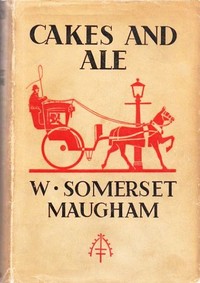
Cakes and ale by W. Somerset Maugham
QR code
Cakes and Ale, or, The Skeleton in the Cupboard (1930) is a novel by the British author W. Somerset Maugham. Maugham exposes the misguided social snobbery levelled at the character Rosie Driffield, whose frankness, honesty, and sexual freedom make her a target of conservative opprobrium. Her character is treated favourably by the book's narrator, Ashenden, who understands that she was a muse to the many artists who surrounded her, and who himself
enjoyed her sexual favours. Maugham drew his title from the remark of Sir Toby Belch to Malvolio in William Shakespeare's Twelfth Night: "Dost thou think, because thou art virtuous, there shall be no more cakes and ale?" Cakes and ale are also the emblems of the good life in Joseph Jacobs' 1912 rendition of Aesop's fable of "The Town Mouse and the Country Mouse": "Better beans and bacon in peace than cakes and ale in fear." In his introduction to a Modern Library edition, published in 1950, Maugham wrote, "I am willing enough to agree with common opinion that Of Human Bondage is my best work ... But the book I like best is Cakes and Ale ... because in its pages lives for me again the woman with the lovely smile who was the model for Rosie Driffield." (This summary is from Wikipedia.)
Download for free
For your e-reader or reading app — Kindle, Kobo, Apple Books, Calibre etc.
Kindle → Use Send-to-Kindle
Kobo, Nook etc. → Transfer via USB
Phone, tablet or computer → Open in a reading app
Other formats & older devices
There may be more files related to this item.
About this eBook
| Author | Maugham, W. Somerset (William Somerset), 1874-1965 |
|---|---|
| Title | Cakes and ale |
| Original Publication | New York: Triangle Books, 1930, reprint 1941. |
| Note | Wikipedia page about this book: en.wikipedia.org/wiki/Cakes_and_Ale |
| Credits | Produced by: Al Haines, Cindy Beyer & the online Distributed Proofreaders Canada team at www.pgdpcanada.net |
| Summary |
Cakes and Ale, or, The Skeleton in the Cupboard (1930) is a novel by the British author W. Somerset Maugham. Maugham exposes the misguided social snobbery levelled at the character Rosie Driffield, whose frankness, honesty, and sexual freedom make her a target of conservative opprobrium. Her character is treated favourably by the book's narrator, Ashenden, who understands that she was a muse to the many artists who surrounded her, and who himself enjoyed her sexual favours. Maugham drew his title from the remark of Sir Toby Belch to Malvolio in William Shakespeare's Twelfth Night: "Dost thou think, because thou art virtuous, there shall be no more cakes and ale?" Cakes and ale are also the emblems of the good life in Joseph Jacobs' 1912 rendition of Aesop's fable of "The Town Mouse and the Country Mouse": "Better beans and bacon in peace than cakes and ale in fear." In his introduction to a Modern Library edition, published in 1950, Maugham wrote, "I am willing enough to agree with common opinion that Of Human Bondage is my best work ... But the book I like best is Cakes and Ale ... because in its pages lives for me again the woman with the lovely smile who was the model for Rosie Driffield." (This summary is from Wikipedia.) |
| Language | English |
| LoC Class | PR: Language and Literatures: English literature |
| Subject | Authors -- Fiction |
| Subject | England -- Fiction |
| Subject | Domestic fiction |
| Subject | Married people -- Fiction |
| Subject | Biographers -- Fiction |
| Subject | Authors' spouses -- Fiction |
| Category | Text |
| eBook-No. | 78723 |
| Release Date | May 22, 2026 |
| Copyright | Public domain in the USA. |
| Downloads | 1798 downloads in the last 30 days. |
Project Gutenberg eBooks are always free!